
LIMITED-TIME OFFER
Give Your Baby Sulcata a Stronger Start—and Save 30%
Supporthealthy growth with a high-fiber, low-protein food formulated specifically for baby sulcatas. Superfood provides calcium, essential nutrients, and probiotics in an easy-to-serve powder.
GET 30% OFF SUPERFOODHerpetologist-formulated • Made in the USA
A sulcata tortoise outdoor enclosure is not a temporary project. You’re building infrastructure that will house an animal capable of living a century, growing to 30 inches, and weighing over 150 pounds — and that will test every weak point you leave in the design. Walls that aren’t footed underground get undermined. Drainage that isn’t planned for creates chronic dampness. Shade that only covers one corner at noon covers nothing useful by mid-afternoon. A shelter that’s sized for a juvenile becomes a trap for an adult.
This guide is a practical build guide — focused on the decisions, materials, and construction details that determine whether a sulcata tortoise outdoor enclosure actually works long-term. The design philosophy and space planning behind outdoor sulcata keeping is covered in our companion sulcata tortoise habitat guide. This post is about how to build it correctly, from the ground up.
Planning the Sulcata Tortoise Outdoor Enclosure Before You Break Ground
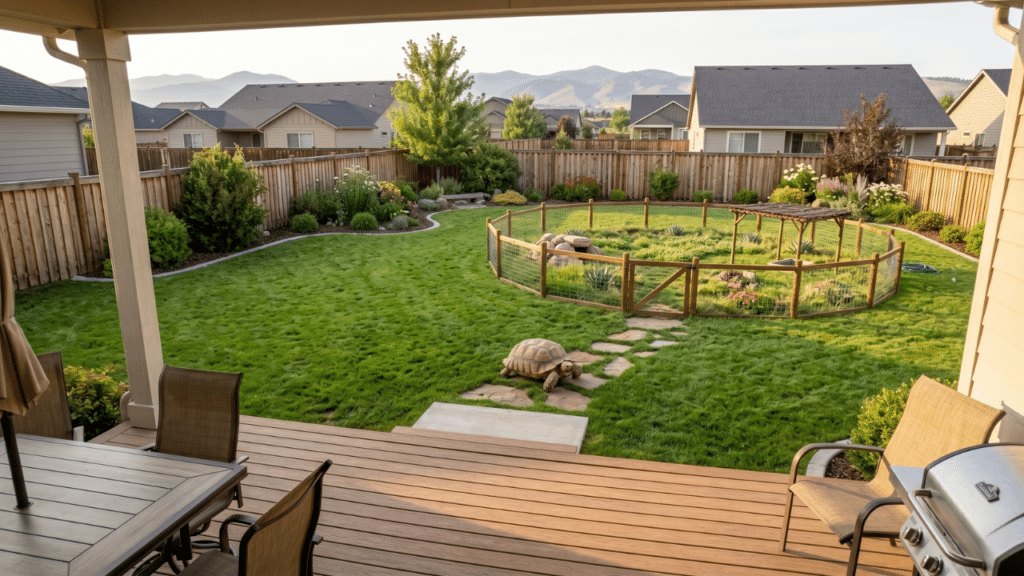
The single most valuable thing you can do before building a sulcata tortoise outdoor enclosure is plan for the adult animal, not the one you have today. A hatchling sulcata at 2 inches will be 10–12 inches within three to five years, and fully grown at 20–30 inches within a decade or two. An enclosure sized for a juvenile requires a complete rebuild — or at minimum a significant expansion — within a few years if you haven’t thought ahead.
The practical minimum for a permanent adult sulcata tortoise outdoor enclosure is 150 square feet, with 300–500 square feet representing a genuinely comfortable living environment for one adult. If your property can accommodate 300+ square feet, build to that from the start. The additional material cost of going larger during initial construction is a fraction of the cost of rebuilding later.
Before settling on a location, assess the site for three things: sun exposure throughout the day (not just at noon — trace where sunlight and shade move from morning through late afternoon), natural drainage (does water pool here after rain, or does it drain freely?), and proximity to property boundaries, structures, and underground utilities. Call 811 (in the US) to have underground lines marked before any digging begins.
Choosing the Right Wall Materials for Your Sulcata Tortoise Outdoor Enclosure
Wall material is one of the most consequential decisions in building a sulcata tortoise outdoor enclosure, and there’s no single right answer — the best choice depends on your climate, budget, permanence goals, and DIY skill level. What all wall materials must share: they need to be solid and opaque, tall enough to prevent escape, and capable of extending below ground to prevent undermining.
The table below compares the most commonly used materials across the key decision factors.
| Material | Pros | Cons | Cost | Best For |
|---|---|---|---|---|
| Cinder block / CMU | Extremely durable, predator-proof, solid and opaque, retains heat well | Heavy, requires mortar or rebar anchoring, permanent — difficult to relocate | $$ Medium | Large permanent adult enclosures |
| Solid wood plank (treated) | Affordable, easy to cut and build, readily available, looks natural | Requires sealing and periodic maintenance, can rot if drainage is poor | $ Low | Most suburban setups, DIY builds |
| Concrete poured walls | Maximum durability and security, fully customisable shape | Requires professional pour, permanent, highest cost and effort | $$$ High | Permanent large-scale installations |
| Composite / PVC panels | Waterproof, rot-proof, lightweight, easy to clean | Less natural appearance, can warp in extreme heat, more expensive than wood | $$ Medium | Wet climates, low-maintenance builds |
| Brick / stone | Extremely durable and attractive, retains heat for cool mornings | Labour-intensive to build, mortar required, essentially permanent | $$$ High | Permanent show-quality enclosures |
The Opaque Wall Requirement
Whatever material you choose, the walls of a sulcata tortoise outdoor enclosure must be solid — not chain-link, not wire mesh, not slatted wood with gaps. Sulcatas that can see through the enclosure perimeter will persistently try to reach whatever is on the other side. The result is relentless wall-pacing, rostral (nose) abrasion from repeatedly pushing against the barrier, and chronic behavioral stress. A solid, opaque wall stops the tortoise from fixating on the outside world and encourages it to settle and engage with the interior environment instead.
Wall Height
Above-ground wall height should be a minimum of 18 inches for juveniles and 24 inches for adults. Sulcatas are not climbers, but a large adult pushing against a wall with its full body weight can exert significant force — walls that are too short, too lightweight, or not properly anchored at the base can be displaced over time. If your enclosure also needs to keep predators out (dogs, coyotes, raccoons), 24–30 inches plus a hardware cloth overhang or full top significantly increases security.
Underground Footings: The Most Overlooked Part of the Sulcata Outdoor Enclosure Build
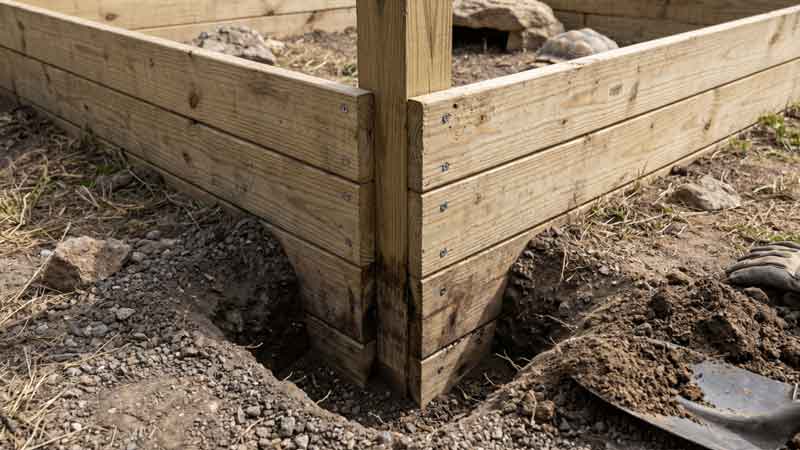
If there is one construction detail that separates sulcata tortoise outdoor enclosures that work from those that eventually fail, it is underground footings. Sulcatas are powerful, persistent excavators. A wall that sits at or just below ground level provides almost no real containment for a motivated adult sulcata — they will dig along the base until they find a gap or create one.
Every wall section in a sulcata tortoise outdoor enclosure needs to extend a minimum of 12 inches below finished ground level, and 18 inches is significantly more secure for large adults. For wooden walls, this means setting posts deep in concrete footings and running a bottom board or hardware cloth apron at the same depth. For cinder block walls, this means laying the first one or two courses below grade, mortared in place, before building up to finished height. For any material, the underground section should be as solid and continuous as the above-ground section — gaps at the base of the footing are just as exploitable as gaps above ground.
A hardware cloth apron — a horizontal section of heavy-gauge wire mesh extending 12–18 inches outward from the base of the wall underground — is an additional layer of security worth incorporating into any build. Even if a sulcata digs along the wall and hits the apron, the horizontal section prevents them from continuing downward and outward. It’s standard practice in predator-proof tortoise enclosure construction and adds meaningful security for minimal additional cost.
Drainage: Engineering a Dry Sulcata Tortoise Outdoor Enclosure
Chronic dampness is one of the most damaging conditions a sulcata can live in. Their native Sahel environment is arid — their respiratory systems, skin, and shell are all adapted to dry conditions. An outdoor sulcata tortoise enclosure that stays wet after rain, or that has poor surface drainage, sets up the conditions for respiratory infections, shell rot, bacterial skin problems, and fungal issues in the substrate.
Are You Starving Your Tortoise?
Save 10% on premium tortoise food and supplements from Tortoise Resource Center on Amazon now using code BUYNOWGET10

Sulcata Vitamin & Mineral Topper Supplement
30-Day Supply | 2 oz (56 g)
$24.99
Baby Sulcata Tortoise Superfood Powder
30-Day Supply | 2.5 oz (70.8 g) Bag
$24.99
Assessing Your Site’s Natural Drainage
The first step is understanding how your site naturally drains. Sandy and loam-based soils drain quickly and are ideal for a sulcata tortoise outdoor enclosure with minimal intervention. Clay-heavy soils drain slowly and can pool water at the surface for hours or days after significant rain. If your site has clay-heavy soil and poor natural drainage, you have two options: amend the top 12 inches of soil with coarse sand and gravel to improve surface permeability, or install a French drain system to actively move water away from the enclosure.
The French Drain Option
A French drain is a gravel-filled trench with a perforated pipe at the bottom, running from the low point of the enclosure to a point outside the perimeter where water can discharge freely. It’s not a complex installation, but it does require knowing where water is coming from, where it needs to go, and that the pipe has a consistent downward slope (a minimum 1% grade — roughly 1 inch of drop per 8 feet of run) to function correctly. If your property has significant drainage challenges, a French drain installed during the initial build is far easier than retrofitting one after the walls are up.
For most suburban builds on reasonably well-drained soil, a French drain isn’t necessary. Good substrate selection — a 50:50 mix of topsoil and coarse sand across the enclosure floor, rather than heavy clay or pure topsoil — provides adequate surface drainage in most conditions.
Building the Tortoise House: Shelter Within the Sulcata Outdoor Enclosure
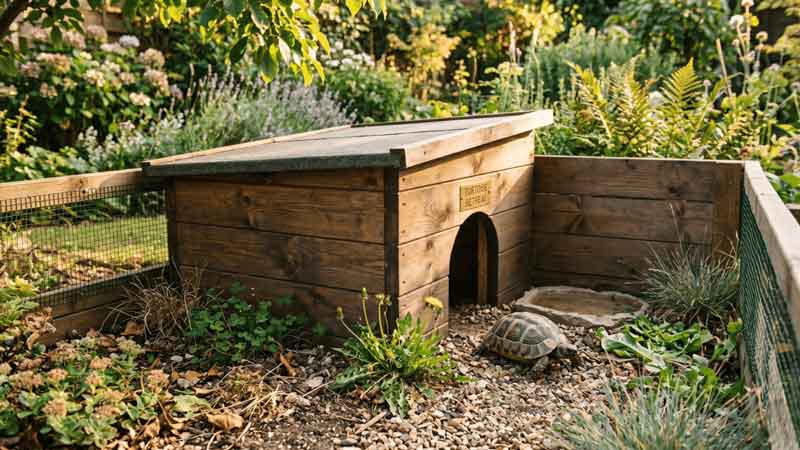
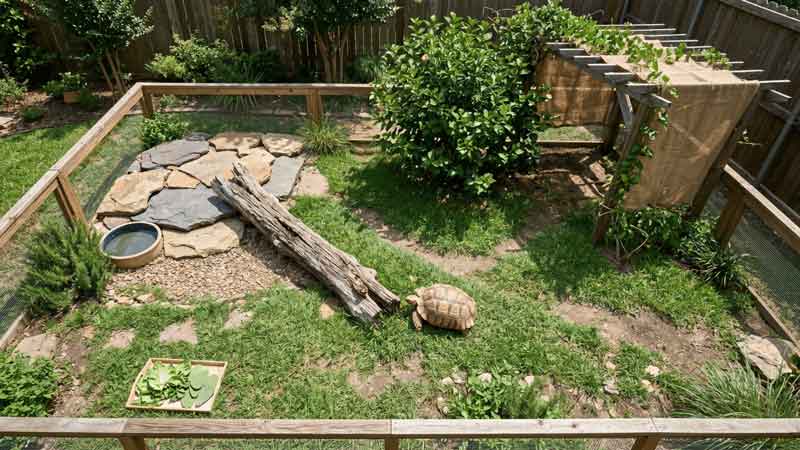
Every sulcata tortoise outdoor enclosure needs at least one shelter — a structure the tortoise can retreat into to escape peak midday heat, shelter during inclement weather, and stay warm on cool nights. For owners in cooler climates, the shelter also needs to provide supplemental heat during the months when ambient outdoor temperatures drop into ranges that are uncomfortable or dangerous for sulcatas (below the mid-60s°F at night).
Sizing the Tortoise House
Size the tortoise house for the adult animal, not the current juvenile. A tortoise house needs to be large enough for the tortoise to enter, turn around fully, and settle comfortably without any part of the shell touching the walls. For a full-grown sulcata at 20–24 inches of shell length, that means an interior floor space of at least 30 inches × 30 inches, and preferably 36 × 36 inches. Interior height should be a minimum of 16–18 inches above the substrate level inside the house. An entry opening of 12–14 inches wide and 10–12 inches tall accommodates most adults without requiring them to significantly compress to enter.
Construction and Insulation
The most common and practical tortoise house construction for a suburban sulcata tortoise outdoor enclosure is a wooden box built from 3/4-inch exterior-grade plywood, with an insulating layer of rigid foam board (2-inch polyiso or XPS) on the interior walls and roof. The foam board is then covered with a smooth interior liner — thin plywood, FRP board, or similar — to prevent the tortoise from accessing and ingesting the foam. The exterior should be sealed and painted with an exterior-grade, non-toxic paint or deck sealant to weather-proof it.
The tortoise house should be positioned with its entry facing away from the prevailing wind direction to reduce drafts. Placing it against an interior enclosure wall (rather than freestanding) provides additional insulation from one side and makes the structure more stable.
Adding Heat to the Tortoise House
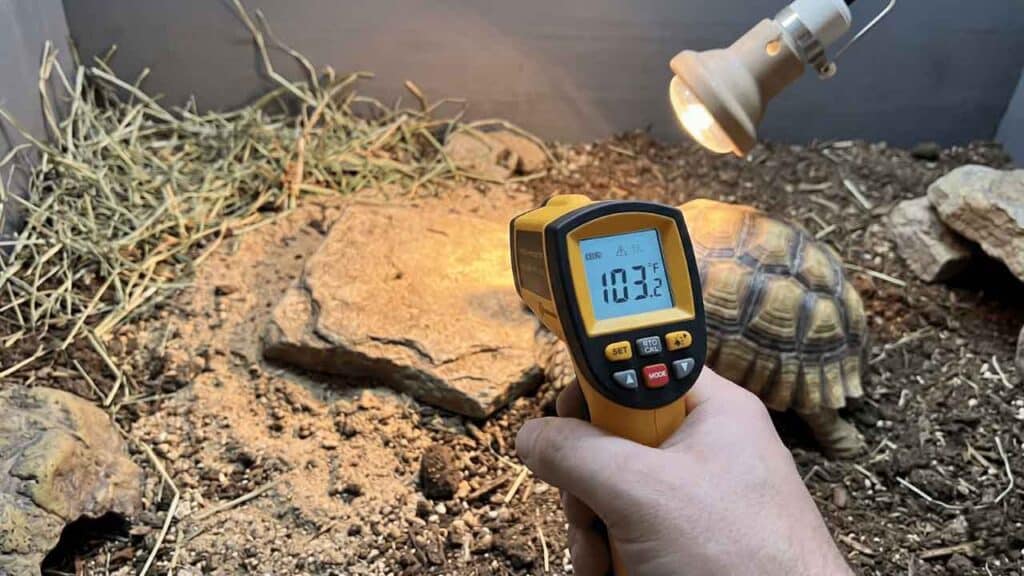
For owners in climates where nighttime temperatures regularly fall below 60°F for significant portions of the year, a heat source inside the tortoise house is not optional — it’s a welfare requirement. The most practical and safe option for an outdoor tortoise house is a radiant heat panel connected to a thermostat, mounted to the ceiling of the shelter. Radiant heat panels produce no light (which would disrupt nighttime behavior), are relatively fire-safe when properly mounted, and respond well to thermostat control.
Any electrical components in or near a sulcata tortoise outdoor enclosure must be weatherproofed and properly grounded. Use outdoor-rated wiring, weatherproof junction boxes, and GFCI-protected circuits. If you’re not comfortable with the electrical work, hire a licensed electrician — the consequence of a failure in this part of the build is serious.
Predator-Proofing the Sulcata Tortoise Outdoor Enclosure
Large adult sulcatas have few predators they can’t defend against with their shells and leg scales — but juveniles and sub-adults are genuinely vulnerable to domestic dogs, coyotes, raccoons, and in some regions, foxes and raptors. Even adult sulcatas can be harassed or injured by determined dogs. Rats are a less obvious but significant threat: they will gnaw on sleeping or inactive tortoises, particularly targeting soft tissue around the limbs and head.
The Top Question
Whether to add a top to the sulcata tortoise outdoor enclosure is one of the most common decisions keepers face, and the answer depends on your specific predator risk. If you have dogs on the property, if coyotes are active in your area, or if you’ve experienced raccoon visits, a partial or full top is strongly recommended — particularly over the area where the tortoise sleeps. A frame of 2×4 lumber topped with 16-gauge welded wire mesh or 1/2-inch hardware cloth provides meaningful predator resistance while allowing sunlight and airflow through.
A full top over the entire enclosure isn’t always practical for a large adult-sized build, and it reduces UVB access slightly (glass and some plastics block UVB; open wire mesh does not). A partial top over the sleeping area and the most vulnerable corners is a reasonable compromise that provides most of the security benefit without fully enclosing the space.
Gate Security
Every gate in a sulcata tortoise outdoor enclosure is a potential failure point. Use a double-latch system — two independent latches or a latch plus a secondary clip — so that accidental opening requires two separate failures simultaneously. Check that the gap between gate and post at ground level is less than 2 inches; a motivated juvenile can push through surprisingly small gaps. Hinge hardware should be exterior-rated stainless steel — standard zinc hardware will rust and seize within a couple of seasons in most outdoor conditions.
Enrichment and Planting Inside the Sulcata Tortoise Outdoor Enclosure
A well-built sulcata tortoise outdoor enclosure that’s empty of interest produces a bored tortoise that paces the perimeter. Enrichment isn’t decoration — it directly influences natural behavior, activity levels, and mental health.
Large flat rocks positioned throughout the enclosure serve multiple functions: they provide thermal mass that radiates heat in the morning (helping the tortoise warm up faster after a cool night), offer physical surfaces for the tortoise to scratch and rub against, and create visual barriers that break up the sightlines within the enclosure. Driftwood logs and large pieces of cinder block serve similar functions and can be arranged to create partial shelter and crawl-through features that encourage exploration.
Living grass inside the sulcata tortoise outdoor enclosure is both the best enrichment and the best food source simultaneously. Bermuda grass handles the wear of a large sulcata grazing and moving across it better than most other varieties — it recovers quickly and tolerates compaction. Timothy, orchard, and meadow grasses are excellent alternatives in cooler climates. Plan to reseed or resod worn sections periodically; a single adult sulcata will graze a section down to bare soil over a season if the enclosure isn’t large enough to allow rotation.
Any plants inside the enclosure must be verified non-toxic, because sulcatas will eat them. Prickly pear cactus (spineless varieties), hibiscus, and mulberry are all appropriate and provide genuine food value alongside their enrichment function.
Water and Feeding Setup in the Sulcata Tortoise Outdoor Enclosure
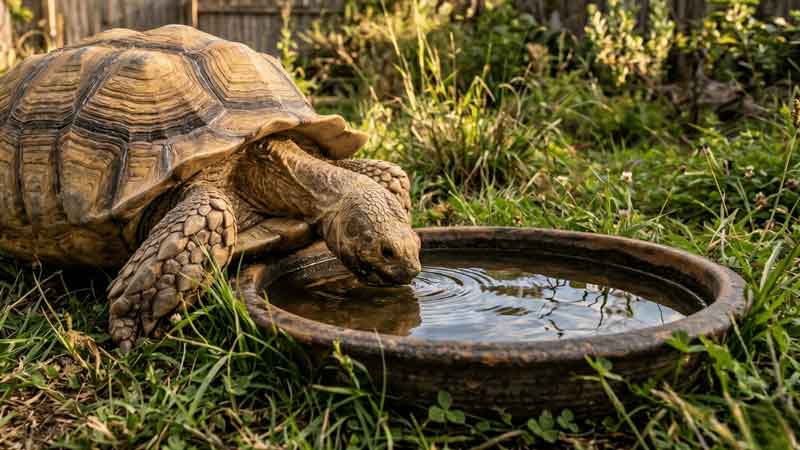
The water dish in a sulcata tortoise outdoor enclosure should be large, shallow, and stable. A heavy ceramic or stone dish, or a purpose-built shallow soaking pan, works better than lightweight plastic that tips easily. The dish should be large enough for the tortoise to soak in but shallow enough that a juvenile cannot become trapped — a maximum water depth of 2–3 inches for most setups. Setting the dish slightly recessed into the substrate, or surrounding it with substrate to prevent tipping, keeps it stable even when a large adult pushes against it.
Refresh the water daily regardless of whether it looks clean — outdoor dishes accumulate algae, dust, and waste quickly. A stiff brush and a rinse with clean water is sufficient for daily cleaning; a proper scrub with diluted reptile-safe disinfectant once or twice a week keeps bacterial load in check.
For feeding, scatter hay and supplemental foods around the enclosure rather than placing them in a single dish. Scatter feeding encourages foraging movement, keeps the tortoise active throughout its day, and distributes grazing pressure more evenly across the enclosure floor.
Even with living grass and a well-planted sulcata tortoise outdoor enclosure, trace mineral supplementation remains important. Regional soil composition affects what minerals grass actually delivers, and the variation is significant enough that consistent supplementation is the reliable approach. Our Vitamin and Mineral Topper is formulated specifically for desert tortoise species — a light dusting 1–2 times per week on fresh food covers the selenium, zinc, magnesium, and vitamin gaps that even a high-quality outdoor diet can leave open.
For juveniles spending time in the outdoor enclosure during transition from indoor keeping, our Baby Sulcata Superfood Powder (available in 2.5 oz and 4.5 oz sizes) provides the calibrated protein-to-fiber-to-calcium support that growing tortoises need at each stage. Use code BUYNOWGET10 at checkout on Amazon to save 10%.
Ongoing Maintenance for the Sulcata Tortoise Outdoor Enclosure
A well-built sulcata tortoise outdoor enclosure is low-maintenance by design, but low-maintenance is not the same as no-maintenance. A consistent routine prevents small problems from becoming expensive ones.
Daily tasks: remove feces, refresh the water dish, visually check that the tortoise is active and moving normally, and scan the enclosure for anything obviously wrong — a section of wall that looks pushed, standing water after rain, or a gap that wasn’t there yesterday.
Weekly: inspect the full perimeter at ground level and below for signs of digging activity near the walls. Check gate latches and hinges. Assess grass coverage and determine whether any sections need reseeding. If the enclosure has a heated tortoise house, verify the thermostat is reading correctly with a secondary probe thermometer.
Seasonally: before winter in cooler climates, weatherproof the tortoise house, verify the heat source is functioning correctly, and test the thermostat under a cold load. Before summer, check shade coverage throughout the day — shade structures and tree cover change as vegetation grows, and a gap in afternoon shade that didn’t exist last year may be significant this year. Check and treat any exposed wood surfaces that have weathered.
Annually: do a full structural inspection of the enclosure walls, footings, and gate hardware. Check underground sections where accessible. Replace any corroded fasteners. Assess substrate depth in high-traffic areas and add a top-dressing of fresh sandy-loam mix where depth has been reduced by compaction and grazing.
Building a Sulcata Tortoise Outdoor Enclosure That Lasts
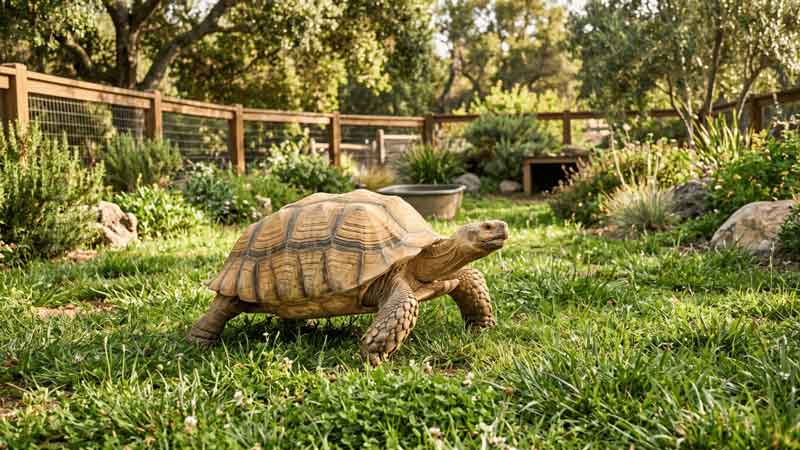
A sulcata tortoise outdoor enclosure built correctly the first time is infrastructure that serves the animal for decades. The decisions that matter most — wall material, underground footing depth, drainage design, shelter sizing and insulation, and predator security — are all easiest to get right during initial construction and significantly harder to correct after the fact.
Build with the adult animal in mind. Plan drainage before you lay a single wall section. Foot every wall section at least 12 inches below grade. Make the tortoise house larger than you think you need. Double-latch every gate. Plant living grass and add enrichment that creates a genuinely stimulating environment, not just an adequate one.
The sulcata that lives in a well-built outdoor enclosure — with space to roam, grass to graze, a proper shelter to retreat to, and a thermal gradient to self-regulate across — is fundamentally healthier and more behaviorally engaged than one that lives in a compromised environment. That difference compounds over a lifespan that can span 80 to 100 years. Build it right from the start, and your tortoise has the physical foundation to use every one of those years.