Knowing how to sex a sulcata tortoise is one of the questions that trips up new and experienced owners alike. Unlike mammals, sulcatas don’t advertise their sex with obvious external differences from birth. The markers that distinguish male from female develop gradually over years, and even once they’re present, a confident read requires knowing exactly what to look for and how to examine your tortoise correctly.
Getting it wrong has real consequences. House two males together and you risk serious, injury-causing combat. Assume a tortoise is male and fail to provide nesting conditions — and an egg-bearing female can develop egg binding, a potentially fatal complication. Know how to sex a sulcata tortoise accurately and you can manage housing, nutrition, and care correctly for each animal’s actual biology.
This guide covers every reliable marker — physical and behavioral — with a full comparison table, a practical step-by-step examination method, and a clear explanation of why juveniles are so difficult to sex accurately and what your options are when shell length hasn’t reached the reliable threshold yet.
When Can You Reliably Sex a Sulcata Tortoise?
The most important thing to understand before trying to sex a sulcata tortoise is that reliable visual sexing is simply not possible in young animals. The secondary sexual characteristics — tail length, plastron concavity, gular projection, anal scute shape — all develop as the tortoise approaches sexual maturity, which in sulcatas typically occurs around 5 years of age when shell length reaches 10–12 inches.
Before that threshold, the differences between males and females are minimal and inconsistent. Attempting to sex a sulcata tortoise with a shell length under 8 inches based on physical markers alone is largely guesswork, even for experienced keepers. This is a biological reality, not a shortcoming of technique — the characteristics simply aren’t developed enough to read accurately.
At shell lengths of 10–12 inches and above, the markers become clear and reliable. A tortoise at 12+ inches with a well-developed plastron concavity, long muscular tail, and prominent gular scutes is a confident male. One at 12 inches with a flat plastron, short blunt tail, and rounded anal scutes is a confident female. Below that threshold, treat any identification as provisional.
For hatchlings and young juveniles where sex determination is genuinely needed — for a breeding program, for example — the only reliable method is veterinary endoscopy. A small camera is used to view the reproductive organs directly. It’s minimally invasive, accurate, and the only appropriate tool for definitively sexing a sulcata tortoise under 8 inches of shell length.
Male vs. Female Sulcata Tortoise: Visual Comparison Table
Use this table as your primary reference when examining your tortoise. Work through each marker systematically rather than relying on a single indicator — confident sexing of a sulcata tortoise comes from reading multiple markers that agree with each other.
| Marker | Male | Female |
|---|---|---|
| Tail | Long, thick, muscular — extends well beyond the rear shell edge. Cloaca positioned far from the body along the tail length. | Short, narrow, blunt. Cloaca sits close to the base of the tail, barely extending past the shell edge. |
| Plastron | Noticeably concave (dips inward) along the central length — allows the male to mount the curved carapace of a female during mating. | Flat or very slightly convex — provides internal space for developing eggs. |
| Gular scutes | Long, pronounced, and project forward significantly beneath the neck. Used as a battering ram in male-on-male combat. | Shorter and less prominent — do not project far forward from the front plastron edge. |
| Anal scutes | Wide, forming a broad open V-shape at the rear of the plastron. | Narrower and more rounded, forming a U-shape — the wider rounded opening accommodates egg laying. |
| Overall size | Larger on average — typically 24+ inches shell length, 100–130+ lbs at full maturity. | Smaller on average — typically 16–18 inches shell length, 65–75 lbs at full maturity. |
| Reliable from | Shell length 10–12 inches (approximately 5 years old) | Shell length 10–12 inches (approximately 5 years old) |
How to Sex a Sulcata Tortoise: Step-by-Step Examination
Reading the physical markers correctly requires examining the tortoise in a deliberate sequence. Here is the practical method for how to sex a sulcata tortoise using each key characteristic.
Step 1: The Tail — Your Fastest and Most Reliable Starting Point
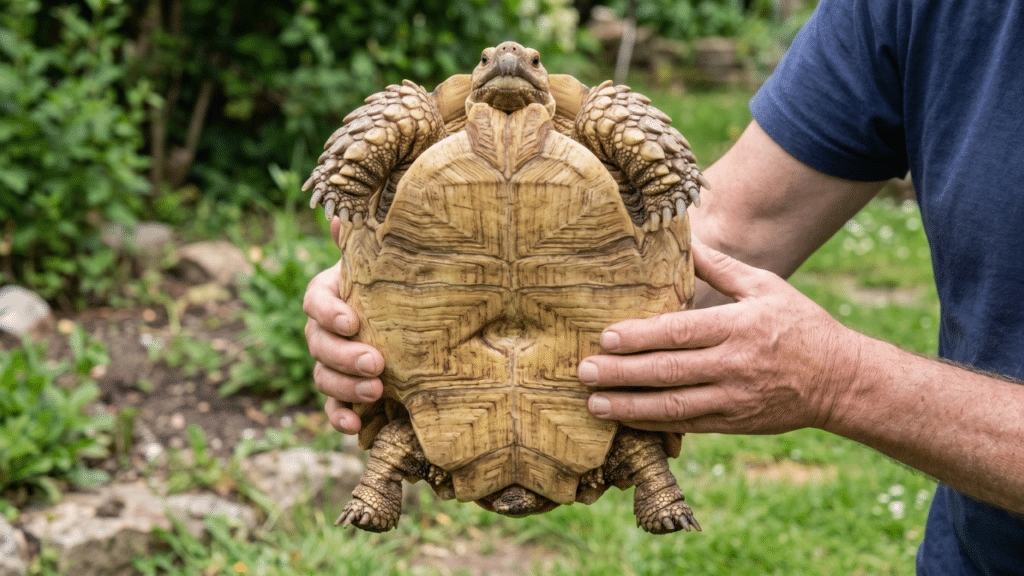
Tilt the tortoise gently so you can see the underside and tail clearly. The tail is almost always the fastest indicator on a sexually mature sulcata tortoise. A male’s tail is long, thick, and muscular — it extends well beyond the rear edge of the shell when relaxed, and the cloaca (the opening for waste and reproduction) sits noticeably far down the length of the tail, away from the body. A female’s tail is short, narrow, and blunt — it barely clears the shell edge, and the cloaca sits very close to the base.
If the tail is clearly long and substantial, you’re almost certainly looking at a male sulcata tortoise. If it’s short and blunt, that’s a strong female indicator. In juveniles below the 10-inch threshold, the difference is subtle enough to mislead — this is where many confident-but-incorrect sexings happen.
Step 2: Examine the Plastron for Concavity
With the tortoise on a stable flat surface, look at the underside of the shell — the plastron. In a sexually mature male sulcata tortoise, the plastron has a noticeable concave dip along its central length. This evolutionary adaptation allows the male to stay positioned on the curved carapace of a female during mating. Run your finger lightly along the center of the plastron — on a male you will feel the inward curve clearly; on a female the surface will be flat or very slightly convex.
Plastron concavity is one of the clearest markers for how to sex a sulcata tortoise in adults, but it develops gradually. At exactly 10 inches of shell length the concavity may be subtle. At 14+ inches in males it is typically unmistakable.
Step 3: Check the Gular Scutes
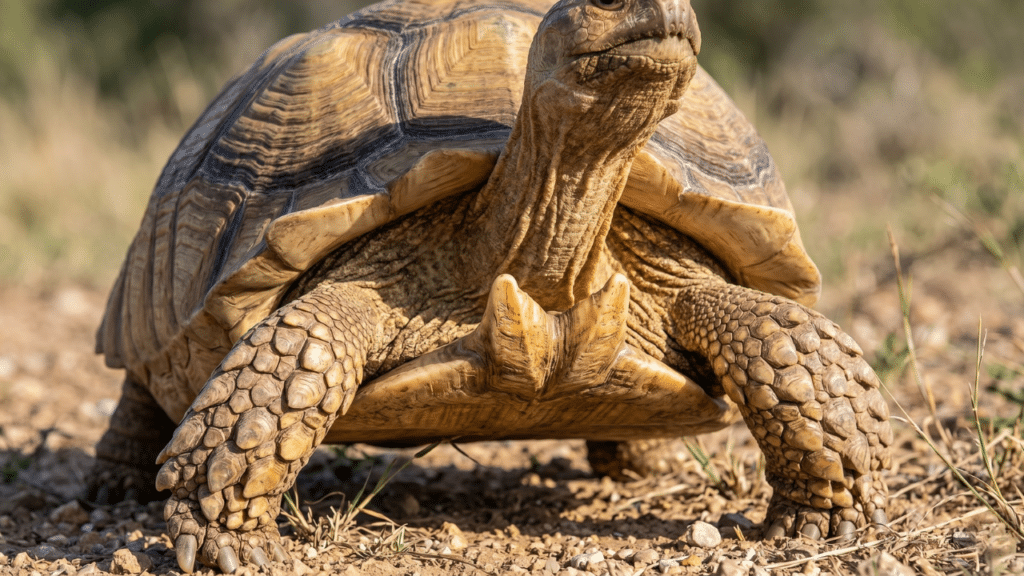
The gular scutes are the pair of plates at the very front of the plastron, just beneath where the neck emerges. In male sulcata tortoises, these are long, pronounced, and project forward significantly — males use them as a battering ram when competing with rivals, ramming and attempting to flip opponents during territorial disputes. In females, the gular scutes are shorter, less prominent, and project only minimally forward from the plastron edge.
To check this, view the tortoise from the front or at a low side angle. A male’s gulars will be clearly visible projecting forward. A female’s will appear much more flush with the rest of the front plastron edge.
Are You Starving Your Tortoise?
Save 10% on premium tortoise food and supplements from Tortoise Resource Center on Amazon now using code BUYNOWGET10

Sulcata Vitamin & Mineral Topper Supplement
30-Day Supply | 2 oz (56 g)
$24.99

Baby Sulcata Tortoise Superfood Powder
30-Day Supply | 2.5 oz (70.8 g) Bag
$24.99
Step 4: Examine the Anal Scutes
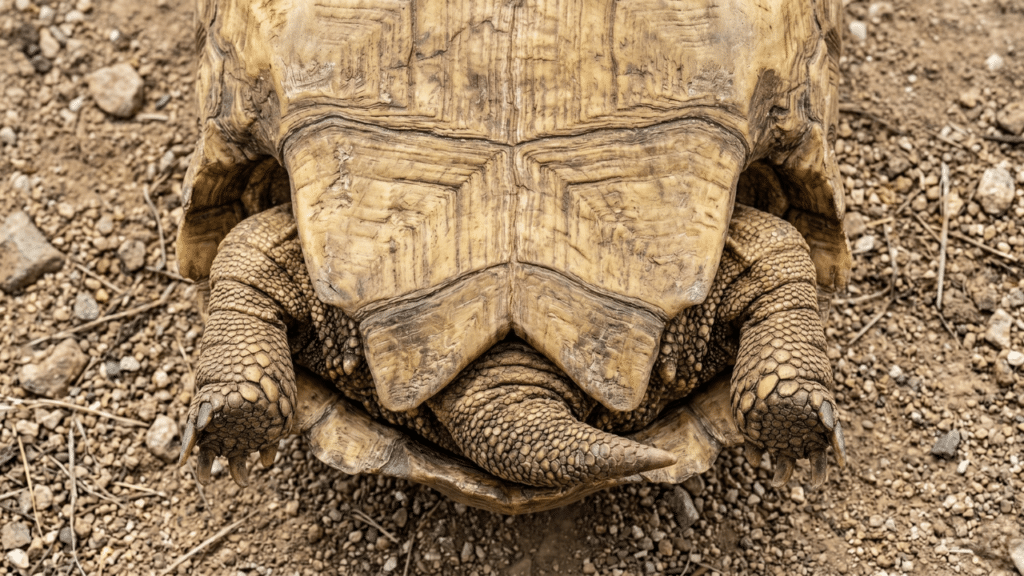
The anal scutes are the paired plates at the rear of the plastron forming the posterior shell opening. In male sulcata tortoises, these are wide and form a broad, open V-shape when viewed from below. In females, they are narrower and form a more rounded U-shape — the wider rounded opening accommodates egg passage during laying.
This is most clearly read with the tortoise tilted to expose the rear plastron. Compare the shape of the gap between the two anal scutes: a wide, angled V indicates male; a softer, rounder U indicates female.
Step 5: Consider Overall Size — as a Supporting Indicator Only
Adult male sulcata tortoises are significantly larger than females on average — males typically reach 24+ inches and 100–130+ pounds at full maturity, while females are generally 16–18 inches and 65–75 pounds. This size difference is real, but it’s an unreliable standalone marker. Growth rates vary considerably with diet and husbandry, and a well-fed female can outsize a nutritionally limited male. Use size to support other markers, not as a primary method to sex a sulcata tortoise.
Behavioral Signs That Help Confirm the Sex of a Sulcata Tortoise
Physical examination is the most reliable method to sex a sulcata tortoise, but behavioral signs provide strong supporting evidence — particularly as your tortoise approaches or reaches sexual maturity.
Male Behaviors
Male sulcatas become markedly more assertive and territorial as they reach maturity. The clearest behavioral sign is aggression toward other tortoises — males will ram rivals, attempt to flip them, and vocalize loudly during confrontation. This male-on-male combat is serious and can cause significant shell and limb injuries; two confirmed males should never be permanently housed together.
During courtship, males exhibit an unmistakable sequence: head bobbing, circling, persistent following, nipping at the female’s legs and shell edges, and ramming. A tortoise performing active, focused courtship behaviors toward another tortoise is definitively male. Males also vocalize audibly during mating — a repetitive grunting or wheezing sound that is difficult to miss once heard.
Female Behaviors
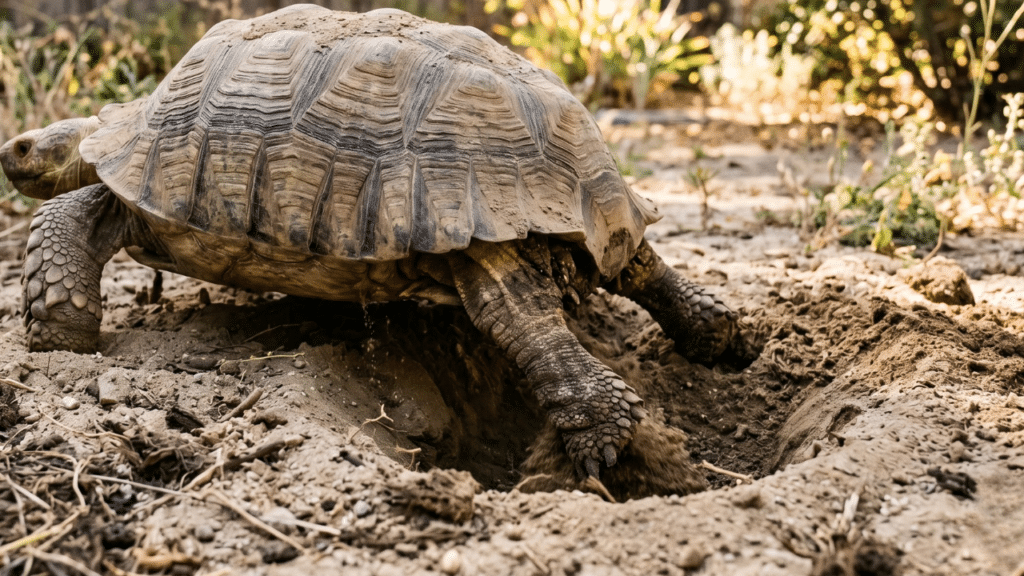
The most definitive behavioral confirmation that a sulcata tortoise is female is nesting behavior. A gravid (egg-bearing) female becomes increasingly restless, investigates the enclosure perimeter persistently, and eventually begins digging — using her hind legs to excavate a flask-shaped nest chamber. Female sulcatas can lay 15–30 eggs per clutch and produce two to five clutches per year. A tortoise that digs a nest and lays eggs is unambiguously female.
Notably, females can retain sperm for extended periods and may lay infertile eggs even without recent contact with a male. So nesting behavior in a tortoise that has been housed alone is still a reliable female indicator and should prompt you to provide appropriate nesting conditions promptly.
Why Knowing How to Sex a Sulcata Tortoise Changes How You Care for Them
Calcium and Nutrition for Females
Egg production places a significant calcium demand on female sulcata tortoises. A female producing multiple clutches per year draws substantial calcium from her body to form eggshells — if dietary and supplemental calcium isn’t meeting that demand, she mobilizes calcium from her own bones and shell, leading to metabolic bone disease and structural shell problems over time. Female sulcatas should receive phosphorus-free calcium supplementation at every feeding, with particular attention during and after breeding season.
The wider trace mineral picture matters too for breeding females. Our Vitamin and Mineral Topper provides the selenium, zinc, magnesium, and vitamins A and E that females drawing on their reserves especially need — a light dusting 1–2 times per week on fresh food supports the nutritional baseline that consistent egg production requires.
Nesting Requirements for Females
A gravid female sulcata tortoise needs access to a suitable nesting area with deep, diggable substrate where she can excavate a proper nest chamber. In an outdoor habitat, a section with 12+ inches of compactable sandy-loam soil works well. For indoor-kept females, a dedicated nesting box — a large container of moist sandy-loam, deep enough for full excavation — should be available when nesting behaviors begin. Failure to provide adequate nesting conditions can result in egg binding, which is a veterinary emergency.
Housing Males Separately
Once you have confirmed more than one male, separate housing is a welfare requirement, not a preference. Adult male sulcata tortoises fight with a force and determination that causes shell damage, limb injuries, and chronic stress. A male housed with a female will also mount persistently, creating physical wear on the female. Multi-tortoise households need housing plans built around confirmed sexes.
Getting Juvenile Nutrition Right for Either Sex
While sex-specific nutrition matters most in adults, the foundation is the same regardless of sex. The protein-to-fiber-to-calcium ratios during the first 18 months determine shell structure and organ health that last a lifetime. Our Baby Sulcata Superfood Powder (available in 2.5 oz and 4.5 oz sizes) is formulated to complement a grass-based diet with calibrated support at each growth stage — for both the future breeding female and the solitary companion male. Use code BUYNOWGET10 at checkout on Amazon to save 10%.
When to Stop Guessing and Get a Veterinary Confirmation
There are situations where attempting to sex a sulcata tortoise yourself isn’t the right call and professional confirmation is the appropriate next step.
If your tortoise is under 8 inches of shell length and you need a definitive sex determination, endoscopy is the only reliable method. The physical markers simply aren’t developed enough for confident visual sexing at that stage, regardless of how closely you examine them.
If your tortoise is at the threshold size of 10–12 inches where markers are beginning to emerge but aren’t yet fully clear, and you need to make an immediate housing or breeding decision, a reptile-experienced vet can often provide a confident read that a non-expert eye will miss at that intermediate stage.
Any time a female shows nesting behaviors but is struggling — repeatedly attempting to dig without successfully completing a nest, becoming lethargic, or refusing food — seek veterinary attention promptly. These are signs of potential egg binding, which requires treatment and should not be managed with a wait-and-see approach.
Sexing Your Sulcata Tortoise with Confidence: Final Thoughts
Learning how to sex a sulcata tortoise is a skill that builds with familiarity. The first time you work through the markers you may feel uncertain — tail length on a juvenile is ambiguous, plastron concavity on a young adult is subtle. The second and third time, the markers start to become readable. By the time you’ve examined several tortoises at the 12-inch threshold and above, confident visual sexing becomes second nature.
The process is straightforward: work through the markers in order — tail first, then plastron, then gular scutes, then anal scutes — and look for agreement across all four. When multiple markers consistently point to the same sex, you can be confident in your assessment. When markers conflict or remain ambiguous, respect that uncertainty and either wait for further development or seek veterinary confirmation.
Once you know your tortoise’s sex, let that knowledge actively inform how you care for them. Females get consistent calcium and proper nesting access. Males get appropriate separation from other males. Both get the correct nutritional foundation from hatchling through adulthood — because whether you’re raising a future breeding female or a lifelong companion male, the commitment to correct diet and supplementation is what determines how well your sulcata thrives across the decades ahead.