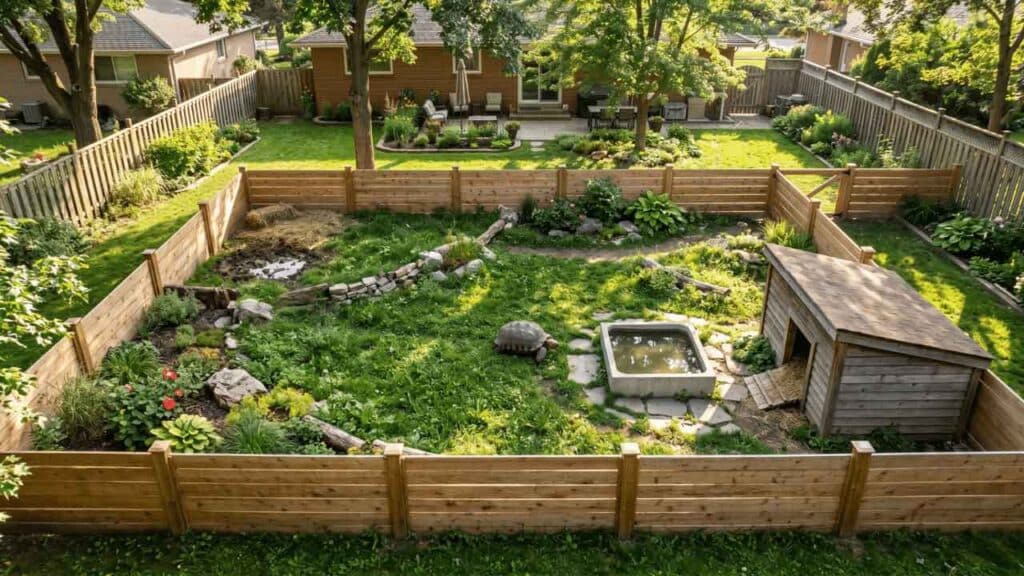
The sulcata tortoise habitat is where most owners either get things right or start a slow series of compromises that chip away at their tortoise’s health over years. Space too small. Substrate too shallow. No burrow opportunity. No proper thermal gradient. Each individual shortfall might seem manageable on its own — but sulcatas can live 80 to 100 years, and those shortfalls compound.
This guide is focused specifically on what a correct sulcata tortoise habitat looks like in practice: how to size it, how to build it, what the substrate needs to do, how to handle climate, and how to create an environment where a tortoise built for the African Sahel can genuinely thrive in captivity. The indoor enclosure setup is covered separately — this post is about getting the outdoor setup right, which is where most healthy adult sulcatas ultimately belong.
What the Natural Sulcata Tortoise Habitat Actually Looks Like
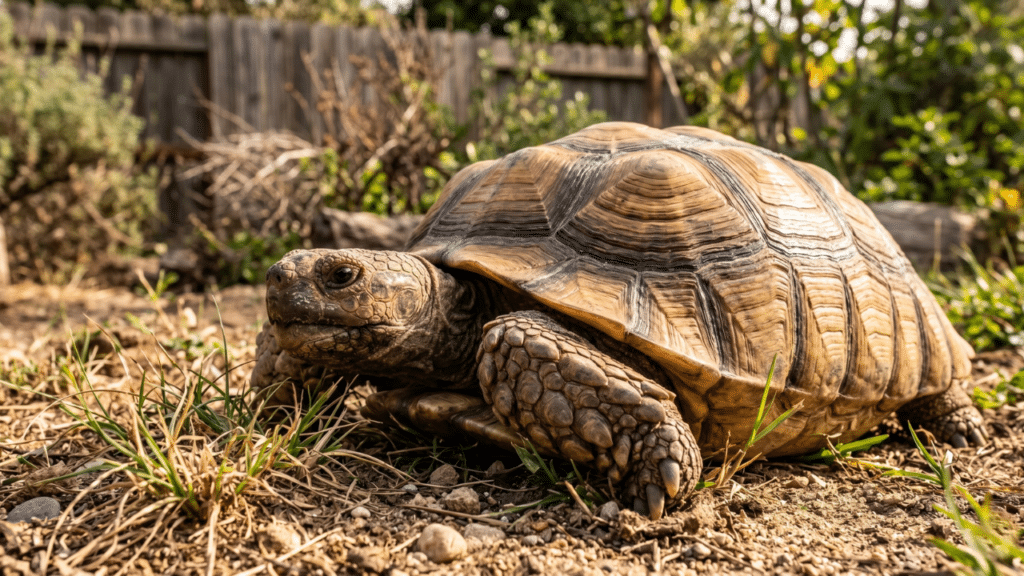
Understanding the wild sulcata tortoise habitat is the starting point for everything that follows. Sulcatas are native to the Sahel — the semi-arid transition zone running along the southern edge of the Sahara desert across sub-Saharan Africa. This is a landscape of sparse grasses, scattered shrubs, sandy loam soils, and very little else.
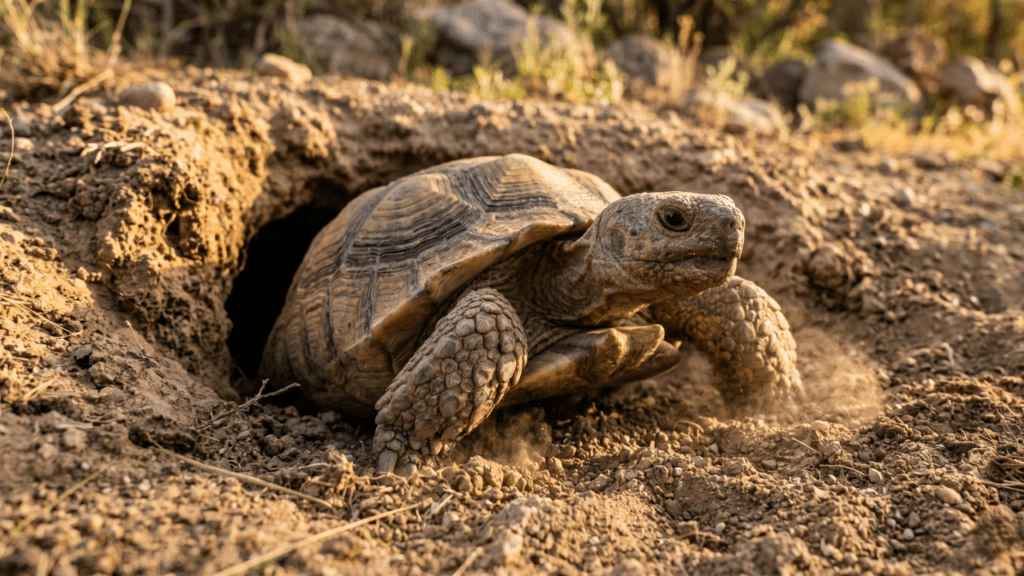
Daytime temperatures in the wild sulcata habitat regularly exceed 100°F. Nights can drop into the 50s°F. The soil is deep, dry, and compactable — ideal for burrowing. Sulcatas in the wild dig tunnels that can extend 10 feet or more underground, which they use to escape midday heat, shelter during cold nights, and wait out dry-season dormancy (called aestivation).
There is very little moisture. There is very little shade from above. There is vast space. And there is a single dominant food source: tough, fibrous, low-nutrient grass.
Every design decision in a captive sulcata tortoise habitat should trace back to this picture. A sulcata that can’t burrow, can’t thermoregulate, can’t move freely, or is kept in persistently damp conditions is being asked to survive in an environment its body wasn’t built for. The captive habitat doesn’t need to replicate the Sahel exactly — but it needs to honor the same core principles.
Outdoor vs. Indoor: Why Outdoor Is the Right Long-Term Sulcata Tortoise Habitat
For adult sulcatas — and realistically for any sulcata that has grown beyond the juvenile stage — an outdoor habitat is not just preferable, it is the practical standard. The space requirements alone make indoor housing an exercise in compromise for most people. A healthy adult sulcata needs a minimum of 100 square feet, and ideally 200–300 square feet or more.
Outdoors, sulcatas also get what no indoor setup can fully replicate: natural, unfiltered UVB from the sun, which drives vitamin D3 synthesis and calcium metabolism. They get natural temperature fluctuations that support normal activity rhythms. They get access to real grass, to varied terrain, to the sensory stimulation that comes from a living environment. An outdoor sulcata tortoise habitat, done correctly, removes a significant portion of the husbandry complexity that indoor keepers have to engineer manually.
That said, outdoor keeping comes with its own requirements — especially for owners in cooler climates. The right approach depends on where you live, how your property is configured, and the age of your tortoise. Hatchlings and young juveniles are almost always started indoors and transitioned gradually. The indoor enclosure setup for those early stages is covered in our dedicated indoor sulcata enclosure guide.
Space Requirements: The Most Common Mistake in Sulcata Tortoise Habitat Design
Undersizing the habitat is the single most common mistake sulcata owners make — often because they start with a hatchling, build something appropriate for that stage, and never properly plan ahead. A sulcata tortoise habitat that’s the right size today will be too small within 12 to 18 months.
The minimum rule of thumb for adult enclosure sizing is a habitat that is at least six to seven times the shell length in both length and width. In practice, that means a full-grown sulcata at 18–20 inches of shell length needs at minimum an enclosure roughly 10 feet × 10 feet — and that is truly a minimum, not a target. A tortoise at that size living in 100 square feet is surviving, not thriving.
The table below shows space requirements across life stages. The ‘ideal’ column reflects what genuinely supports natural behavior and long-term health, not just the minimum needed to keep a tortoise alive.
| Life Stage | Typical Shell Length | Minimum Space | Ideal Space |
|---|---|---|---|
| Hatchling (0–6 months) | 1.5–3 inches | 4–6 sq ft | 8–10 sq ft |
| Juvenile (6–18 months) | 3–6 inches | 8–12 sq ft | 20–30 sq ft |
| Sub-adult (18 mo–3 yrs) | 6–10 inches | 25–40 sq ft | 50–80 sq ft |
| Young adult (3–6 yrs) | 10–15 inches | 50–80 sq ft | 100–150 sq ft |
| Adult (6+ yrs) | 15–30+ inches | 100 sq ft | 200–300+ sq ft |
If you are planning your sulcata tortoise habitat before your tortoise is fully grown — which is the right time to plan — build for where they are going, not where they are now. A sulcata that reaches adult size in a well-proportioned habitat is a fundamentally different animal, in terms of health and behavior, than one raised in chronically tight quarters.
Substrate: Getting the Foundation of the Sulcata Tortoise Habitat Right
Substrate choice is one of the most consequential decisions in sulcata tortoise habitat design, and one that’s frequently underestimated. Sulcatas are not surface animals — they are burrowers by nature, and the substrate needs to support that behavior, not just provide a floor.
What the Substrate Needs to Do
The substrate in a sulcata tortoise habitat serves three functions: it regulates temperature at depth (burrows stay cooler than the surface during peak heat), it provides a moisture buffer (deeper layers retain more humidity than the arid surface), and it supports physical and psychological wellbeing. A sulcata that cannot burrow, or cannot get below the surface when temperatures peak, is under chronic thermal stress.
Best Substrate Options
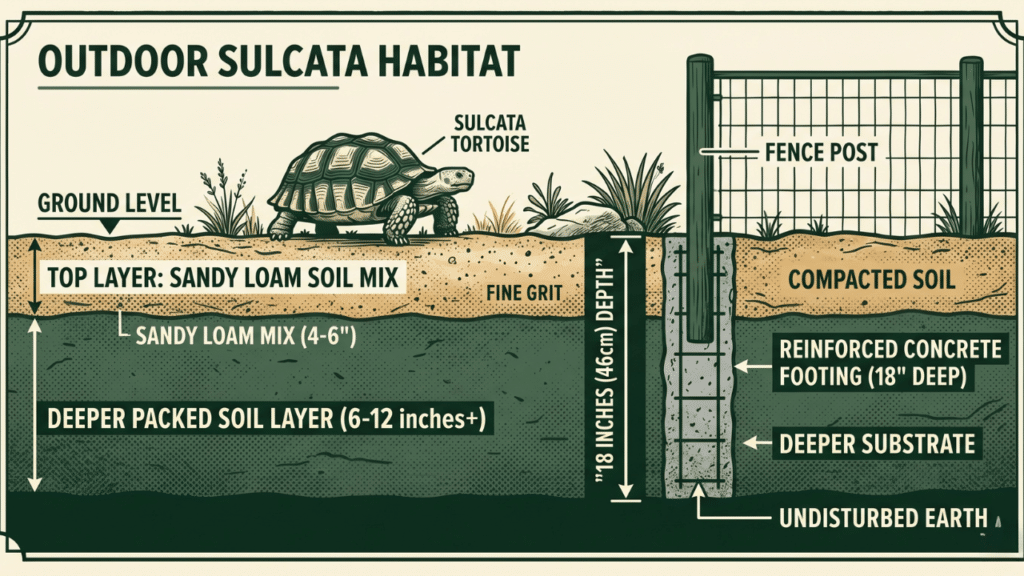
The best outdoor substrate for a sulcata tortoise habitat is a 50:50 mix of topsoil and coarse sand, or plain sandy loam — the closest approximation to the natural Sahel soil profile. This mixture compacts well enough to hold burrow walls without collapsing immediately, while still draining freely enough to prevent dampness at the surface. Depth matters enormously: aim for at least 12 inches of substrate throughout the enclosure, and 24 inches or more in areas where you want to encourage burrowing.
Mulch-based substrates are sometimes used but are a poor choice as a primary substrate for an outdoor sulcata habitat. They don’t support burrow formation, they retain surface moisture, and they decompose in ways that can introduce mold. If used at all, mulch should be a surface layer only, over a compactable base substrate.
For hatchlings and juveniles in indoor setups, the same soil-sand mix works well at a shallower depth — the key requirement is that the tortoise can dig down several inches to thermoregulate even when full burrowing isn’t possible yet.
Are You Starving Your Tortoise?
Save 10% on premium tortoise food and supplements from Tortoise Resource Center on Amazon now using code BUYNOWGET10
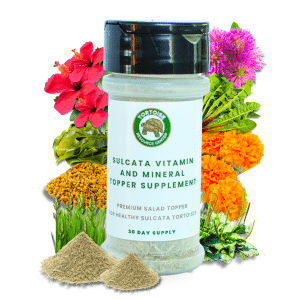
Sulcata Vitamin & Mineral Topper Supplement
30-Day Supply | 2 oz (56 g)
$24.99
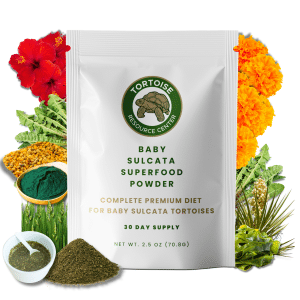
Baby Sulcata Tortoise Superfood Powder
30-Day Supply | 2.5 oz (70.8 g) Bag
$24.99
Burrowing and Dig Security
One of the most critical — and most overlooked — aspects of sulcata tortoise habitat design is underground security. Sulcatas can and do dig under enclosure walls. A wall that sits at ground level provides no actual containment for a motivated sulcata. The enclosure perimeter needs to extend at least 12–18 inches below ground level, using hardware cloth apron, buried concrete block, or deeply set wooden posts. If your sulcata escapes, it is almost always through the substrate, not over a wall.
Temperature and Climate: Matching the Sulcata Tortoise Habitat’s Native Environment
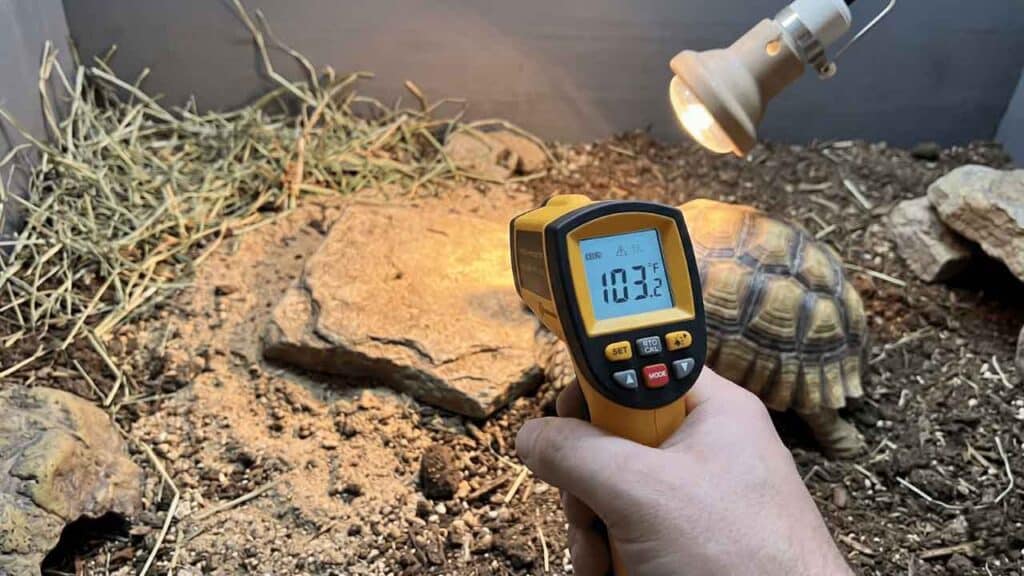
Sulcatas need warm temperatures to function normally. The active range is roughly 70–95°F, with a basking zone that should reach 100–105°F. Nighttime temperatures down to the mid-50s°F are tolerable for healthy adults for brief periods — but sustained cold is dangerous, and temperatures below 50°F can be life-threatening.
Climate Zone Considerations
Owners in USDA hardiness zones 9–11 (parts of California, Arizona, Texas, Florida, and similar warm climates) can often maintain year-round outdoor sulcata tortoise habitats with minimal additional heating infrastructure. Owners in cooler zones need a seasonal strategy: typically a weatherproof, heated shelter within the outdoor enclosure that the tortoise can access when nighttime temperatures drop.
A common and effective approach is to build a small insulated sleeping or shelter box — often called a ‘tortoise house’ — within the outdoor enclosure, fitted with a ceramic heat emitter or radiant heat panel on a thermostat. This allows the tortoise to self-select warmth at night without running the entire enclosure’s heating. The shelter should be large enough for the tortoise to turn around comfortably and deep enough to retain heat, but not so large that the heating is ineffective.
Thermal Gradient
Within the sulcata tortoise habitat, temperature should not be uniform. Sulcatas thermoregulate behaviorally — they move between warmer and cooler zones throughout the day. The enclosure should have a sunny basking area that reaches 100–105°F, a shaded mid-range area in the 80s°F, and ideally a burrow or dig area where temperatures at depth stay in the 70s°F even during peak surface heat. Without this gradient, the tortoise cannot regulate its own temperature, which affects digestion, immune function, and behavior.
Shade Structures
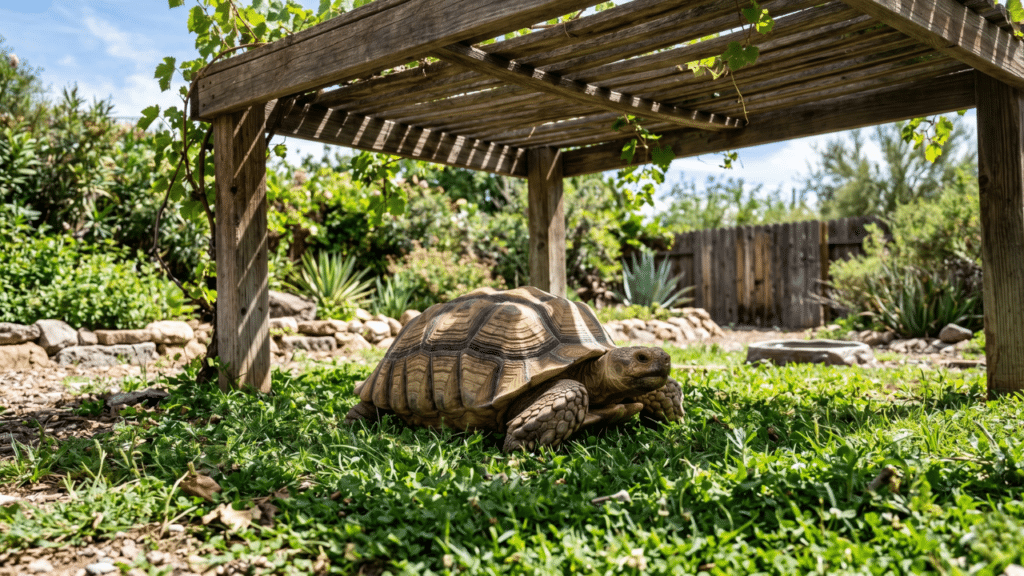
Shade is not optional in a sulcata tortoise habitat — it’s a health requirement. A tortoise that cannot escape direct sun during peak afternoon hours is at risk of heat stress and dehydration. Shade can be provided through planted vegetation (non-toxic trees or large shrubs at the enclosure perimeter), shade cloth stretched across part of the enclosure, or purpose-built wooden shade structures. The key is that shade moves — a fixed shadow that only covers one corner of the enclosure at noon may cover nothing useful at 3 pm. Plan for shade at multiple times of day.
Security: Protecting the Outdoor Sulcata Tortoise Habitat
Outdoor sulcata tortoise habitats face threats that indoor keepers don’t have to manage: predators, opportunistic neighbors, and the sulcata’s own escape instincts. Each requires deliberate planning.
Perimeter Walls
The walls of an outdoor sulcata tortoise habitat should be solid, opaque, and at least 18–24 inches above ground level. Solid walls matter because sulcatas that can see through a barrier will persistently try to reach what’s on the other side, often wearing themselves down and damaging their shell in the process. Chain-link fencing is a poor choice for this reason. Wooden plank fencing, cinder block walls, or solid plastic panels all work well.
Wall height matters not just for keeping the tortoise in, but for keeping predators out. Raccoons, coyotes, foxes, and dogs can all pose a threat — particularly to juveniles. A wire or hardware cloth top over part or all of the enclosure provides meaningful additional security, especially overnight.
Gates and Entry Points
Every entry point in the sulcata tortoise habitat perimeter is a potential failure point. Gates should be fitted with latches that require two deliberate actions to open — sulcatas won’t operate a latch, but a gate that swings open in the wind or can be nudged by a dog creates obvious risks. Check the seal between gate and post regularly; even a modest gap at ground level can be enough for a determined juvenile to squeeze through.
Enrichment and Plantings in the Sulcata Tortoise Habitat
A sulcata tortoise habitat that is just a flat, empty pen meets the minimum requirements but misses an opportunity to support genuine behavioral health. Sulcatas in the wild navigate varied terrain, encounter obstacles, forage across distance, and make choices about where to go and what to investigate. Captive environments that provide some version of this result in more active, engaged tortoises.
Large rocks, driftwood logs, and cinder blocks scattered around the enclosure encourage exploration and provide natural scratching and rubbing surfaces. Visual barriers — even just strategically placed rocks or raised substrate mounds — break up lines of sight and give the tortoise something to navigate around. These features are especially valuable in larger enclosures.
Safe Plants for the Sulcata Tortoise Habitat
Any plants placed inside the sulcata tortoise habitat must be non-toxic, because sulcatas will attempt to eat them. Spineless or low-spine prickly pear cactus pads are an excellent choice — they’re appropriate food, they survive in hot dry conditions, and they look natural in the enclosure. Hibiscus planted at or outside the perimeter (where leaves and flowers can be offered through the fence as enrichment) is another good option. Mulberry, grape vine, and various grasses can all be incorporated depending on climate.
Avoid any ornamental plants common in residential landscaping without verifying safety first. Many commonly used garden plants — oleander, azalea, sago palm, foxglove — are toxic to tortoises. When in doubt, keep plantings outside the enclosure and offer clippings as supplemental food rather than allowing unsupervised access.
Water Access in the Sulcata Tortoise Habitat
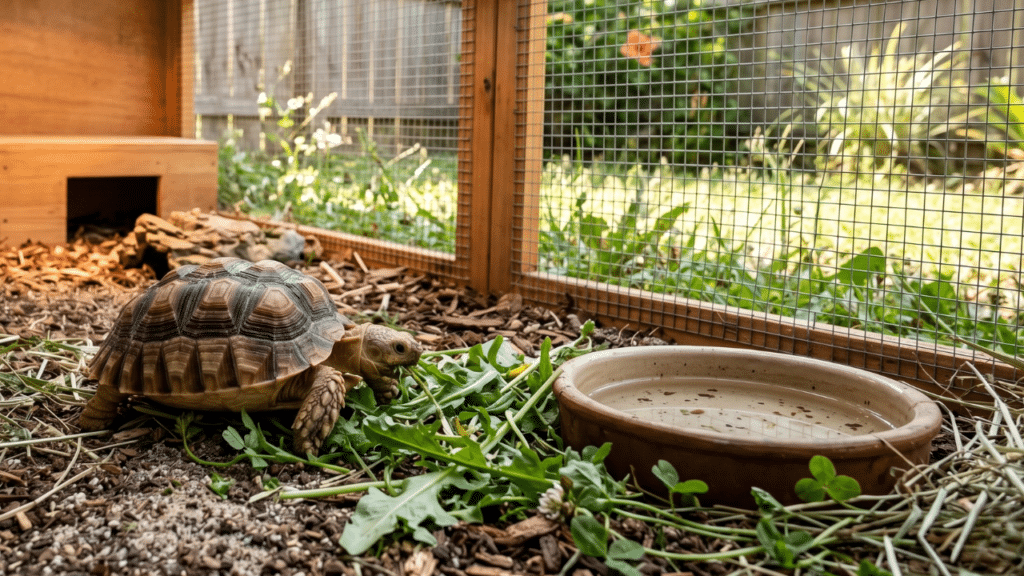
Sulcatas evolved in an arid environment but still need consistent access to fresh water in captivity. In the wild, they obtain much of their moisture from plant matter and seasonal rainfall; in a captive sulcata tortoise habitat, a shallow, stable water dish should be available and refreshed daily. The dish should be large enough for the tortoise to soak in if it chooses — sulcatas do drink and soak — but shallow enough that a juvenile cannot tip it and become trapped.
Periodic soaking for juveniles (2–3 times per week in a shallow warm-water bath) is particularly important in the first year, as young tortoises are more prone to dehydration than adults. As they transition to full outdoor keeping with natural rainfall access and larger bodies, soaking frequency can be reduced. Keep the overall habitat substrate dry, however — chronic surface dampness causes respiratory issues and shell problems over time.
Feeding Within the Sulcata Tortoise Habitat
A well-designed sulcata tortoise habitat naturally supports good feeding behavior. Outdoor enclosures with established grass allow for the kind of low-level, continuous grazing that sulcatas are built for — and this is far more appropriate than scheduled bowl feeding. If the habitat has living grass, the tortoise will often self-manage much of its own feeding during active hours.
Supplement grazing with scattered hay, dandelion, hibiscus, and appropriate weeds. Avoid piling food in one location — scatter it to encourage foraging movement throughout the habitat. Even within a well-planted outdoor enclosure, rotating supplemental foods maintains variety and ensures the tortoise isn’t relying entirely on one grass variety.
Even sulcatas with access to excellent outdoor habitat benefit from consistent mineral supplementation. Natural grass provides fiber and some minerals, but trace elements like selenium, zinc, and magnesium can be inconsistent depending on regional soil composition. Our Vitamin and Mineral Topper is formulated specifically for desert tortoise species — a light dusting 1–2 times per week on fresh food fills the gaps that even a high-quality outdoor sulcata tortoise habitat can’t always guarantee.
For juveniles transitioning into or spending part of their time in an outdoor habitat, consistent nutrition support is especially important. Our Juvenile Superfood Powder provides calibrated protein, calcium, and fiber support during the growth stages where diet has the most impact on long-term shell structure and organ health.
Maintaining the Sulcata Tortoise Habitat Over Time
A sulcata tortoise habitat is not a build-it-and-forget-it project. Ongoing maintenance keeps the environment healthy and catches problems before they compound.
Daily tasks are simple: remove feces, refresh the water dish, check that food is available, and do a quick visual scan for anything unusual — a new dig, a section of perimeter that looks stressed, standing water after rain. Most daily maintenance takes under ten minutes.
Monthly, inspect the enclosure walls and underground footings for signs of undermining. Check the gate hardware. Assess substrate depth in high-traffic areas — sulcatas compact substrate significantly over time and the dig zone may need refreshing with additional soil. If using a heated shelter, verify the thermostat is accurate and the heat source is functioning correctly going into seasonal temperature changes.
Annually, do a full substrate assessment. In large outdoor habitats, full replacement isn’t feasible, but adding a top-dressing of fresh sandy-loam mix in worn areas and turning the substrate in burrowing zones keeps conditions appropriate. Replace any shade cloth that has degraded. Inspect and treat any wooden structural components for weathering.
Building a Sulcata Tortoise Habitat That Serves the Whole Lifespan
A sulcata can live a century. The habitat you build or plan for today will be part of that animal’s life for decades — which means getting the fundamentals right has compounding returns, and getting them wrong has compounding costs.
The core principles of a correct sulcata tortoise habitat are not complicated: sufficient space for natural movement and grazing, substrate deep enough for behavioral burrowing, a genuine thermal gradient with shade and warm basking zones, secure perimeters above and below ground, and access to fresh water. When these elements are in place, most of the chronic health problems associated with captive sulcatas — shell deformities, respiratory issues, escape injuries, behavioral stress — are largely preventable.
Start with the right habitat design, build with the adult size in mind, and your sulcata has the environmental foundation to match the remarkable lifespan it’s capable of. If you’re managing a younger tortoise that isn’t yet in a full outdoor setup, our dedicated indoor sulcata enclosure guide walks through the specific requirements for that stage in detail.