Most guides on baby sulcata growth hand you a checklist: correct temperatures, UVB lighting, calcium supplementation, daily feeding. All of that is necessary — but a checklist isn’t the same as understanding, and with a species that will live for 70 years, understanding matters.
What most care guides don’t explain is why each factor matters, how they interact with each other, and what the consequences actually look like when something is off. A baby sulcata that’s too cold doesn’t just eat less — it can’t digest what it does eat. A hatchling kept too dry doesn’t just feel uncomfortable — it’s building a shell with compromised keratin structure that no amount of later correction will fully fix. A tortoise overfed for rapid growth isn’t thriving — it’s accumulating the conditions for pyramiding and kidney stress.
This guide approaches baby sulcata growth as a system — one where environment, nutrition, activity, and monitoring all influence each other — and gives you the depth to make genuinely informed decisions during the 18 months that matter most.
Why the First 18 Months Define a Sulcata for Life
Baby sulcatas are not simply small adult tortoises with the same needs scaled down. They are organisms in active construction — simultaneously developing bone structure, hardening shell plates, building digestive bacteria colonies, maturing organ systems, and establishing the musculature they’ll depend on for the rest of a very long life.
Every system being built during this window is being built once. The keratin layers forming in a hatchling’s scutes, the bone density accumulating in those first months, the gut microbiome establishing itself in the hindgut — these don’t get a do-over if conditions aren’t right. That’s not meant to be alarmist; it’s meant to reframe what attentive care during this period is actually doing. You’re not preventing problems. You’re building an animal.
The most important mindset shift for keepers of young sulcatas: optimal growth isn’t about size or speed. A hatchling that reaches 200 grams in six months on a diet that pushes rapid weight gain is not ahead of schedule — it’s at elevated risk for shell deformities and organ stress. Steady, proportional growth across all developmental markers is the goal.
Temperature: The Driver Behind Nearly Everything
Temperature is not just a comfort factor for baby sulcatas — it is the primary regulator of metabolism, digestion, immune function, and growth rate. As ectotherms, their bodies cannot generate their own heat. Every physiological process runs faster, slower, or not at all depending on their thermal environment.
Getting the Gradient Right
A single temperature reading tells you almost nothing useful. What matters is the thermal gradient across the entire enclosure — the full range of temperatures your hatchling can move through to regulate their own body temperature behaviorally. For baby sulcatas, that gradient should look like this:
- Basking zone: 95–100°F — where active digestion and peak metabolic function happen.
- Mid-enclosure: 80–85°F — where a tortoise between basking sessions can stay comfortably warm.
- Cool end: 75–80°F — where the animal can retreat to reduce body temperature voluntarily.
- Nighttime: allow a drop to 70–75°F — this natural cooling cycle is developmentally important, not just acceptable.
The transition between zones should be gradual. Sharp temperature boundaries — a warm zone ending abruptly at a cold surface — prevent the behavioral thermoregulation that sulcatas rely on. Use strategic heat lamp placement and enclosure design to create a smooth thermal gradient rather than hot and cold patches.
What Happens When Temperatures Are Wrong
Too cool, and your hatchling cannot properly digest food regardless of diet quality — undigested food in a cold gut becomes a source of bacterial problems rather than nutrition. Too hot without a cool retreat, and the animal becomes chronically stressed with nowhere to down-regulate. Inconsistent temperatures — warm some days, cool others — disrupt the digestive rhythm that developing sulcatas depend on for nutrient absorption. Consistency matters more than perfection.
Humidity: The Most Underestimated Factor in Baby Sulcata Growth
The assumption that sulcatas need dry conditions because they come from arid environments is one of the most persistent and harmful myths in sulcata husbandry — and it causes the most damage during exactly the developmental period when humidity matters most.
In the wild, baby sulcatas spend the majority of their first years underground in burrows where humidity levels are substantially higher than at the desert surface. This isn’t coincidental — developing keratin and mineralizing bone both require adequate ambient moisture. The dry, pyramided shells that are so common in captive sulcatas are not a genetic trait. They are primarily a product of insufficient humidity during the growth phase.
Practical Humidity Management
For hatchlings and young juveniles, target 60–80% humidity during active daytime hours, dropping to 40–50% at night. This cycling pattern — higher during the day when the tortoise is active and feeding, lower at night — mirrors what would occur naturally in a burrow environment.
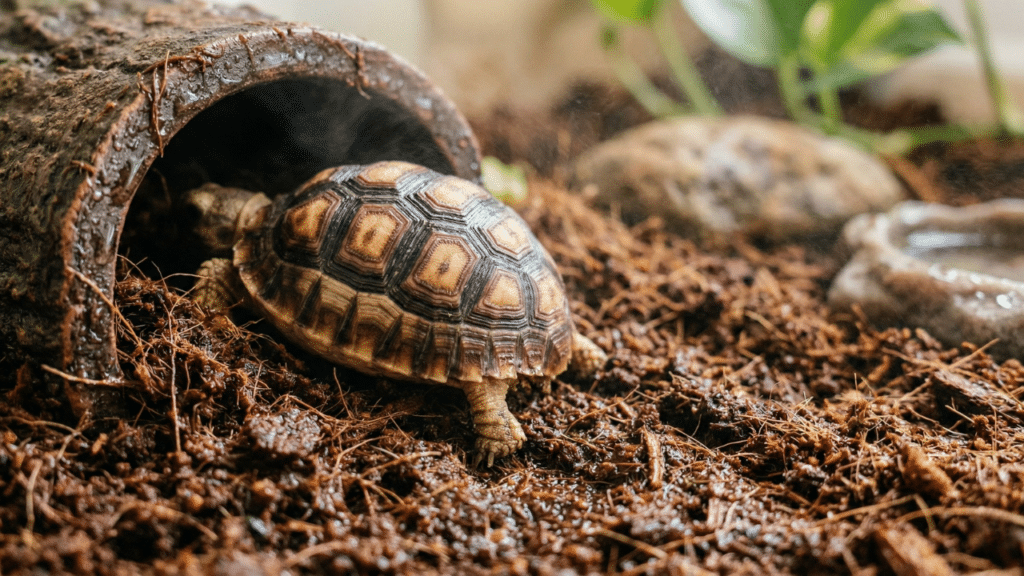
The most important humidity element in any hatchling setup is a dedicated humid hide: an enclosed shelter with damp substrate — coco coir works well — where the tortoise can retreat and absorb moisture passively. This isn’t optional. A humid hide gives your hatchling the ability to self-regulate hydration in the way nature intended, without requiring you to maintain high enclosure-wide humidity constantly.
Monitor humidity at tortoise level, not at the top of the enclosure. Readings at height can be significantly higher than at the substrate surface where your hatchling actually lives — a common source of false confidence in humidity management.
Are You Starving Your Tortoise?
Save 10% on premium tortoise food and supplements from Tortoise Resource Center on Amazon now using code BUYNOWGET10
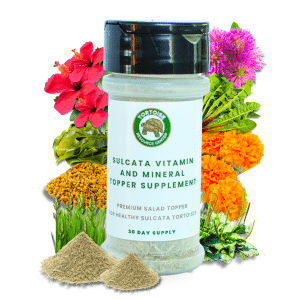
Sulcata Vitamin & Mineral Topper Supplement
30-Day Supply | 2 oz (56 g)
$24.99
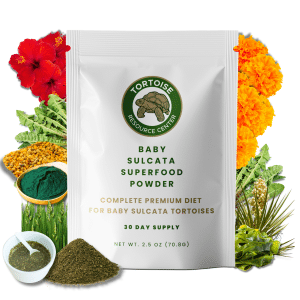
Baby Sulcata Tortoise Superfood Powder
30-Day Supply | 2.5 oz (70.8 g) Bag
$24.99
Nutrition for Baby Sulcata Growth: Balance Over Volume
Feeding a baby sulcata well is less about the volume of food offered and more about the composition and consistency of what’s in front of them every day. The base diet should be built around foods that deliver steady nutrition without pushing rapid weight gain.
The Core Diet Breakdown
A well-structured daily diet for a hatchling under 12 months looks approximately like this:
- 50–60% grasses and hays — timothy, bermuda, orchard grass. This is the foundation and should always be available.
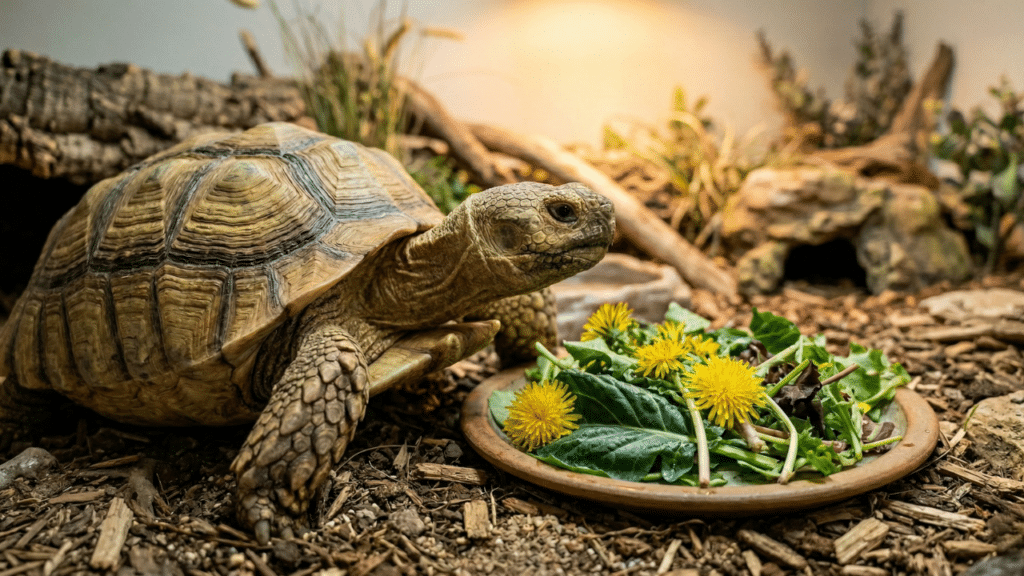
- 30–35% calcium-rich dark leafy greens — collard greens, mustard greens, turnip greens, dandelion. Rotate regularly.
- 10–15% appropriate vegetables — squash, bell peppers. These add variety and hydration.
- Up to 5% occasional foods — prickly pear cactus, hibiscus flowers, safe seasonal plants.
Feed daily for the first 12 months. A useful portion guide: offer roughly 1.5 times the surface area of your tortoise’s shell per feeding. This provides adequate nutrition for healthy growth without the excess that pushes developmental problems.
The Role of Supplementation in Growth Support
Even a varied, well-chosen diet has nutritional gaps — particularly for hatchlings cycling through the same available foods week after week. Calcium dusting is widely understood, but the micronutrients that support protein synthesis, immune function, and shell keratin formation are harder to deliver consistently through fresh food alone.
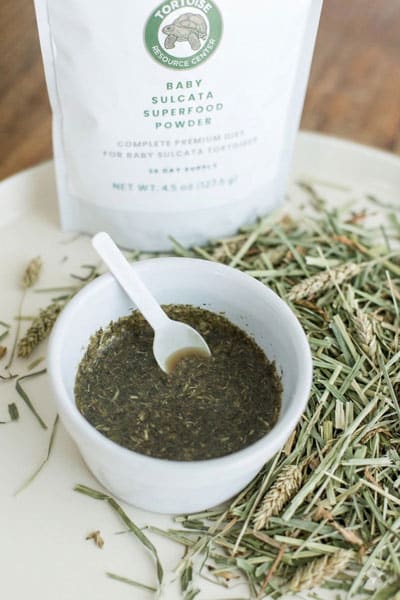
For hatchlings in the 0–12 month growth window, the Baby Sulcata Superfood Powder (4.5 oz) provides a nutritional profile specifically calibrated for rapid-growth phase sulcatas — covering the amino acids, trace minerals, and micronutrients that fresh greens and grasses alone don’t reliably deliver. The 2.5 oz option is a good starting size if you’re new to supplementing. Use code BUYNOWGET10 for 10% off.
Calcium, D3, and the Supplement Timing That Most Guides Skip
Calcium supplementation is widely recommended but rarely explained with enough precision to be useful. The distinction that matters most: calcium without D3 can be offered more frequently (5–6 times per week), while calcium with D3 should be used more sparingly (1–2 times per week) to avoid D3 accumulation. The body’s ability to use calcium at all depends on D3 status — which in turn depends on UVB exposure quality.
In practice, this means that a hatchling with inadequate UVB lighting will struggle to utilize calcium supplementation regardless of how consistently it’s applied. Supplementation and lighting are interdependent, not interchangeable.
Beyond calcium, the trace minerals — zinc, magnesium, selenium — that support bone mineralization and immune function are often absent from basic calcium supplements. The Vitamin and Mineral Topper covers these alongside the fat-soluble vitamins that support healthy organ development during the growth phase. A light dusting over food two to three times per week is sufficient.
UVB Lighting and Its Direct Role in Baby Sulcata Growth
UVB is not a general wellness add-on for sulcatas — it is a physiological requirement that sits upstream of calcium metabolism, bone formation, and shell development. Without adequate UVB, vitamin D3 synthesis cannot occur, and without D3, dietary calcium cannot be effectively absorbed regardless of supplementation.
For baby sulcatas kept indoors, use a T5 HO UVB tube rated at 10.0 or 12% output, positioned 12–18 inches from the basking surface. Run it for 12–14 hours daily. Replace the bulb every six months — UVB output degrades significantly before the bulb stops emitting visible light, and an aging bulb providing inadequate UVB while appearing functional is one of the most common hidden causes of shell and bone problems in young sulcatas.
Two details that most guides omit: glass blocks UVB entirely, so positioning an enclosure near a window provides warmth but no UV benefit. And mesh lids reduce UV transmission significantly — if your enclosure has a mesh cover, factor in that reduction when positioning your light and consider verifying actual UVI levels at basking depth with a UV index meter.
Space and Physical Activity as Growth Factors
Baby sulcata growth is not purely a nutritional and environmental story — physical activity plays a direct role in bone density, muscle development, and shell formation. A hatchling that spends most of its time stationary in an undersized enclosure is not just bored; it’s missing a developmental input.
Minimum enclosure size for a hatchling under 6 months is 4 x 8 feet — and this is a genuine minimum, not an ideal. Within that space, create varied terrain: a gentle slope, a few smooth rocks to navigate around or over, substrate depth sufficient for digging attempts. These aren’t decorative elements. They’re prompts for the natural movement patterns that drive healthy musculoskeletal development.
When outdoor temperatures are consistently above 70°F, supervised outdoor sessions on natural ground provide benefits that indoor setups genuinely cannot replicate — natural UV exposure, varied walking surfaces, contact with soil bacteria that contribute to gut microbiome diversity, and the stimulus of a varied environment. Even short sessions several times per week during appropriate weather add up meaningfully over the course of a growth season.
Stress Reduction as a Growth Strategy
Stress is a growth inhibitor in baby sulcatas in a direct physiological sense, not just a welfare consideration. When a hatchling is chronically stressed — through excessive handling, unpredictable environmental conditions, competition with enclosure-mates, or inadequate hiding space — cortisol-equivalent hormones suppress immune function, reduce appetite, and redirect metabolic resources away from growth and tissue building.
Practical stress reduction for growing sulcatas:
- Limit handling to necessary health checks and enclosure maintenance, particularly during the first six months. A hatchling that’s frequently picked up is a hatchling that’s frequently stressed.
- Provide at least two hides of different types: a warm dry hide near the basking zone and a humid hide at the cool end. Choice and availability of retreat space is a significant component of psychological security.
- Keep enclosure interiors opaque — sulcatas can register their own reflection as a territorial intruder, causing sustained pacing stress.
- If housing multiple hatchlings together, monitor for feeding competition and social stress. Apparent compatibility can mask subtle dominance dynamics that suppress growth in smaller individuals. When in doubt, separate.
- Maintain consistent daily routines for lighting, feeding, and temperature cycles. Sulcatas are creatures of routine, and predictability reduces the chronic low-level stress that accumulates from environmental uncertainty.
Monitoring Baby Sulcata Growth: What to Measure and When
Monitoring isn’t just about catching problems — it’s about building a picture of what normal looks like for your individual tortoise, so that deviations are visible early rather than obvious late.
Weekly: Weight Tracking
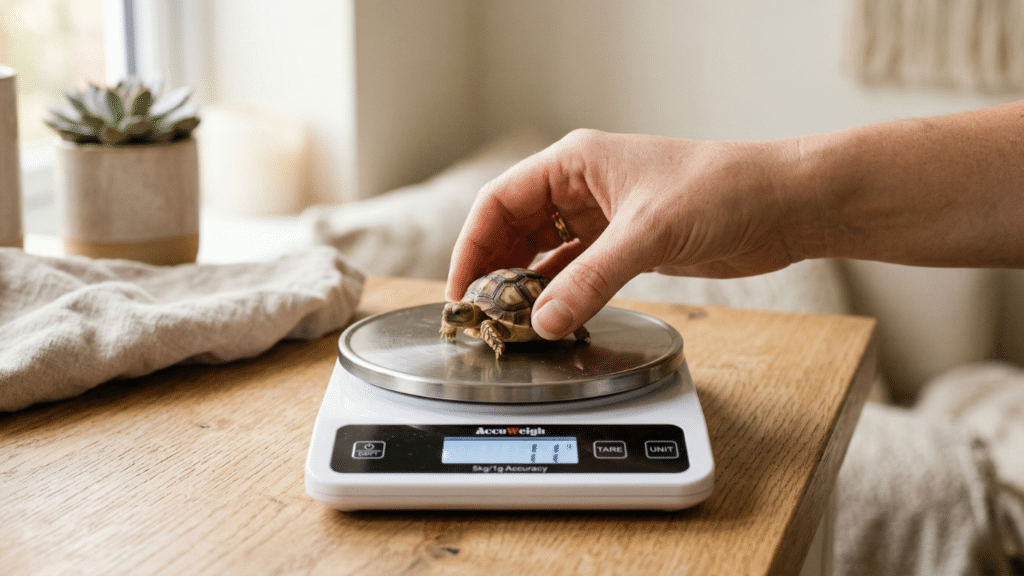
Weigh your hatchling weekly using a kitchen scale accurate to one gram. Record the number alongside brief notes on appetite and activity. You’re looking for a trend of consistent, gradual increase — not dramatic week-to-week jumps. Plateau for more than two consecutive weeks without obvious illness warrants a review of temperature, diet, and UVB setup. Sudden rapid weight gain warrants a diet review.
Monthly: Shell and Body Assessment
Once a month, measure shell length and width and photograph from above and from the side at a consistent angle and distance. This creates a visual record that makes early pyramiding, asymmetrical growth, or scute irregularities visible in a way that casual daily observation cannot. During the same monthly check, assess muscle firmness — a healthy hatchling should feel solid and well-supported, not soft or flaccid when held.
Environmental Monitoring
Digital thermometers and hygrometers placed at tortoise level — not mounted at the side of the enclosure — give you accurate readings of what your hatchling is actually experiencing. Check and log these weekly alongside growth data. Temperature and humidity records become invaluable diagnostic context if health problems develop later.
Annual Veterinary Review
A wellness visit with a reptile-specialist veterinarian once a year — even for a tortoise that appears completely healthy — is the single best way to catch subclinical issues before they become clinical ones. Fecal testing for parasites, physical shell and body assessment, and a blood panel evaluating kidney and liver function provide information that no amount of home observation can replicate.
Age-Specific Growth Support: What Changes and When
0–6 Months: Intensive Foundation
This is the highest-demand period of your sulcata’s entire life. Every environmental parameter matters more now than it will at any later stage. Feed daily, maintain humidity diligently, minimize handling, and weigh weekly without exception. Do not attempt to accelerate growth by increasing food volume — steady development is the goal. If something seems off, act on it rather than waiting to see if it resolves.
6–12 Months: Sustained Development
Growth rates begin to stabilize slightly, but remain substantial. Maintain daily feeding and consistent environmental conditions. Begin expanding the enclosure if the tortoise is outgrowing its current space — cramped conditions at this stage are a direct growth inhibitor. This is also when outdoor supervised access becomes particularly valuable during warm months.
12–18 Months: Beginning the Transition
As the hatchling approaches juvenile status, feeding can begin transitioning toward every-other-day rather than daily, contingent on consistent growth and good body condition. Begin increasing the proportion of grasses and hays relative to higher-protein foods. Watch the shell closely during this period — the transition in diet and environment often reveals whether previous conditions were optimal. This is also the time to begin planning seriously for adult-scale housing.

Common Baby Sulcata Growth Mistakes Worth Knowing in Advance
These are the errors that consistently appear in rescue intake records and keeper community discussions. Knowing them before they happen is far more useful than recognizing them after:
- Prioritizing growth speed over growth quality. A rapidly growing hatchling is not necessarily a healthy one. Fast weight gain without proportional shell and bone development is a warning sign, not a milestone.
- Treating humidity as optional. The dry conditions that seem natural for a desert species are not appropriate for hatchlings. Shell pyramiding that begins in the first year is almost never reversible.
- Underestimating enclosure space requirements. A 4 x 8 foot enclosure for a hatchling seems large relative to the animal. It isn’t relative to the developmental need for movement.
- Inconsistent supplementation. Calcium and vitamins offered sporadically provide far less benefit than smaller amounts offered on a reliable schedule.
- Responding to growth plateaus by adding more food rather than reviewing environmental conditions. Poor temperature gradient or degraded UVB lighting are more commonly the cause of stalled growth than insufficient food volume.
- Applying adult care timelines too early. A 14-month-old sulcata is not ready for adult feeding schedules or reduced supplementation, regardless of its size.
The Growth Foundation You Build Now Lasts 70 Years
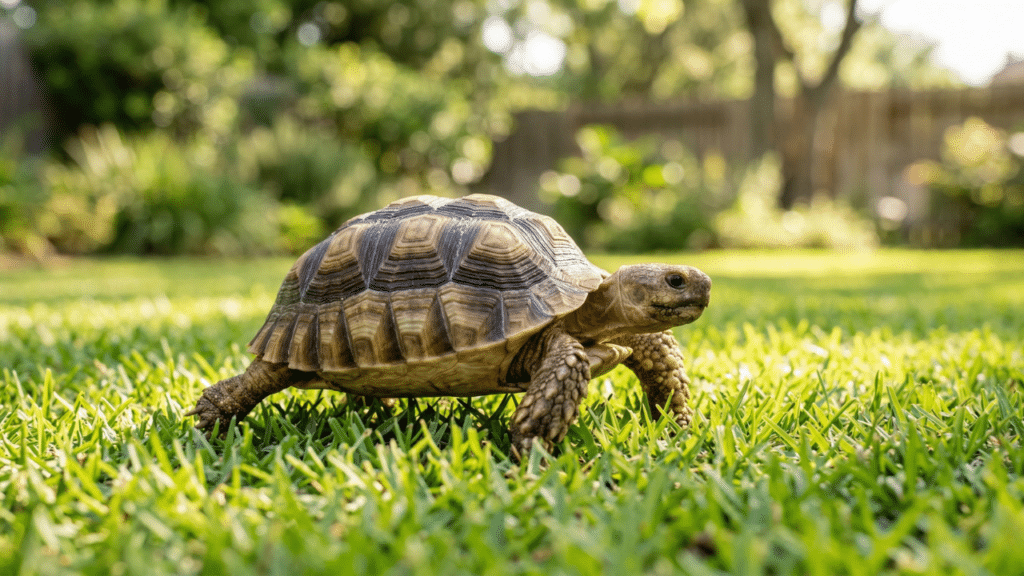
Baby sulcata growth isn’t a phase you manage until your tortoise reaches a certain size and then move past. It is the period when the physical foundation for your animal’s entire life is being constructed — bone by bone, scute by scute, organ system by organ system.
The sulcatas that arrive at adulthood with smooth shells, sound skeletal structure, healthy kidneys, and robust immune systems didn’t get lucky. They had keepers who understood that consistent conditions, appropriate nutrition, adequate space, and attentive monitoring during those first 18 months were not optional extras — they were the work.
That work is front-loaded and demanding. But for a species that can live longer than most of the people who take them in, it is also one of the most consequential investments a keeper will ever make.
If you want reliable nutritional support during the growth window, the Baby Sulcata Superfood Powder (4.5 oz) and 2.5 oz option are formulated specifically for the growth-phase sulcata, and the Vitamin and Mineral Topper rounds out the trace minerals and vitamins that diet alone often misses. All are available on Amazon — use code BUYNOWGET10 to save 10%.