
LIMITED-TIME OFFER
Give Your Baby Sulcata a Stronger Start—and Save 30%
Supporthealthy growth with a high-fiber, low-protein food formulated specifically for baby sulcatas. Superfood provides calcium, essential nutrients, and probiotics in an easy-to-serve powder.
GET 30% OFF SUPERFOODHerpetologist-formulated • Made in the USA
Setting up an indoor sulcata tortoise enclosure is fundamentally an engineering challenge. Outdoors, the sun handles UVB. The earth handles thermal gradients. Natural rainfall and substrate depth manage humidity. A well-sized yard handles space. Indoors, you have to provide every single one of those things deliberately — with hardware, planning, and ongoing monitoring.
Done well, an indoor sulcata tortoise enclosure supports healthy development, normal behavior, and proper shell formation. Done poorly — with inadequate UVB, incorrect temperatures, insufficient space, or the wrong substrate — it produces the chronic health problems that give indoor keeping a bad reputation: metabolic bone disease, shell pyramiding, respiratory infections, and behavioral suppression.
This guide covers every component of a correctly built indoor sulcata tortoise enclosure, from the right setup for hatchlings through to the honest conversation about when indoor housing becomes a transitional stage rather than a permanent solution. The outdoor habitat setup is covered separately in our sulcata tortoise habitat guide — this post is specifically about getting the indoor enclosure right.
When an Indoor Sulcata Tortoise Enclosure Makes Sense
Most sulcata owners start with an indoor enclosure regardless of their long-term plans, because hatchlings and young juveniles are simply too small and too temperature-sensitive to go directly into a large outdoor setup. An indoor sulcata tortoise enclosure is the right environment for the first 12–18 months of a tortoise’s life in almost every climate.
For owners in cooler climates — USDA zones 7 and below, where outdoor temperatures are unsuitable for meaningful portions of the year — an indoor enclosure may be a long-term necessity rather than just an early-stage solution. In these cases, the engineering demands are higher and the space commitment is real: a healthy adult sulcata needs a minimum of 100–150 square feet of enclosure space, which means a dedicated room, a large garage section, or a finished basement.
The honest answer for most owners is that an indoor sulcata tortoise enclosure is a starting point. Plan the indoor setup well, but also plan for the outdoor transition — and build that transition into your timeline before your tortoise outgrows what you can realistically provide indoors.
Space Requirements for an Indoor Sulcata Tortoise Enclosure
The space requirements for an indoor sulcata tortoise enclosure follow the same biology as outdoor keeping — the walls just happen to be inside a building. Sulcatas are large, active tortoises that need to move. An enclosure that’s too tight produces a tortoise that paces, repeatedly bumps the walls, and develops both behavioral and physical problems from chronic confinement.
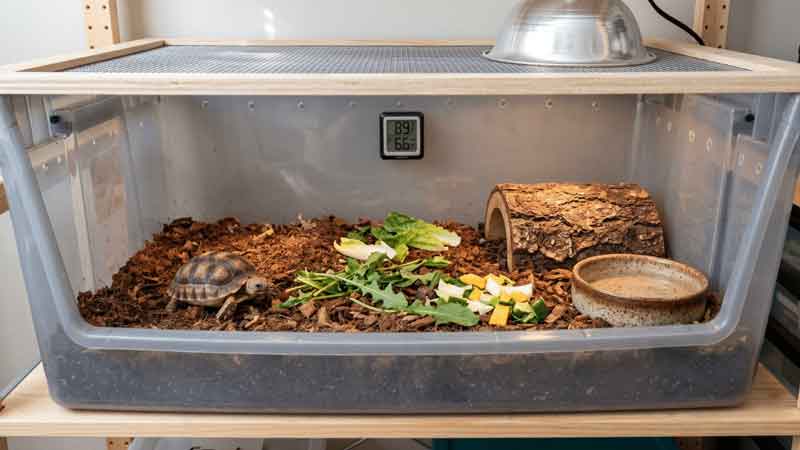
For hatchlings in their first six months, a 4–6 square foot enclosure is sufficient. A large plastic storage tote, a properly modified stock tank, or a purpose-built tortoise table all work well at this stage. By the time shell length reaches 4–6 inches (typically around 6–12 months), the enclosure should be at least 8–12 square feet. At 8–10 inches of shell length, you’re looking at a minimum of 25–40 square feet.
Adult indoor sulcata tortoise enclosures are a serious undertaking. A full-grown sulcata at 18+ inches of shell length needs a minimum of 100 square feet — roughly a 10×10 foot space — and that is a bare minimum for basic function, not a comfortable living situation. Most owners managing adult sulcatas indoors long-term do so in a dedicated room, a large sectioned-off garage, or a similarly substantial space.
If you can’t provide that space indoors as your tortoise grows, the indoor enclosure should be treated as a juvenile stage, with an outdoor habitat planned and built before it’s urgently needed rather than after.
Enclosure Materials: What to Build or Buy for an Indoor Sulcata Tortoise Enclosure
For Hatchlings and Juveniles
Young sulcatas up to about 6 inches can be housed in a range of commercially available or repurposed containers. Large plastic storage totes (the 100+ gallon variety) work well — they’re easy to clean, retain humidity better than open-topped enclosures, and are inexpensive. Tortoise tables — open-topped wooden enclosures — are a popular purpose-built option that provide good ventilation and easy access. Stock tanks and large plastic kiddie pools are also used, particularly as a stepping stone to a larger custom enclosure.
For any juvenile indoor sulcata tortoise enclosure, avoid glass aquariums. They don’t provide adequate floor space relative to their volume, they create problematic reflection behaviors (the tortoise sees itself in the glass and becomes fixated), and they offer poor thermal gradient management.
For Sub-Adults and Adults
Once your sulcata outgrows commercial options — which happens faster than most owners expect — a custom-built indoor sulcata tortoise enclosure is the only practical route. The most common construction approach is a wooden frame built from 2×6 or 2×8 dimensional lumber, with plywood or solid wood panel walls. All wood surfaces that will contact substrate or be exposed to moisture need to be sealed with a non-toxic, waterproof sealant — untreated wood absorbs urine and moisture, rots quickly, and becomes a bacterial reservoir.
Walls should be solid and opaque, for the same reason as outdoor enclosures: sulcatas that can see through their enclosure perimeter will persistently try to reach whatever is on the other side, which leads to wall-pacing, rostral (nose) abrasions, and chronic frustration. Minimum wall height is 18–24 inches above substrate level to prevent escape in adults.
Cinder block and brick construction is used by some keepers for permanent indoor installations and is very durable, but requires anchoring — adult sulcatas are strong enough to topple blocks that are simply stacked. If using masonry, the blocks need to be mortared or secured in a way that can withstand a 100+ pound animal pushing against them.
Substrate for the Indoor Sulcata Tortoise Enclosure
The substrate in an indoor sulcata tortoise enclosure serves overlapping purposes: it provides a surface for natural digging behavior, helps buffer temperature and humidity at depth, and contributes to the overall health of the enclosure environment.
The best substrate for an indoor sulcata tortoise enclosure is the same as for outdoor keeping: a 50:50 mix of plain topsoil and coarse sand, or purchased sandy loam. This mixture mimics the natural Sahel soil profile — it compacts moderately (allowing shallow digging and substrate burrowing), drains freely at the surface (preventing dampness), and doesn’t contain the synthetic additives, fertilizers, or perlite found in most potting soils. Depth should be at least 4–6 inches for juveniles and 8–12 inches for adults, to allow meaningful digging behavior.
Cypress mulch is sometimes used as a surface layer over sandy loam and is acceptable in that role — it helps with humidity and feels more natural underfoot. It should not be the primary substrate, however, as it doesn’t compact for digging, retains too much moisture at depth, and breaks down in ways that can introduce mold over time.
Commercially prepared tortoise substrates are a convenient option for smaller juvenile enclosures. For large adult enclosures, the volume required makes commercial substrate prohibitively expensive — bulk sandy loam sourced from a garden center is the practical choice.
One thing to avoid: loose, fine particle substrates like calcium sand, play sand, or coconut coir as a primary base. Fine particles can be accidentally ingested while eating and cause impaction, particularly in juveniles. Coarse sand mixed with topsoil is safe; fine, uniform sand is not.
Are You Starving Your Tortoise?
Save 10% on premium tortoise food and supplements from Tortoise Resource Center on Amazon now using code BUYNOWGET10
Sulcata Vitamin & Mineral Topper Supplement
30-Day Supply | 2 oz (56 g)
$24.99
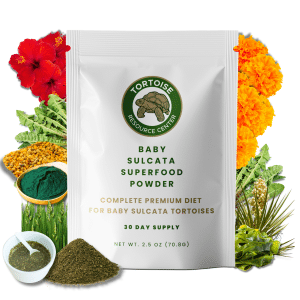
Baby Sulcata Tortoise Superfood Powder
30-Day Supply | 2.5 oz (70.8 g) Bag
$24.99
UVB Lighting: The Most Critical Component of the Indoor Sulcata Tortoise Enclosure
UVB lighting is not optional in an indoor sulcata tortoise enclosure — it is the most critical single component of the setup. Without adequate UVB, sulcatas cannot synthesize vitamin D3, which means calcium cannot be properly absorbed regardless of how well you supplement. The result is metabolic bone disease, shell softening, and skeletal deformities. This is one of the leading causes of preventable health failure in captive sulcatas.
The challenge with artificial UVB is that no bulb replicates natural sunlight. The key variables are output index (UVI), coverage area, and bulb lifespan — all of which vary significantly between product types.
Comparing UVB and Heating Options
| Bulb Type | UVB Output | Heat Output | Cost | Replace |
|---|---|---|---|---|
| T5 HO Fluorescent + UVB tube | ✅ Good UVB output | ❌ No heat — needs separate basking lamp | $ Low | Every 6 months |
| LED Full-Spectrum UVB | ✅ Good UVB, energy efficient | ❌ No heat — needs separate basking lamp | $$ Medium | Every 12 months |
| Mercury Vapor Bulb (MVB) | ✅ Excellent UVB output | ✅ Produces significant heat | $$ Medium | Every 6 months |
| Halogen Basking Lamp only | ❌ No UVB — needs separate UVB source | ✅ Excellent focused heat | $ Low | Every 2–3 months |
| Ceramic Heat Emitter (CHE) | ❌ No UVB — needs separate UVB source | ✅ 24-hr heat, no light output | $$ Medium | Annually |
UVB Placement and UVI Targets
Correct UVB output at the tortoise’s level is more important than bulb type. For sulcatas, the target UVI at the basking spot surface is 3–6, which requires a T5 HO tube or mercury vapor bulb positioned 10–14 inches above the tortoise. Positioning matters enormously — the same bulb at 6 inches produces very different UVI than at 18 inches. Use a Solarmeter 6.5 or similar UVI meter to verify output rather than estimating by proximity.
UVB bulbs degrade before they visibly dim. A fluorescent tube that still looks bright may be producing almost no UVB after six months of use. Replacing bulbs on schedule — every 6 months for fluorescent tubes, every 6–12 months for LED and MVB — is not optional maintenance, it’s a core health requirement of the indoor sulcata tortoise enclosure.
The UVB light source should cover at least two-thirds of the enclosure length, positioned to allow the tortoise to move in and out of the UVB zone naturally. This creates a photoperiod gradient — the tortoise can self-regulate UV exposure the same way it would self-regulate temperature, by moving between zones.
Heating and Thermal Gradient in the Indoor Sulcata Tortoise Enclosure
A correctly heated indoor sulcata tortoise enclosure provides three distinct temperature zones, not a single uniform temperature. Sulcatas thermoregulate behaviorally — they move between warm and cool areas throughout the day to manage digestion, immune function, and activity levels. An enclosure with no thermal variation forces the tortoise to stay at whatever the ambient temperature happens to be, which compromises all of those functions.
The basking spot — positioned directly under the heat source at one end of the enclosure — should reach 100–105°F at substrate level. The cool end of the enclosure should be in the mid-70s°F. The ambient mid-enclosure temperature should fall in the low-to-mid 80s°F during the day. At night, temperatures can drop to the mid-60s°F for healthy tortoises; juveniles and hatchlings should not go below 70°F overnight.
Thermostat Control
Any heating device in an indoor sulcata tortoise enclosure should be connected to a thermostat rather than run on an uncontrolled timer. Thermostats prevent temperature spikes that occur when ambient room temperature changes with seasons, time of day, or HVAC fluctuations. Proportional thermostats (which modulate power output continuously) provide more stable temperatures than on/off thermostats and are worth the additional cost for radiant heat panels. On/off pulse thermostats are acceptable for ceramic heat emitters.
Measuring Temperatures Accurately
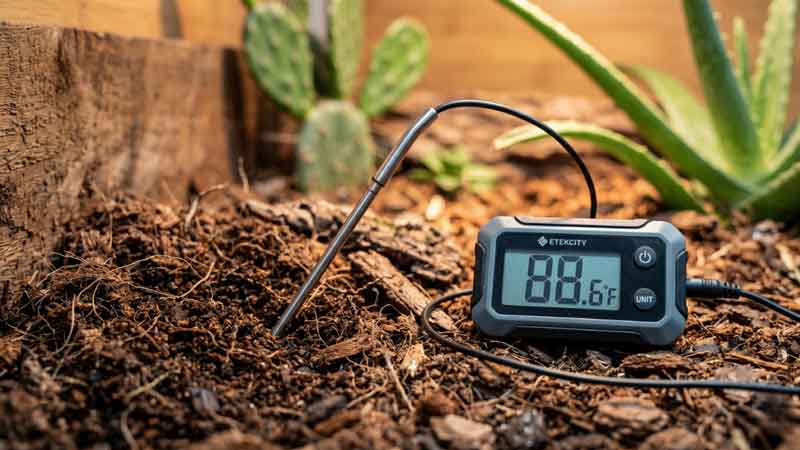
Temperature guns (infrared thermometers) and digital probe thermometers are both necessary tools for managing an indoor sulcata tortoise enclosure. Temperature guns measure surface temperature at the basking spot accurately. Probe thermometers measure ambient air temperature at tortoise level and can be left in place to monitor the cool end. Stick-on dial thermometers affixed to enclosure walls are unreliable — they measure wall temperature, not air or substrate temperature where the tortoise actually lives.
Humidity Management in the Indoor Sulcata Tortoise Enclosure
Sulcatas come from an arid environment, and the overall indoor sulcata tortoise enclosure should reflect that. The ambient humidity in the enclosure should be kept relatively low — generally 40–60%. Chronic high humidity in the enclosure causes respiratory infections, shell problems (including rot in severe cases), and skin conditions. Good ventilation across the enclosure is essential, which is one reason open-topped or well-vented enclosure designs are preferable to fully enclosed tanks.
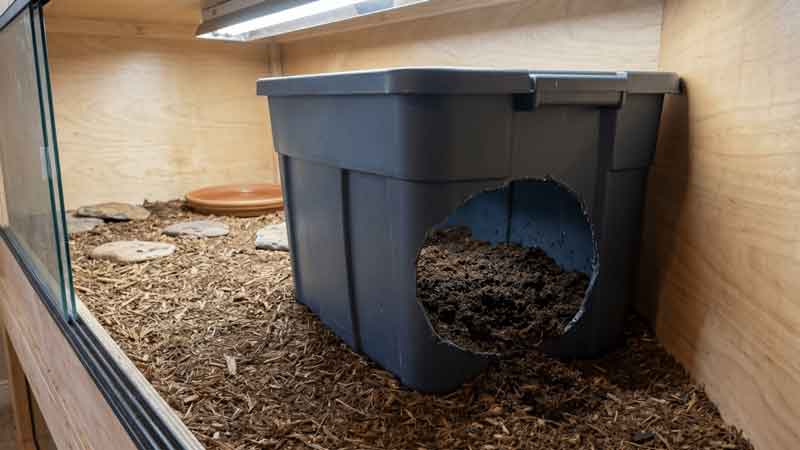
However, there is an important nuance: the hide box inside the enclosure should be kept measurably more humid than the rest of the enclosure. This creates the same microclimate effect as a natural burrow, where deeper soil retains more moisture than the arid surface. A damp hide — a hide box with slightly moistened substrate inside — provides the hydration microclimate that helps prevent dehydration and is directly linked to reducing shell pyramiding in juveniles.
To create a damp hide, use a large plastic storage box with a door cut into one side (an opening large enough for the tortoise to enter and turn around). Fill the bottom with 2–3 inches of the same sandy-loam substrate used in the main enclosure, and lightly dampen it every 2–3 days. The inside of the hide should feel noticeably cooler and more humid than the enclosure floor, but should not be wet or soggy.
Hides and Enrichment in the Indoor Sulcata Tortoise Enclosure
Because indoor sulcatas cannot dig the long tunnels they would construct naturally, the hide box is the primary substitute for that behavioral need. Every indoor sulcata tortoise enclosure should have at least one hide — ideally two, so one can be kept dry while the other serves as the damp burrow substitute.
The hide needs to be large enough for the tortoise to enter, turn around, and settle without touching the walls. A hide that fits snugly may feel secure to a small juvenile but becomes a confinement problem as the tortoise grows. Size the hide for where the tortoise is going, not just where it is now.
Beyond hides, enrichment in the indoor sulcata tortoise enclosure should provide varied terrain and obstacles that encourage movement and exploration. Large smooth rocks, driftwood pieces, and stable cinder blocks all work well as visual barriers and physical obstacles. The goal is to break up the flat, open floor plan of the enclosure so the tortoise is making navigational choices rather than pacing the perimeter.
Live plants inside the indoor enclosure need to be non-toxic, because sulcatas will eat them. Options that work well in indoor setups include small hibiscus plants, pothos (kept at the enclosure margin where grazing is limited), or pots of wheatgrass that can be rotated in as a supplemental food source.
Water and Soaking in the Indoor Sulcata Tortoise Enclosure
A shallow, stable water dish should be available in the indoor sulcata tortoise enclosure at all times and refreshed daily. The dish should be large enough for the tortoise to soak in if it chooses, but shallow enough that a juvenile cannot tip it and become trapped or unable to right itself. A heavy ceramic or stone dish is preferable to lightweight plastic for this reason.
For hatchlings and juveniles, supplemental soaking 2–3 times per week in a separate shallow warm-water container (not in the enclosure itself) is an important part of the indoor care routine. Young sulcatas are more prone to dehydration than adults, and regular soaking helps maintain hydration, supports kidney function, and encourages waste elimination. Soak water should be lukewarm — around 85–90°F — and shallow enough that the tortoise can comfortably lift its head above the surface.
As sulcatas grow and particularly once they transition to outdoor keeping with natural rainfall access, the supplemental soaking schedule can be reduced. Indoors, maintain it consistently through the juvenile stage.
Feeding Within the Indoor Sulcata Tortoise Enclosure
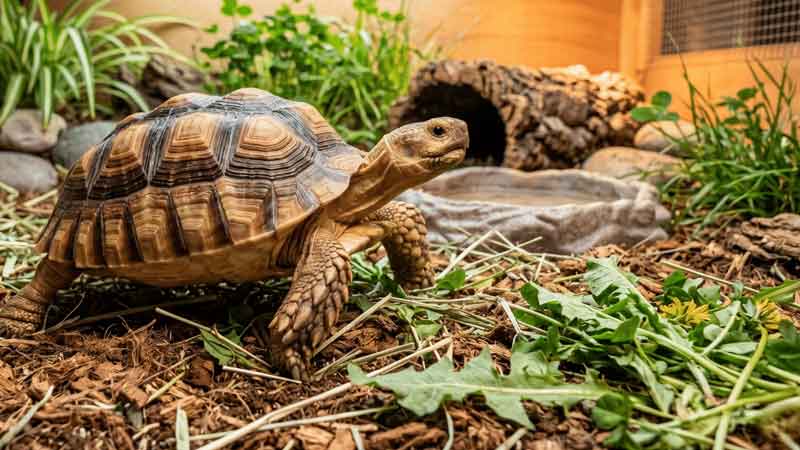
Feeding in an indoor sulcata tortoise enclosure requires more intentional management than outdoor keeping, because the tortoise doesn’t have access to living grass for grazing. Timothy hay should be available at all times — it’s the closest replication of the natural diet and provides the high-fiber, low-protein baseline that sulcatas need. Scatter hay throughout the enclosure rather than placing it in a single pile, to encourage foraging movement.
Supplemental fresh foods — dandelion greens, hibiscus flowers and leaves, appropriate weeds, small amounts of shredded carrot or squash — should be offered 3–5 times per week, scattered around the enclosure floor rather than placed in a dish where possible. Avoid feeding directly on bare substrate with fine particles; a flat slate tile or shallow tray under food portions prevents accidental substrate ingestion.
Calcium supplementation is even more critical in an indoor sulcata tortoise enclosure than outdoors, because the artificial UVB provided is less efficient than natural sunlight at driving D3 synthesis. Dust food with phosphorus-free calcium powder at every feeding for hatchlings and juveniles, 5–6 times per week for growing tortoises.
Trace mineral supplementation fills a gap that fresh food in an indoor enclosure reliably cannot close. Our Vitamin and Mineral Topper is formulated specifically for desert tortoise species and covers the selenium, zinc, magnesium, and vitamin A needs that indoor diets — without access to varied outdoor grazing — often leave short. A light dusting 1–2 times per week on fresh food is all it takes.
For hatchlings and juveniles in the indoor enclosure during the rapid growth phase, our Baby Sulcata Superfood Powder (available in 2.5 oz and 4.5 oz sizes) provides calibrated protein-to-fiber-to-calcium ratios designed to support healthy growth without the overshooting that causes shell pyramiding. Use code BUYNOWGET10 at checkout on Amazon to save 10%.
Maintenance Schedule for the Indoor Sulcata Tortoise Enclosure
An indoor sulcata tortoise enclosure needs more active maintenance than an outdoor habitat because the closed environment means waste, bacteria, and humidity all build up faster. A consistent maintenance routine prevents the accumulation problems that lead to health issues.
Daily: remove feces and uneaten food, refresh the water dish, verify the basking spot temperature with an infrared thermometer, and do a quick visual check on the tortoise.
Weekly: wipe down enclosure walls where substrate or water has contacted them, re-dampen the damp hide substrate if needed, check the cool end temperature with a probe thermometer, and assess the substrate surface for excessive waste accumulation or dampness.
Monthly: replace substrate in the top 2–3 inches (a full substrate replacement in a large adult enclosure isn’t practical every month, but a top-dressing with fresh substrate in high-traffic areas is), clean hides and enclosure furniture with a diluted reptile-safe disinfectant, and inspect all electrical components — thermostats, lamp connections, probe placements — for wear or malfunction.
Every 6 months: replace fluorescent and T5 UVB tubes on schedule regardless of visible output. Check mercury vapor bulb output with a UVI meter and replace if output has dropped below target. Review enclosure sizing against the tortoise’s current shell length and begin planning an upgrade if the tortoise is approaching the space minimum for its size.
Getting the Indoor Sulcata Tortoise Enclosure Right from the Start
An indoor sulcata tortoise enclosure demands more than most pet enclosures — more space, more careful lighting, more deliberate temperature management, more consistent maintenance. But when each component is correctly set up, it provides a genuinely healthy environment for a juvenile or permanently indoor-kept sulcata.
The elements that matter most, in order of health impact: adequate UVB with regular bulb replacement, a proper thermal gradient with a verified basking temperature, sufficient space for normal movement, a damp hide that substitutes for natural burrowing, and correct substrate that allows digging behavior. Get those five things right and the majority of chronic indoor health problems — metabolic bone disease, pyramiding, respiratory issues — are largely preventable.
Plan the indoor enclosure size for where your tortoise is going, not where it is today. A hatchling setup that’s perfect at six months will be inadequate by twelve. Build the transition to outdoor keeping into your plan before the indoor space becomes a limitation, and your sulcata has the best of both worlds — a correctly managed indoor start and an appropriate outdoor habitat when they’re ready for it.