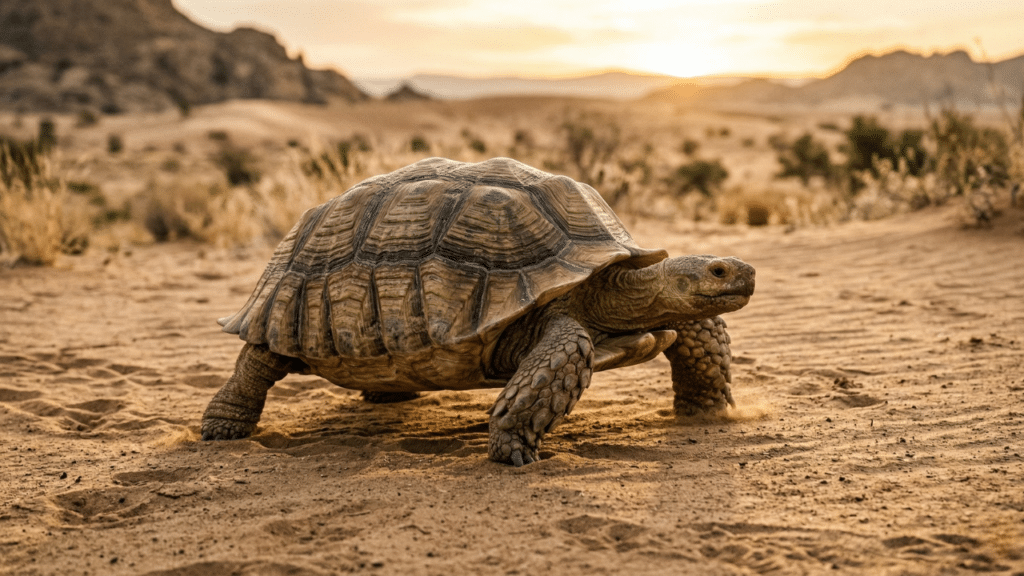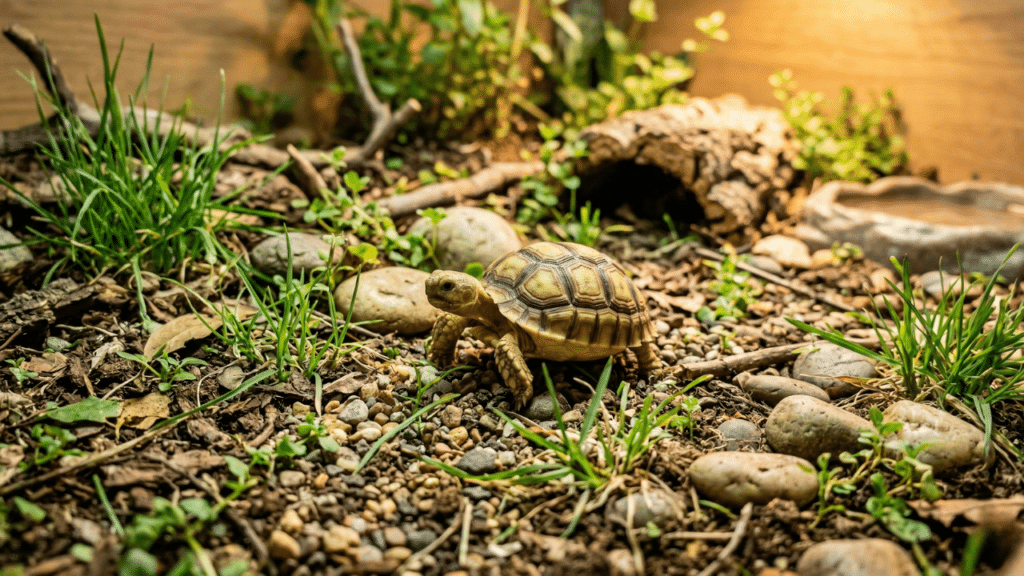
The sulcata tortoise is the most popular giant pet tortoise in the world, and it’s not hard to understand why. They are personable, actively curious, long-lived, and genuinely fascinating to keep. They recognize their caregivers, develop individual personalities, and become the kind of animal that owners describe not as a pet but as a lifelong companion.
They are also one of the most demanding pet commitments available — in space, in infrastructure, in financial planning, and in the sheer duration of the relationship. A sulcata tortoise pet is a 70-to-100-year commitment to an animal that will eventually weigh over 100 pounds and require a dedicated section of your property to house correctly.
This guide is the honest, complete picture of what sulcata tortoise pet ownership actually involves at every life stage. Not just the rewarding parts — the personality, the relationship, the experience of watching a hatchling grow into a magnificent adult — but the practical reality of housing, nutrition, veterinary care, and long-term planning that determines whether that relationship thrives or ends in a rescue surrender. If you’re seriously considering a sulcata tortoise as a pet, this is the guide that prepares you to make that decision well.
Is a Sulcata Tortoise a Good Pet? The Honest Answer
Yes — for the right owner, in the right situation, with the right preparation. A sulcata tortoise pet is one of the most rewarding exotic animal relationships available. The honest qualifier is that the ‘right owner’ part of that sentence does real work. Sulcatas are not beginner pets in the way that many reptiles are. They require more space, more infrastructure, more financial commitment, and more long-term planning than almost any commonly kept companion animal.
The table below gives a balanced overview of what makes sulcatas genuinely rewarding as pets and what prospective owners must honestly plan for before committing.
| What Makes Sulcatas Rewarding Pets | What Prospective Owners Must Plan For |
|---|---|
| ✅ Remarkably long-lived — 70–100 years with correct care | ⚠️ Adult size requires 150–300+ sq ft of dedicated outdoor space |
| ✅ Hardy and forgiving of minor husbandry mistakes | ⚠️ Enclosure build and ongoing costs are significant ($1,500–$3,000+ setup) |
| ✅ Personable and recognizes regular caregivers | ⚠️ Adults (80–150 lbs) require two people and equipment to transport |
| ✅ Fascinating to observe — active, investigative, behaviors visible | ⚠️ Diet must be tightly controlled — wrong food causes irreversible damage |
| ✅ Relatively easy to source from reputable breeders | ⚠️ 70+ year commitment demands life planning most pets don’t require |
| ✅ No live prey required — grass-based diet is convenient | ⚠️ Finding a vet experienced with large chelonians can be challenging |
| ✅ Outdoor keeping in warm climates is low-maintenance once established | ⚠️ Indoor keeping for adults requires a dedicated room or garage section |
The owners who have the most rewarding experiences with a sulcata tortoise as a pet are those who went in with clear eyes — who understood the adult size before acquiring a hatchling, who planned the outdoor enclosure before the tortoise outgrew indoor housing, and who built their care approach around the animal’s actual biological needs rather than what was convenient. That preparation makes the difference between an extraordinary long-term relationship and a tortoise that ends up in rescue at age 5.
Sulcata Tortoise Personality: What to Actually Expect
One of the most consistent surprises for new sulcata tortoise pet owners is how much personality these animals have. Tortoises as a group are often assumed to be passive and unintelligent; sulcatas actively challenge that assumption.
Recognition and Individual Bonding
Sulcatas recognize and respond to their regular caregivers in ways that are genuinely notable. A tortoise that sees the same person every day at feeding time will approach them with an eagerness and directness it doesn’t extend to strangers. This isn’t trained behavior in the mammalian sense — it’s a combination of visual recognition, learned association, and the natural investigative drive that makes sulcatas among the most outgoing tortoise species in captivity. Many long-term owners describe a relationship that feels genuinely mutual, even knowing the animal’s cognitive landscape is very different from a mammal’s.
Curiosity and Active Engagement
A sulcata tortoise pet in a well-designed enclosure is an active, investigative animal. They explore their environment deliberately, have clear preferences for specific basking spots and sleeping areas, and will investigate anything new introduced into their space with persistent attention. Unlike many reptiles that spend the majority of their time motionless, sulcatas kept correctly are visibly engaged with their world during active hours.
This curiosity is part of what makes them so enjoyable to observe — and part of what makes an undersized or understimulating enclosure so damaging to their behavioral health. A sulcata with nothing to explore, no foraging variation, and no terrain to navigate becomes a wall-pacing, frustrated animal. The investment in enrichment, varied plantings, and appropriate space is directly visible in the animal’s behavior.
Temperament by Life Stage
Hatchlings and juveniles are naturally more cautious and prone to withdrawing than adults. A young sulcata tortoise pet will spend significant time in its hide and may not approach readily for the first weeks in a new environment. This is normal — not a sign of illness or poor adjustment. As the tortoise grows and develops familiarity with its keeper and environment, most become progressively more outgoing.
Adult males can become more assertive and territorial, particularly during breeding season. This doesn’t make them dangerous to humans — sulcata bites are unusual and the animals are not aggressive toward people — but it does mean that adult male behavior in a multi-tortoise setting requires management. Two adult males cannot be permanently housed together. An adult male housed with a female will mount persistently, which causes physical wear and stress on the female that requires its own management.
The Sulcata Tortoise Pet Care Commitment: Life Stage by Stage
Care requirements for a sulcata tortoise pet change significantly across life stages — and planning for those transitions before they become urgent is one of the most important things a prospective owner can do. The table below summarizes the key care elements at each stage, including the supplements that address the specific nutritional needs of each phase.
| Life Stage | Housing | Diet | Supplements | Key Notes |
|---|---|---|---|---|
| Hatchling(0–12 mo) | 4–12 sq ft indoor | Grass + hay daily; calcium every feed | Baby Sulcata Superfood Powder + Calcium Topper | Most fragile stage. Temperature and humidity critical. Soak 2–3×/week. |
| Juvenile(1–3 yrs) | 15–40 sq ft; begin outdoor planning | Grass + hay 80%; greens/weeds 20% | Baby or Juvenile Superfood Powder + Calcium Topper + Multivitamin | Rapid growth phase. Monitor for pyramiding monthly. Begin outdoor transition. |
| Sub-adult(3–7 yrs) | 50–100 sq ft outdoor | Outdoor grazing + hay; limited supplemental greens | Juvenile or Adult Superfood + Vitamin & Mineral Topper | Sex becomes clearly identifiable. Housing upgrade essential. |
| Adult(7+ yrs) | 150–300+ sq ft outdoor | Outdoor grazing + hay; calcium 2–3×/week | Adult Sulcata Superfood + Vitamin & Mineral Topper + Multivitamin | Full strength. Plan for transport logistics. Annual vet wellness exam. |
Are You Starving Your Tortoise?
Save 10% on premium tortoise food and supplements from Tortoise Resource Center on Amazon now using code BUYNOWGET10
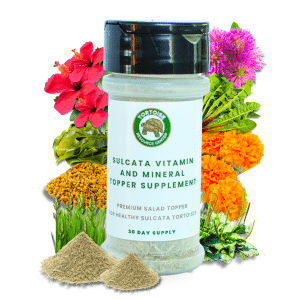
Sulcata Vitamin & Mineral Topper Supplement
30-Day Supply | 2 oz (56 g)
$24.99
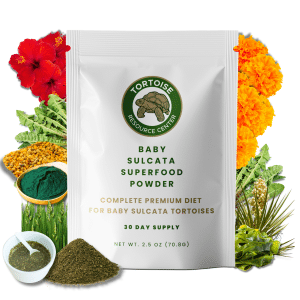
Baby Sulcata Tortoise Superfood Powder
30-Day Supply | 2.5 oz (70.8 g) Bag
$24.99
Hatchling Care: The Foundation Stage
The hatchling stage is the most intensive and most critical period of sulcata tortoise pet ownership. Hatchlings are fragile — significantly more sensitive to temperature swings, dehydration, and nutritional imbalance than juveniles or adults — and the care decisions made in the first 12 months have disproportionate influence on shell quality, organ health, and growth trajectory across the entire lifespan.
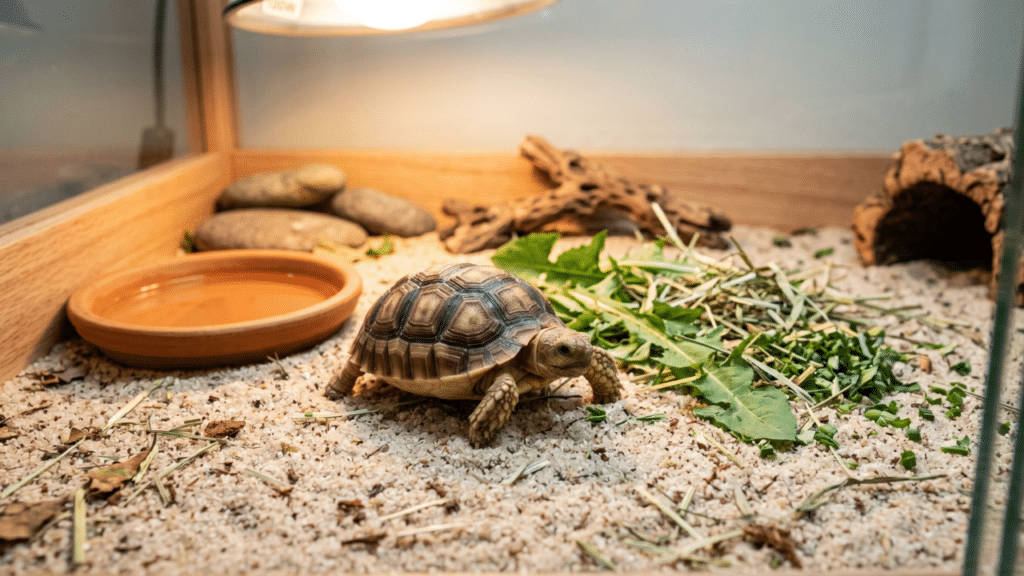
Temperature management is the immediate priority. Hatchlings need a basking spot of 95–100°F, ambient enclosure temperature in the mid-80s°F, and should not be exposed to temperatures below 70°F. UVB lighting from a quality T5 HO or mercury vapor source is non-negotiable from day one — calcium metabolism depends on it and cannot be compensated by supplementation alone.
Diet at the hatchling stage should be grass and hay as the foundation, with daily calcium dusting and appropriate species-specific supplementation. The protein-to-fiber-to-calcium balance during the first six months establishes the shell development pattern that will be visible for life. Our Baby Sulcata Superfood Powder (available in 2.5 oz and 4.5 oz sizes) is formulated specifically for the nutritional demands of this stage, complementing a grass-based diet with the calibrated mineral support that hatchling development requires. Pair it with our Tortoise Calcium Topper at every feeding for complete bone and shell foundation support.
Soaking 2–3 times per week in a shallow, lukewarm bath is important for hatchlings — young sulcatas are significantly more prone to dehydration than adults, and regular soaking supports kidney function and waste elimination during the rapid early growth phase.
Juvenile Care: Managing the Growth Window
The juvenile stage — roughly 1 to 3 years of age — is when the sulcata tortoise pet grows most dramatically and when dietary management has the most leverage on long-term outcomes. Shell length may increase by 1–2 inches per year and weight can multiply several times over during this period.
The critical risk at this stage is rapid growth driven by excess protein or total caloric overload. A juvenile that grows too fast develops pyramiding — the raised, irregular shell scutes that are a permanent structural marker of incorrect early nutrition — and faces elevated risk of kidney stress, joint problems, and reduced adult lifespan. The correct approach is steady, measured growth on a grass-forward diet with appropriate supplementation, not maximum growth on a high-variety, high-protein diet.
Monthly straight carapace length measurements with a digital caliper give you the data to know whether your juvenile’s growth rate is within the healthy range. If growth consistently exceeds 2 inches per year in the first two years, the diet needs to be adjusted toward more grass and hay and away from higher-protein supplemental foods.
As your juvenile sulcata tortoise pet transitions through this phase, nutritional needs shift from the intensive hatchling profile toward the sub-adult range. Our Juvenile Sulcata Superfood is formulated for this transition stage, providing the adjusted protein, fiber, and mineral ratios that support healthy growth without overloading the system. Combined with our Tortoise Daily Multivitamin Supplement a few times per week and continued Calcium Topper use, this covers the full nutritional picture during the most consequential growth window.
Sub-Adult and Adult Care: The Long Game
From 3 years onward, the sulcata tortoise pet enters the phase that will define the majority of its captive life. The care demands shift from the intensive monitoring of the hatchling and juvenile stages toward a steadier, more sustainable routine — but the infrastructure requirements reach their maximum during this period.
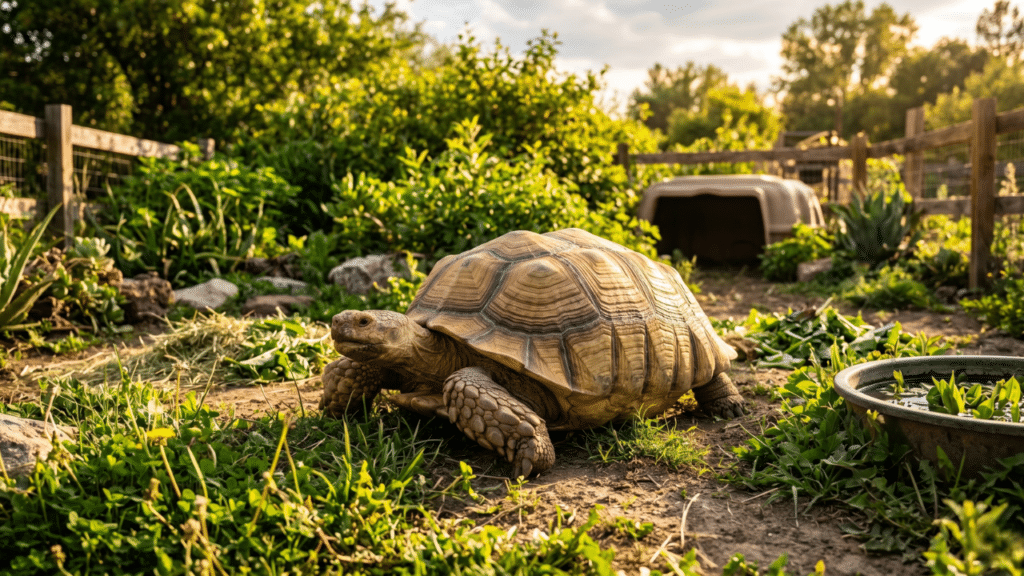
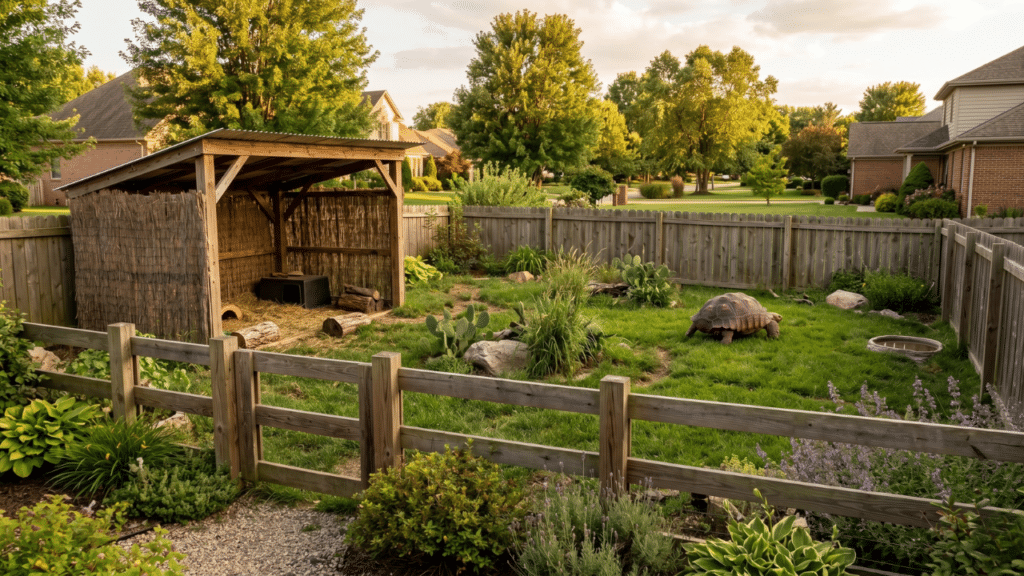
Outdoor housing becomes effectively mandatory once shell length exceeds 10–12 inches for most owners. A correctly built outdoor enclosure — with solid perimeter walls, underground footings to prevent burrowing out, a heated shelter for cooler climates, and sufficient space for natural grazing and movement — is the single largest investment in sulcata tortoise pet ownership and the one that most directly determines the animal’s long-term quality of life. Our outdoor enclosure build guide and sulcata tortoise habitat guide cover construction specifics in detail.
Nutritional needs for the adult sulcata tortoise pet are best supported by access to living, pesticide-free grass supplemented with hay, appropriate weeds and flowers, and targeted supplementation. Our Adult Sulcata Superfood provides the adjusted nutritional profile suited to a fully grown desert tortoise’s requirements. Our Vitamin and Mineral Topper fills the trace mineral gaps — selenium, zinc, magnesium, vitamins A and E — that regional soil variation means even excellent outdoor grazing can leave open. And our Tortoise Daily Multivitamin Supplement a few times per week rounds out the comprehensive supplementation approach that long-lived, healthy adults benefit from. Use code BUYNOWGET10 at checkout on Amazon to save 10% across all products.
The Long-Term Commitment: What Sulcata Tortoise Pet Ownership Really Means
Planning for Adult Size and Space
The most common cause of sulcata tortoise surrender is owners who acquired a hatchling without genuinely planning for the adult animal. A 2-inch hatchling becomes a 15-inch, 30-pound sub-adult within 5 years and a 20-inch, 80-pound adult within 10. The property infrastructure required to house that animal correctly — 150–300+ square feet of dedicated outdoor enclosure, a proper shelter, solid perimeter walls — needs to be planned before the animal outgrows its current housing, not after.
If you are acquiring a sulcata tortoise as a pet and you don’t yet have the outdoor space for the adult enclosure, the right approach is to plan that enclosure as part of the acquisition decision, not as a future problem to solve. Owners who plan ahead have extraordinary long-term relationships with their animals. Owners who plan retrospectively often find themselves in a housing crisis with a 50-pound tortoise and no adequate space to put it.
Veterinary Care
A sulcata tortoise pet needs a reptile-experienced veterinarian — ideally one with specific chelonian (tortoise and turtle) experience — and establishing that relationship before there’s an emergency is far better than searching for one when your tortoise is ill or injured. Annual wellness exams ($75–$200) catch developing issues early and are significantly more cost-effective than treating advanced problems. Fecal parasite checks annually are also recommended.
As your sulcata grows into adulthood, verify that your vet can physically examine a large animal — some exotic practices have weight limits on what they can safely handle. Transport logistics for a 100+ pound tortoise require planning: a reinforced carrier, a vehicle with adequate cargo space, and at minimum two people to load and unload.
The 70-Year Question
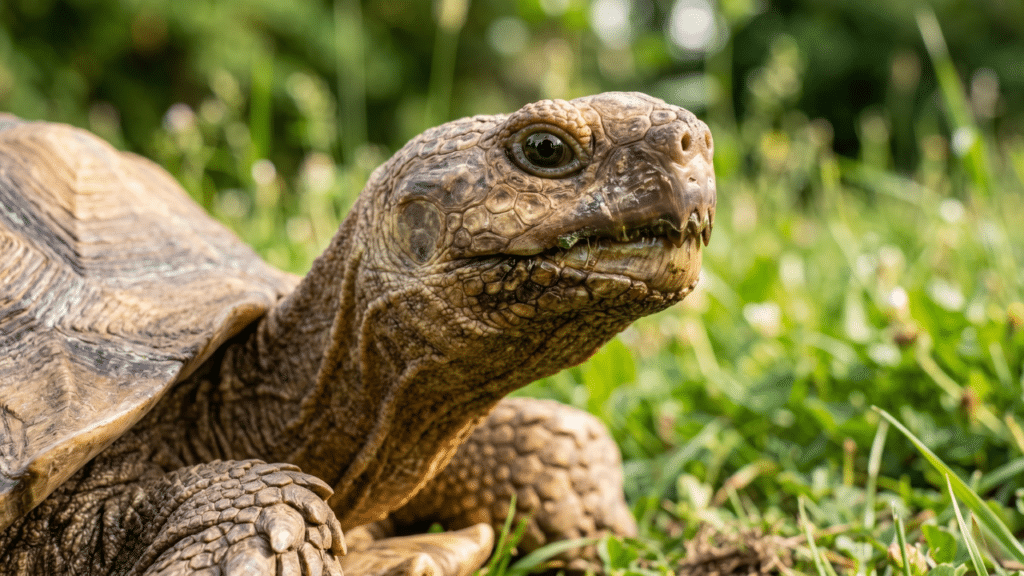
A correctly kept sulcata tortoise pet will very likely outlive most of the circumstances of your current life. The house, the yard, the physical ability to manage a large animal, the financial situation — all of these can change over a 70-year animal’s lifespan in ways that are difficult to predict at acquisition. Responsible sulcata pet ownership includes thinking through what happens to your tortoise if you move to a property without outdoor space, if your health changes, or if the animal outlives you. These aren’t hypothetical edge cases — they’re statistical near-certainties over a 70-year timespan.
Building contingency plans — connections with local sulcata keepers who could provide emergency care, a documented plan in your estate, familiarity with the rescue network in your region — is not pessimism. It’s the same long-term thinking that makes someone a good sulcata owner in the first place.
Is a Sulcata Tortoise the Right Pet for You?
The honest pre-commitment checklist for a sulcata tortoise pet comes down to a few key questions. Do you have, or can you create, 150–300+ square feet of dedicated outdoor space suitable for an adult sulcata enclosure? Is your climate compatible with outdoor keeping, or do you have the infrastructure budget for a properly heated shelter? Are you prepared for the physical demands of managing a 100+ pound animal over decades — transport, enclosure maintenance, and the day-to-day care that doesn’t stop regardless of weather, travel, or life circumstances? Can you budget $700–$1,500+ per year in ongoing care costs, with additional reserves for veterinary emergencies? And can you genuinely commit to — or make solid plans for — the 70-year duration of this relationship?
If the honest answer to each of those questions is yes, a sulcata tortoise pet offers something genuinely rare in the world of companion animals: an intelligent, personable, long-lived creature that becomes more interesting and more rewarding with every passing year. The investment is real. The relationship it purchases is extraordinary.