Baby sulcata calcium is not a topic where ‘some is good enough’ applies. It is one of the few areas of sulcata care where consistent, correctly dosed supplementation from the very first feeding is directly linked to outcomes that cannot be corrected later — shell structure, bone density, and the kidney health that determines whether a sulcata reaches 30 years or 80.
The problem isn’t that owners don’t know calcium matters. It’s that most guidance stops at ‘dust their food regularly’ without explaining the mechanism — the Ca:P ratio that determines whether the calcium you’re providing is actually absorbed, the D3 dependency that makes your UVB setup as important as your supplement, the difference between what a hatchling needs and what a juvenile needs, and what you’re actually buying when you choose a calcium supplement built on a natural botanical base versus plain calcium powder.
This guide covers all of it. By the end you’ll have a clear, actionable baby sulcata calcium protocol — for every life stage, with every relevant dietary and environmental factor accounted for.
Why Baby Sulcata Calcium Needs Are So High
A baby sulcata in its first year undergoes one of the most intensive growth trajectories of any commonly kept reptile. The shell is not just growing outward — it is actively mineralising. Each scute is being laid down and hardened in a process that requires a continuous, reliable supply of calcium delivered at the right ratio relative to phosphorus, and absorbed through a metabolic pathway that depends entirely on adequate vitamin D3.
At the same time, the skeletal system is developing — every bone in the body is being formed during this window. The kidneys are learning to process a diet that, if incorrectly balanced, will stress them in ways that accumulate silently for years. And the growth rate itself — a hatchling can triple in weight in six months under optimal conditions — means calcium demand is not just high in absolute terms, it is high relative to total body mass in a way that has no adult equivalent.
This is why the guidance for baby sulcata calcium supplementation is so much more frequent than for adults. It’s not overcaution — it’s a direct reflection of how much structural work is happening inside a hatchling’s body every single day.
The Ca:P Ratio: The Most Misunderstood Part of Baby Sulcata Calcium
The calcium-to-phosphorus ratio is where most baby sulcata calcium approaches fail, even when owners are supplementing consistently. Here’s why: phosphorus doesn’t just exist alongside calcium in the diet. In excess, it actively blocks calcium absorption. Specifically, when dietary phosphorus is too high relative to calcium, it binds to calcium in the gut and forms insoluble calcium phosphate salts that the intestinal wall cannot absorb. The calcium passes through unused.
This means a baby sulcata eating a diet high in phosphorus-rich foods — many vegetables, legumes, high-protein greens — may be receiving calcium supplementation that is largely wasted. You’re dusting the food, the tortoise is eating it, and the calcium is not reaching the bloodstream in meaningful amounts because the phosphorus ratio is undermining absorption.
The target ratio for baby sulcata calcium intake is 2:1 to 3:1, calcium to phosphorus. Above 5:1 for sustained periods can begin to cause issues in the opposite direction; below 1.5:1 means phosphorus is blocking absorption. The practical implication is that diet composition and calcium supplementation are not separate decisions — they operate on the same system, and a high-phosphorus diet cannot be fully compensated by heavier supplementation.
This is also why the natural botanical base of our Tortoise Calcium Topper matters practically, not just aesthetically. Built on Timothy Hay, Kelp Powder, Marigold Flower, and Rose Hips — all naturally low-phosphorus, calcium-appropriate ingredients — the formula delivers 26% calcium from Calcium Carbonate without adding a phosphorus load that works against itself. Plain calcium powder does the same thing in isolation, but a formula built on the right botanical base is one that tortoises accept readily without rejection, which is the only version that actually works consistently.
The D3 Dependency: Why UVB and Baby Sulcata Calcium Are Inseparable
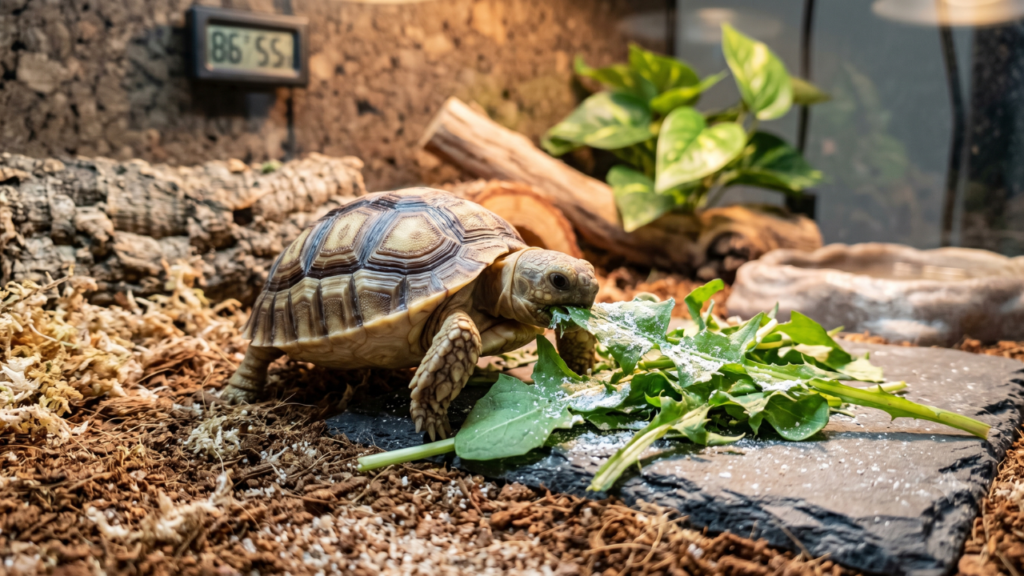
Calcium cannot be absorbed from the gut without adequate vitamin D3 in the system. This is not a nuance — it is a fundamental biochemical dependency. Vitamin D3 triggers the production of calcium-binding proteins in the intestinal lining that are required for calcium to cross from the gut into the bloodstream. Without D3, dietary calcium and supplemental calcium pass through largely unused, regardless of how much is present.
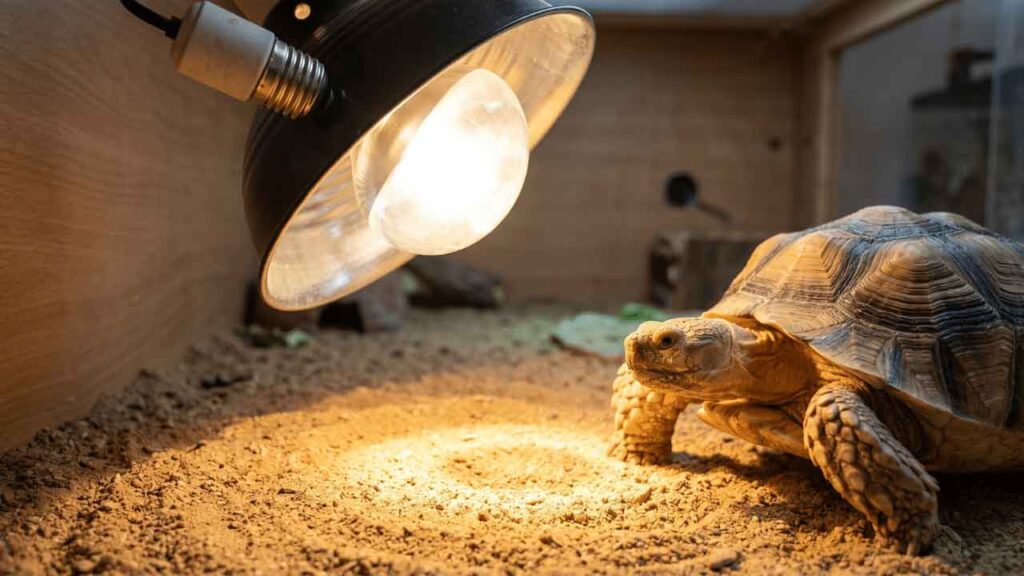
For sulcatas with reliable outdoor sun access, natural UVB synthesis in the skin produces adequate D3. For indoor-kept hatchlings and juveniles — which describes most baby sulcata keepers for at least the first 12–18 months — artificial UVB must carry that load, and it does so imperfectly. T5 HO fluorescent tubes degrade to near-zero UVB output by 6 months of age while still appearing bright. A hatchling under a 7-month-old UVB bulb that looks fine may be synthesizing essentially no D3.
This is the rationale for including Vitamin D3 at 2,000 IU/kg in our Tortoise Calcium Topper. For tortoises with consistent, quality outdoor sun access, the D3 in the formula is supplemental and harmless at this level. For indoor-kept hatchlings and juveniles where UVB quality is variable, managed, or the bulb age is uncertain, it closes a gap that diet and supplementation alone cannot reliably address. The calcium and D3 are delivered together because they operate together — separating them into two products adds complexity without adding benefit.
UVB bulb replacement every 6 months regardless of visible output remains non-negotiable regardless of what supplement you use. The D3 in a supplement addresses the gap when UVB falls short — it is not a substitute for functional UVB, which also supports other aspects of immune function and behavioral health that a supplement cannot replicate.
Baby Sulcata Calcium Supplementation: The Complete Schedule
The table below provides the full supplementation protocol by life stage, including frequency, amount, D3 source guidance, and key notes for each phase.
| Life Stage | Frequency | Amount | D3 Source | Key Notes |
|---|---|---|---|---|
| Hatchling (0–6 months) | Every feeding (daily) | Light dusting — 1 tsp per 1 lb of fresh food | Included in Calcium Topper formula (2,000 IU/kg) | Most critical window. Never skip. D3 in supplement supports indoor UVB gaps. |
| Juvenile (6–18 months) | 5–6× per week | 1 tsp per 1 lb fresh food per application | Calcium Topper formula covers D3 need | Still growing rapidly. Maintain high frequency through active pyramiding-risk window. |
| Sub-adult (18 months–3 yrs) | 4–5× per week | 1 tsp per 1 lb fresh food | Calcium Topper; supplement D3 if primarily indoor | Transition to outdoor access improves natural D3 synthesis. Adjust accordingly. |
| Adult (3+ years) | 2–3× per week | 1 tsp per 1 lb fresh food | Maintain D3 source year-round | Growth slowed but shell and bone maintenance ongoing. Don’t stop supplementing. |
| Gravid females (all ages) | Every feeding | 1 tsp per 1 lb fresh food | Calcium Topper formula covers D3 need | Egg production draws heavily on calcium reserves. Increase to every-feeding schedule during clutch season. |
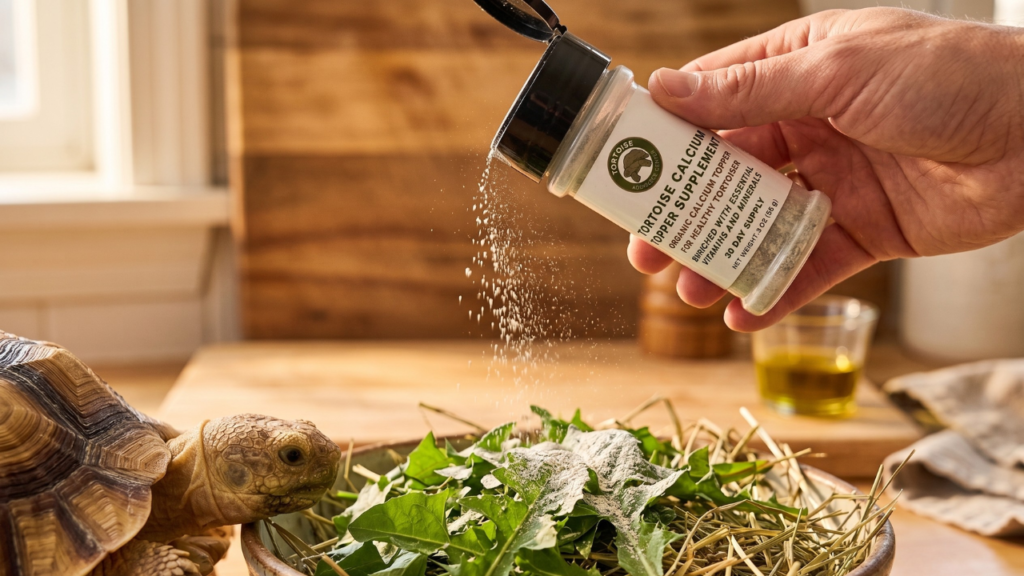
The dosing amount — 1 tsp per 1 lb (approximately 450g) of fresh food — is the guideline from the Tortoise Calcium Topper product. Lightly mist food before applying for best adhesion; the powder is designed to cling to damp leaf surfaces rather than falling off dry food. The result should be a visible but light dusting — not a thick white coating, which can make food unpalatable and cause tortoises to push it aside.
Natural Calcium Sources: Ranked by Ca:P Ratio
Supplementation is the most reliable baby sulcata calcium delivery method, but diet composition sets the foundation the supplement builds on. The table below ranks common sulcata foods by calcium content and Ca:P ratio — the two numbers that actually determine how useful each food is for calcium delivery.
| Food | Calcium per 100g | Phosphorus per 100g | Ca:P Ratio | Rating |
|---|---|---|---|---|
| Dandelion (whole plant) | 187 mg/100g | 66 mg/100g | ~2.8:1 ✅ | Excellent — feed freely |
| Collard greens | 232 mg/100g | 25 mg/100g | ~9.3:1 ✅ | Excellent — strong Ca source |
| Turnip greens | 190 mg/100g | 42 mg/100g | ~4.5:1 ✅ | Excellent |
| Mustard greens | 103 mg/100g | 43 mg/100g | ~2.4:1 ✅ | Good — use in rotation |
| Prickly pear cactus pads | 56 mg/100g | 26 mg/100g | ~2.2:1 ✅ | Good — excellent hydration |
| Timothy hay | ~400 mg/100g | ~220 mg/100g | ~1.8:1 ✅ | Dietary staple — foundation of diet |
| Romaine lettuce | 33 mg/100g | 26 mg/100g | ~1.3:1 ⚠️ | Low Ca — minimal value |
| Spinach | 99 mg/100g | 49 mg/100g | N/A ❌ | High oxalates block absorption — avoid |
| Kale | 150 mg/100g | 92 mg/100g | ~1.6:1 ⚠️ | High protein — use sparingly |
| Carrots | 33 mg/100g | 35 mg/100g | ~0.9:1 ❌ | Poor Ca:P — occasional only |
A few points from this table worth emphasising. Dandelion whole plant is one of the best freely available calcium sources — if you have a pesticide-free yard with dandelions, you have a free high-quality calcium food available much of the year. Collard greens have an exceptional Ca:P ratio but are high in protein — use them in rotation, not as a daily staple, and balance with grass and hay. Spinach appears calcium-rich on paper but is high in oxalic acid, which binds calcium in the gut and renders it unabsorbable — the listed calcium content is effectively unavailable to the tortoise and spinach should be avoided. Carrots have more phosphorus than calcium, creating a net-negative Ca:P effect that undermines supplementation when fed regularly.
Choosing a Baby Sulcata Calcium Supplement: What Actually Matters
Are You Starving Your Tortoise?
Save 10% on premium tortoise food and supplements from Tortoise Resource Center on Amazon now using code BUYNOWGET10
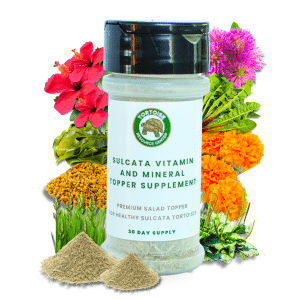
Sulcata Vitamin & Mineral Topper Supplement
30-Day Supply | 2 oz (56 g)
$24.99
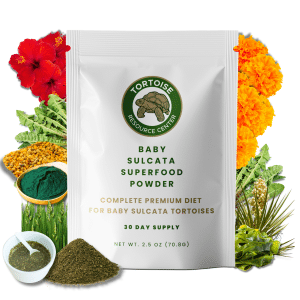
Baby Sulcata Tortoise Superfood Powder
30-Day Supply | 2.5 oz (70.8 g) Bag
$24.99
Calcium Source: Carbonate vs. Gluconate vs. Lactate
Calcium carbonate is the most common and most appropriate form for tortoise supplementation — it provides a high concentration of elemental calcium (40% by weight, meaning 26% elemental calcium in a 65% calcium carbonate product), is well-tolerated at the gut pH that reptile digestion operates at, and is shelf-stable. Calcium gluconate and calcium lactate provide less elemental calcium per gram and are more expensive without meaningful bioavailability advantages for reptiles. When evaluating any baby sulcata calcium supplement, calcium carbonate as the calcium source is the right choice.
Phosphorus-Free Formula
Any baby sulcata calcium supplement should be phosphorus-free. Because sulcatas get ample phosphorus from their plant-based diet, adding more through a supplement undermines the Ca:P ratio you’re trying to maintain. A supplement that includes dicalcium phosphate or any other phosphorus-containing ingredient is working partially against the goal. Our Tortoise Calcium Topper contains no added phosphorus — the formula is built around raising calcium availability, not balancing against an existing phosphorus load.
Natural Base vs. Plain Powder
Plain calcium carbonate powder is effective but often rejected by tortoises that haven’t been introduced to it early — the unfamiliar smell and texture can cause them to eat around supplemented food rather than accepting it. A formula built on botanicals that tortoises recognise — Timothy Hay, Kelp, Marigold Flower, Rose Hips in the Calcium Topper — smells like food rather than chalk, which significantly improves consistent acceptance. A supplement your tortoise consistently eats is categorically more effective than a higher-concentration one it rejects.
D3 Inclusion
For indoor keepers managing artificial UVB, D3 inclusion in the calcium supplement provides meaningful insurance against the UVB quality gaps that are nearly universal in indoor setups. Our Tortoise Calcium Topper includes Vitamin D3 at 2,000 IU/kg — sufficient to support indoor-kept tortoises without approaching the overdose threshold that becomes a concern only at levels several times higher. For tortoises with consistent outdoor sun access, this level of D3 is simply supplemental.
Signs of Baby Sulcata Calcium Deficiency
Calcium deficiency in baby sulcatas manifests progressively — early signs are subtle and become obvious only after significant time has passed on an inadequate protocol. This is what makes consistent supplementation from day one so important: by the time the visible signs appear, the window for prevention has long since closed.
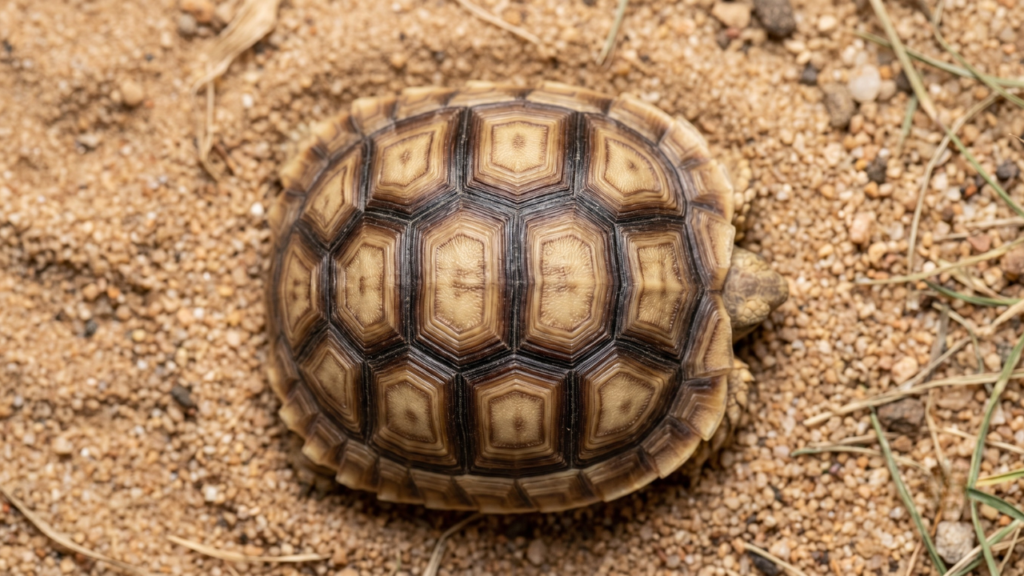
Early signs include shell scutes that feel slightly soft when pressed — not flexible, but lacking the solid resistance of a correctly mineralised shell. Monthly shell photographs reveal this before your fingers do: correctly mineralised scutes reflect light evenly across their surface; deficient scutes often show a slightly dull or uneven texture. Scute edges that begin to raise in the centre rather than lying flat are early pyramiding — the most visible long-term consequence of sustained calcium-to-protein imbalance.
Advanced deficiency produces visibly soft shell sections, limbs that struggle to support body weight, deformed shell growth that cannot be reversed, and eventually metabolic bone disease affecting the full skeletal system. These outcomes are not rare in sulcatas whose owners didn’t prioritise calcium — they appear consistently in rescue animals whose early care was inadequate.
Signs of Baby Sulcata Calcium Overdose: Understanding the Real Risk
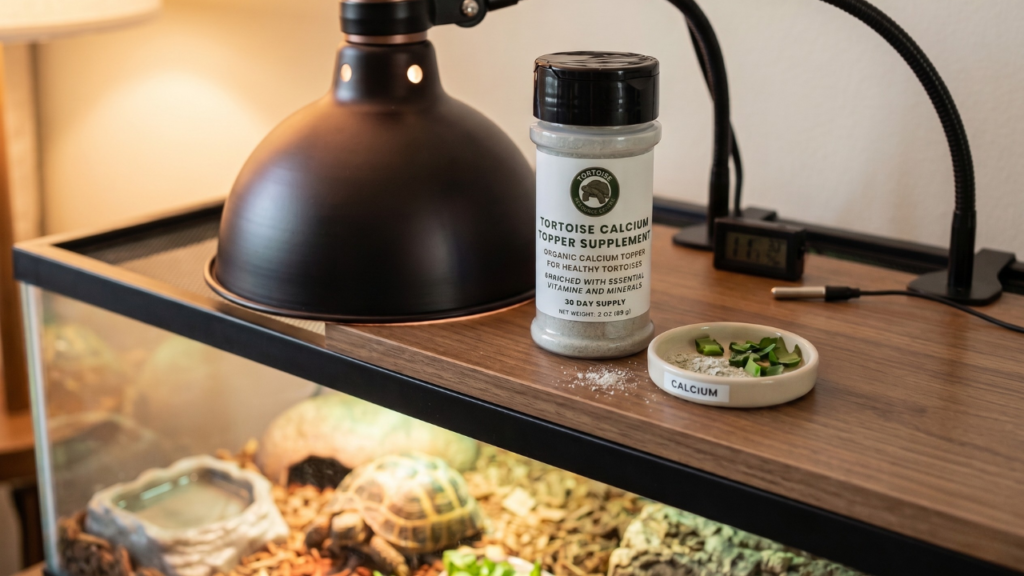
Calcium overdose is a genuine concern but is almost always misunderstood in terms of how it occurs. The risk of overdose from dietary supplementation at correct frequencies — daily for hatchlings, 5–6× per week for juveniles — is extremely low when the supplement is used as directed. A light dusting at the recommended 1 tsp per 1 lb of fresh food does not approach toxic calcium levels.
The realistic overdose risk arises from two specific scenarios: extremely heavy over-supplementation for sustained periods (many times the recommended amount daily), or D3 overdose from synthetic D3 supplements used at high frequency in combination with strong UVB — not from a supplement containing D3 at 2,000 IU/kg used per label directions. The more common D3-related concern in sulcatas is deficiency, not excess.
Chronic excess calcium from sustained over-supplementation (not routine recommended use) can cause kidney stress, constipation, and interference with magnesium and iron absorption. The practical guidance is: follow the recommended dosing, don’t pile on multiple calcium supplements simultaneously, and use a product like the Tortoise Calcium Topper alongside — not in addition to heavy-dose plain calcium carbonate. One well-formulated supplement used consistently outperforms multiple products used inconsistently or in combination without understanding interactions.
Completing the Baby Sulcata Calcium Picture: The Full Supplement Stack
Calcium is the most critical single supplement for baby sulcata development, but it operates within a broader nutritional context. For the full picture to work, the supporting elements need to be in place.
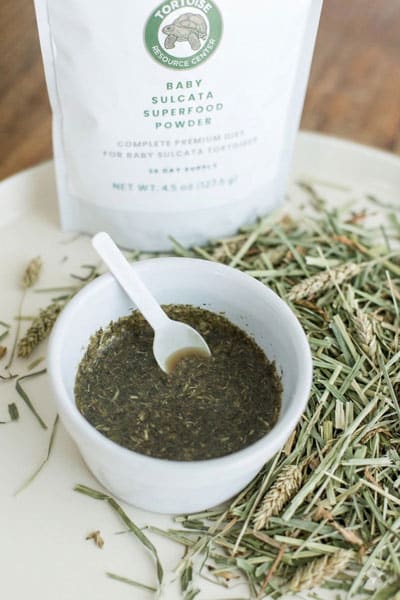
Our Baby Sulcata Superfood Powder (2.5 oz and 4.5 oz sizes) provides the protein-to-fiber-to-calcium foundation calibrated specifically for baby sulcata developmental needs — used alongside the Tortoise Calcium Topper it creates a complete nutritional base for the first growth phase. Our Tortoise Daily Multivitamin Supplement a few times weekly fills the vitamin A and E picture that calcium and protein alone leave open. As the tortoise grows through the juvenile and sub-adult phases, our Juvenile Sulcata Superfood and Vitamin and Mineral Topper address the shifting nutritional requirements of each stage. For adults, our Adult Sulcata Superfood provides the adjusted profile appropriate for a fully grown desert tortoise.
Use code BUYNOWGET10 at checkout on Amazon to save 10% on any product across the range.
Baby Sulcata Calcium: The Bottom Line
Correct baby sulcata calcium supplementation is one of the highest-leverage care decisions available in the first year of a sulcata’s life. The shell quality and bone density established during this window are permanent — every month of consistent, correctly dosed, D3-supported calcium supplementation is an investment in structural health that compounds across a 70-to-100-year lifespan.
The protocol is not complicated: use a calcium supplement built on a natural botanical base that your tortoise will actually eat, at the right frequency for its life stage, with a D3 source that closes the indoor UVB gap, on a grass-forward diet that keeps phosphorus in the right relationship to calcium. Maintain correct temperatures and UVB so the D3 synthesis pathway functions as it should. And monitor shell quality monthly — flat, hard, evenly textured scutes are the best real-time indicator that your baby sulcata calcium approach is working.
Our Tortoise Calcium Topper — 26% calcium from Calcium Carbonate, Vitamin D3 at 2,000 IU/kg, built on a natural base of Timothy Hay, Kelp, Marigold Flower, and Rose Hips, made in the USA — is designed to make this protocol simple, consistent, and effective across all life stages. Use code BUYNOWGET10 at checkout on Amazon to save 10%.