Temperature and humidity are not just comfort factors for a sulcata tortoise — they are direct biological inputs that drive digestion, immune function, calcium metabolism, shell development, and behavioral health. Get them right and most of the other elements of sulcata care become easier. Get them consistently wrong and the consequences accumulate in ways that aren’t always visible until significant damage has been done.
This guide goes beyond basic target numbers. It explains why each sulcata tortoise temperature and humidity parameter matters biologically, how to create the correct conditions in both indoor and outdoor settings, how requirements differ across life stages, what happens when things go wrong, and how to troubleshoot the most common temperature and humidity problems keepers encounter. Use the quick-reference table for daily management and the deeper sections to understand the reasoning that makes the numbers meaningful.
Why Sulcata Tortoise Temperature and Humidity Requirements Are What They Are
Sulcatas evolved in the Sahel — the semi-arid belt running along the southern edge of the Sahara — where daytime temperatures regularly exceed 100°F, nights can drop into the 50s°F, and rainfall is concentrated in a narrow wet season with long dry periods on either side. Their entire physiology is calibrated for this environment.
As ectotherms, sulcatas regulate their body temperature entirely through behavior — moving between warmer and cooler areas throughout the day to achieve the body temperature needed for each physiological function. Digestion requires body temperatures in the upper 80s to low 90s°F. Peak immune activity happens in the high 80s. Basking at 100°F drives the skin synthesis of vitamin D3, which in turn enables calcium absorption. None of these processes work correctly at ambient room temperature — they depend on the tortoise having access to a genuine thermal gradient that allows it to actively self-regulate.
Humidity operates on a similar paradox: the Sahel surface is dry, but underground — where sulcatas spend nights and midday rest periods in burrows they excavate — humidity is significantly higher. A captive sulcata needs both the dry ambient surface environment and access to a moist microclimate that substitutes for that burrow humidity. Providing only one or the other gets it wrong in both directions.
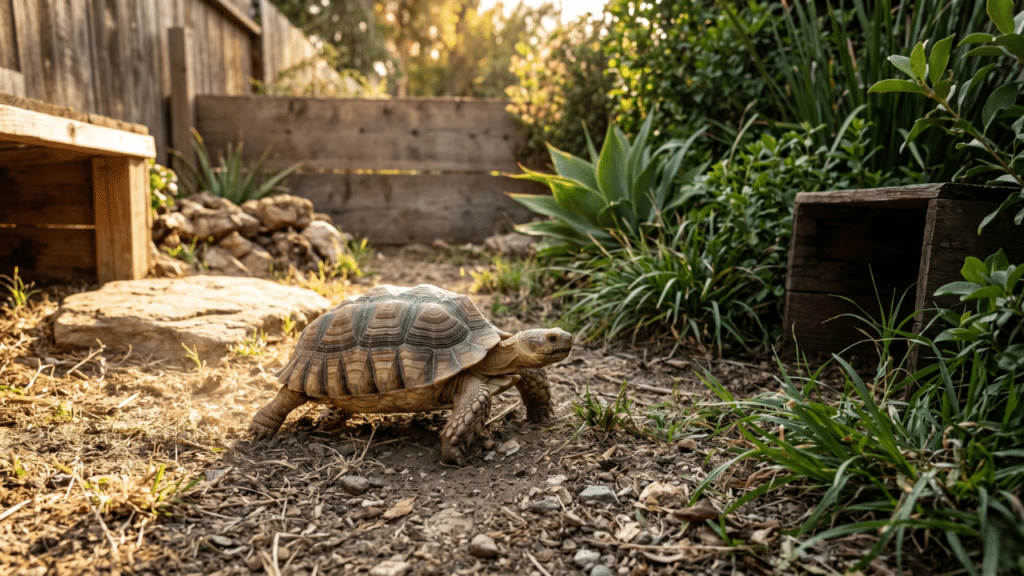
Sulcata Tortoise Temperature and Humidity Quick-Reference Targets
Use this table as your day-to-day management reference. All temperature figures are measured at tortoise level — not at the height of the heat source or the enclosure wall.
| Zone / Area | Hatchling | Juvenile | Adult | Humidity Target |
|---|---|---|---|---|
| Basking spot (surface) | 95–100°F | 95–100°F | 100–105°F | 30–40% (dry surface) |
| Ambient warm side | 85–90°F | 82–88°F | 80–85°F | 40–55% |
| Ambient cool side | 75–80°F | 74–78°F | 70–80°F | 40–55% |
| Damp hide (interior) | 78–82°F | 76–80°F | 74–78°F | 70–80% |
| Nighttime minimum (enclosure) | 70°F min | 68°F min | 60°F min | 40–55% |
| Outdoor ambient (active season) | 75°F+ | 72°F+ | 65°F+ | Ambient — shade available |
A few critical notes on using this table. Basking spot temperature should be verified with an infrared thermometer gun aimed at the substrate surface directly under the heat source — not estimated from the heat source’s position or the ambient air temperature. The damp hide interior should feel measurably cooler and noticeably more humid than the main enclosure floor; this contrast is functional, not aesthetic. And nighttime minimum temperatures are lower for adults than for hatchlings and juveniles because young tortoises have less thermal mass and are less able to buffer temperature drops safely.
Temperature: How to Set Up and Maintain the Thermal Gradient
The Basking Zone
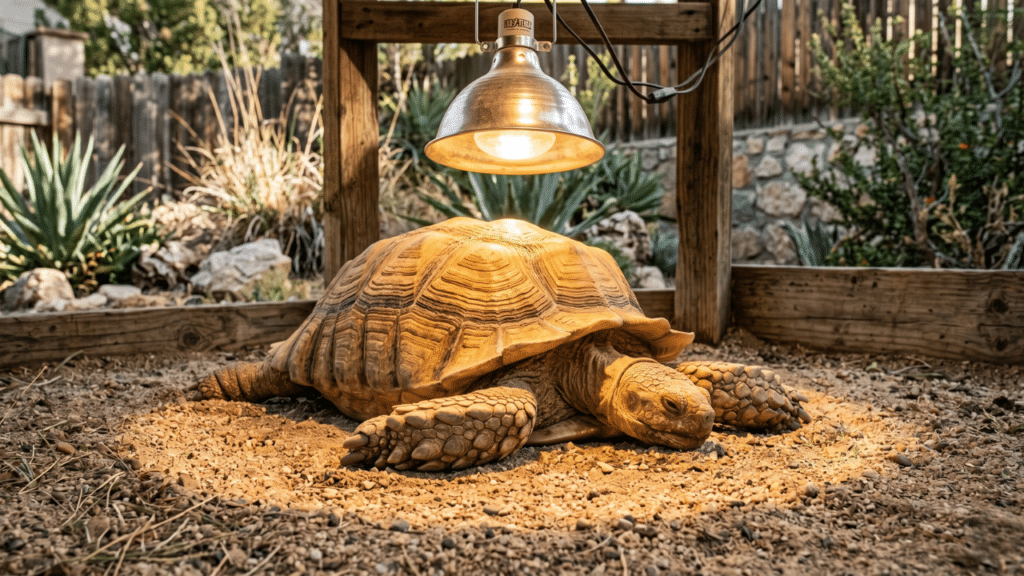
The basking spot is the hottest point in the enclosure and the most functionally important. It needs to reach 100–105°F at substrate level for adults and 95–100°F for hatchlings and juveniles. This temperature drives active basking behavior, vitamin D3 synthesis in the skin (which is essential for calcium metabolism regardless of how well you supplement), and the body temperature needed for efficient digestion after feeding.
Flat rocks or slate tiles placed under the basking lamp increase thermal mass at the surface — they absorb and radiate heat, extending the effective warmth of the basking spot and giving the tortoise a warm surface to press against, which transfers heat more efficiently than warm air alone. This is particularly useful in enclosures where the ambient air temperature makes it difficult to reach adequate basking surface temperatures with a single bulb.
The Thermal Gradient
The space between the basking spot and the cool end of the enclosure is where behavioral thermoregulation happens. A sulcata moving from 100°F basking to 75°F shade in the same enclosure is doing the same thing it would do in the wild — shuttling between microhabitats to maintain the specific body temperature each activity requires. An enclosure with uniform temperature throughout removes that ability entirely, forcing the tortoise to exist at whatever the ambient happens to be.
For the gradient to function correctly, the cool end needs to actually be cool — not just slightly less warm than the basking spot. A 15–25°F temperature differential between the basking zone and the cool end is the minimum for meaningful thermoregulation. In a small enclosure where the whole space heats up uniformly, the tortoise has no ability to cool down, which causes thermal stress even if the basking temperature is technically correct.
Nighttime Temperatures
Nighttime temperature drops are natural and beneficial for sulcata tortoises. Adults in outdoor enclosures in appropriate climates can tolerate temperatures into the low 60s°F overnight without harm. Hatchlings and juveniles should not go below 70°F overnight — they lack the thermal mass to buffer cold safely and are more vulnerable to the respiratory problems that develop from repeated cold exposure.
For indoor enclosures, ceramic heat emitters (CHE) on a thermostat are the standard overnight heat source — they produce heat without light, which would disrupt the tortoise’s natural photoperiod. Radiant heat panels in an insulated shelter work well for outdoor tortoise houses. Any heating device used overnight should be thermostat-controlled, not left to run at full output — uncontrolled overnight heat sources can produce temperatures that are too warm, which is its own problem.
Are You Starving Your Tortoise?
Save 10% on premium tortoise food and supplements from Tortoise Resource Center on Amazon now using code BUYNOWGET10
Sulcata Vitamin & Mineral Topper Supplement
30-Day Supply | 2 oz (56 g)
$24.99
Baby Sulcata Tortoise Superfood Powder
30-Day Supply | 2.5 oz (70.8 g) Bag
$24.99
Indoor vs. Outdoor Temperature Management
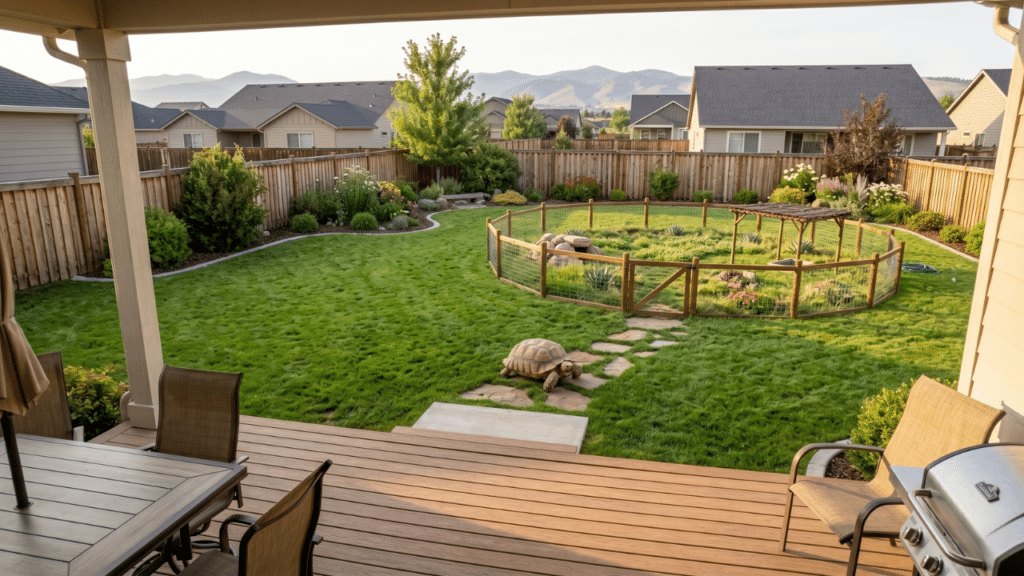
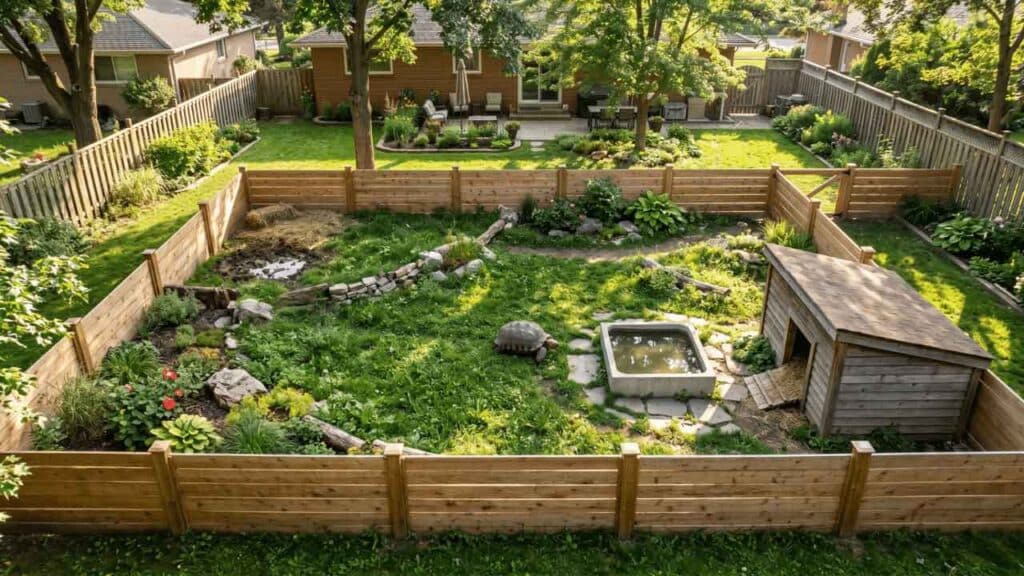
Outdoor sulcata tortoise temperature management is substantially simpler in warm climates — the sun provides the basking heat, natural shade provides the cool end, and the thermal gradient establishes itself across the enclosure. The primary active management need is a heated shelter for nights and cooler periods.
Indoor enclosures require deliberate engineering of every element of the thermal gradient. One end of the enclosure gets a basking heat source (mercury vapor bulb, halogen basking lamp, or deep-heat projector); the other end is left unheated and relies on ambient room temperature for the cool zone. The enclosure should be large enough that the cool end genuinely cools — in a small enclosure, heat radiates to every corner and the gradient collapses.
Seasonal Temperature Management for Outdoor Keepers
Owners in seasonal climates need a temperature transition plan for both spring and autumn. In spring, begin transitioning the tortoise to outdoor time when daytime temperatures are consistently above 65°F and nighttime lows are reliably above 55°F for adults, 65°F for juveniles. Don’t rush the transition based on calendar date — use actual temperature readings.
In autumn, monitor overnight lows and have the heated shelter operational before temperatures drop below 60°F overnight consistently. A tortoise caught in an inadequately heated shelter during an unexpected cold snap is at real risk. Checking the weather forecast and having the heating infrastructure ready before it’s needed — not the night of the first cold front — is the correct approach.
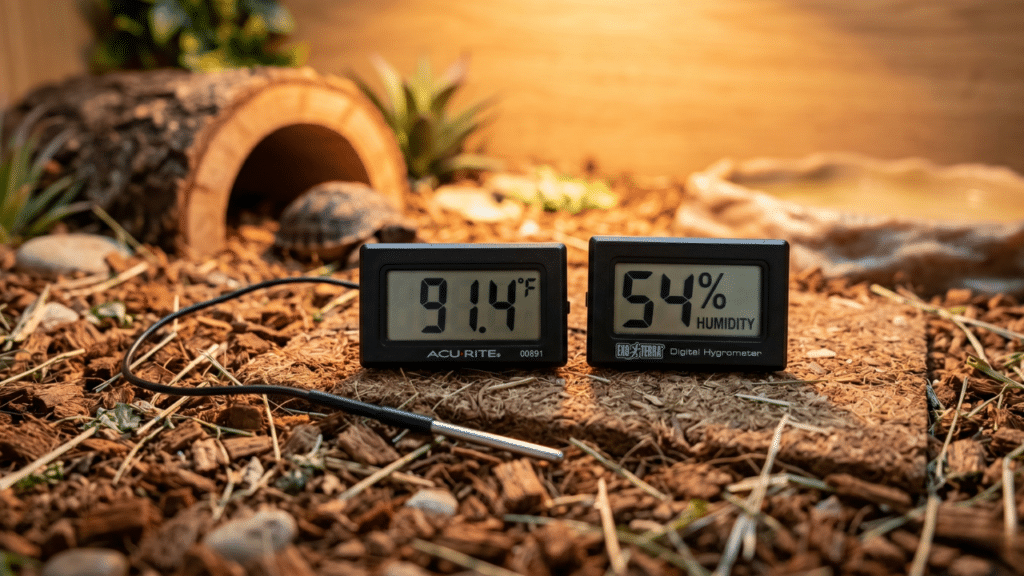
Humidity: The Paradox Most Owners Get Wrong
The most common humidity mistake in sulcata care is applying a single humidity target to the entire enclosure. The correct approach is a humidity gradient that mirrors what a burrow system provides in the wild: dry ambient surface, moist retreat.
Ambient Enclosure Humidity
The main enclosure surface — the area where the tortoise spends its active hours, forages, and basks — should be kept at 40–55% relative humidity. Higher than this on a sustained basis creates the conditions for respiratory infections, fungal growth in the substrate, and shell rot in more severe cases. Good enclosure ventilation is the primary tool for keeping ambient humidity in range — this is why open-topped or well-vented enclosure designs outperform sealed glass tanks for sulcata temperature and humidity management.
Surface moisture from water dishes, misting, or recent soaking should be allowed to dry before the next day. The substrate surface should feel dry to the touch during the tortoise’s active hours. If substrate is consistently staying damp, increase ventilation, reduce water dish size (smaller surface area means less evaporation into the enclosure), or assess drainage in outdoor setups.
The Damp Hide: The Most Important Humidity Element
Every sulcata tortoise enclosure — indoor or outdoor — needs at least one damp hide. This is the humidity microclimate that substitutes for the burrow environment, and it serves functions that dry-side humidity cannot: it provides the moisture contact that prevents dehydration in hatchlings and juveniles, it creates the cooler-damper retreat that supports natural activity rhythms, and it is directly linked to reducing shell pyramiding in growing tortoises.
A correctly set up damp hide feels distinctly different from the main enclosure when you put your hand inside. The substrate should be lightly damp — not wet, not soggy — and the interior temperature should be several degrees cooler than the ambient enclosure. This thermal-humidity contrast is the point: the tortoise is seeking a specific microclimate, not just any enclosed space.
To maintain it: use the same sandy-loam substrate as the main enclosure, lightly misted or hand-moistened every 2–3 days. The moisture should penetrate 2–3 inches deep; the surface can be slightly damp but should never feel wet. If you see condensation on the interior walls of the hide, it’s too wet — reduce the moisture and increase the ventilation of the hide opening slightly.
Hatchlings and Juveniles: Higher Humidity Priority
Young sulcata tortoises are significantly more prone to dehydration than adults and require more active humidity management. The damp hide is not optional for hatchlings — it is essential. Hatchlings kept in a uniformly dry enclosure without a humid retreat develop dehydration symptoms that compound quickly: sunken eyes, dry flaky skin, reluctance to eat, and eventually kidney stress.
Supplemental soaking 2–3 times per week in a shallow lukewarm bath (85–90°F water, shallow enough that the tortoise’s head clears the surface easily) is the most reliable way to maintain hydration in hatchlings and young juveniles alongside the damp hide. As the tortoise grows and develops better hydration management, soaking frequency can be reduced, but the damp hide remains important throughout the juvenile stage.
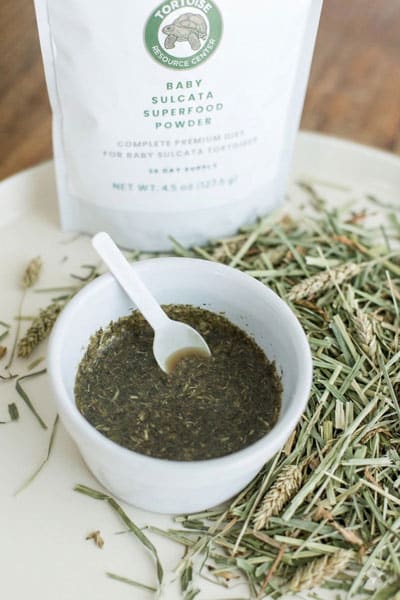
Keeping juveniles well-hydrated also directly supports nutrient absorption. Our Baby Sulcata Superfood Powder (2.5 oz and 4.5 oz sizes) and Tortoise Calcium Topper work most effectively when the tortoise is properly hydrated — dehydration impairs gut motility and reduces the efficiency with which minerals are absorbed, making correct temperature and humidity a prerequisite for getting full value from correct supplementation.
How Temperature and Humidity Connect to Shell Health and Nutrition
The link between sulcata tortoise temperature and humidity management and shell quality is more direct than most owners realize.
Shell pyramiding — the raised, irregular scute development that is a permanent marker of incorrect early care — has two primary drivers: excess dietary protein and inadequate ambient humidity during the juvenile growth phase. The two interact: a juvenile kept in a uniformly dry enclosure without damp hide access is under chronic mild dehydration stress, which affects how the shell scutes calcify as they grow. Combined with a diet even slightly too high in protein, the conditions for pyramiding are established within the first year.
Temperature directly affects calcium metabolism through its role in vitamin D3 synthesis. A tortoise that cannot reach a genuine basking temperature of 95–100°F cannot synthesize adequate D3 regardless of UVB exposure duration — the biochemical process is temperature-dependent. Insufficient D3 means calcium cannot be properly absorbed from food or supplements, leading to softer shell, reduced bone density, and metabolic bone disease over time. This is why correct basking temperature and quality UVB are prerequisites for supplementation to work — not substitutes for it.
For adults, our Adult Sulcata Superfood and Vitamin and Mineral Topper provide the trace mineral and vitamin support that underpins shell and bone maintenance across the full adult life — but they operate most effectively in a tortoise that is correctly thermoregulating, not one living in suboptimal thermal conditions. For juveniles making the growth-stage transition, our Juvenile Sulcata Superfood and Tortoise Daily Multivitamin Supplement address the nutritional side of the same equation. Use code BUYNOWGET10 at checkout on Amazon to save 10%.
Measuring Temperature and Humidity Correctly
Inaccurate measurement is a more common problem than owners realize, and it leads to confident but incorrect conclusions about whether conditions are correct.
Temperature Measurement
An infrared thermometer gun (temperature gun) is the most practical tool for measuring basking spot surface temperature — point it at the substrate surface directly under the heat source, not at the air above it. Air temperature and surface temperature can differ by 10°F or more under a focused heat lamp, and it’s the surface temperature that the tortoise experiences when basking.
Digital probe thermometers give accurate ambient air temperature readings at tortoise level and can be left in place for continuous monitoring. Place one probe at the warm end and one at the cool end to verify the gradient. Stick-on dial thermometers affixed to enclosure walls measure wall temperature, not the air at tortoise level — they are consistently inaccurate for this application and should not be used as primary temperature verification.
Humidity Measurement
A digital hygrometer with a probe gives reliable readings. Position the probe at tortoise level in the ambient zone of the enclosure — not inside the damp hide (which will read higher by design) and not pressed against an enclosure wall. Check readings at multiple times of day: enclosure humidity fluctuates with ambient room conditions, watering cycles, and the tortoise’s own movement.
For the damp hide, don’t rely on a reading to assess moisture level — use your hand. The substrate inside the hide should feel cool and lightly damp when you press a finger into it. This tactile check is more reliable than any instrument for assessing whether the hide microclimate is correct.
Troubleshooting Common Sulcata Tortoise Temperature and Humidity Problems
The table below covers the most common temperature and humidity problems keepers encounter, the signs that indicate each problem, and how to correct it.
| Problem | Signs to Watch For | Fix |
|---|---|---|
| Basking spot too cool | Tortoise inactive, poor appetite, slow digestion | Move heat source closer; add thermal mass (flat rocks) under basking lamp; check bulb wattage and thermostat calibration |
| Ambient too cold overnight | Lethargic in morning; slow to warm up; respiratory symptoms over time | Add radiant heat panel in shelter on thermostat; insulate shelter walls; check for drafts at enclosure base |
| Enclosure too hot (no escape) | Tortoise presses against walls; gaping mouth; lethargy; refuses to bask | Ensure cool zone is genuinely cool; add shade; increase ventilation; check thermostat calibration |
| Ambient humidity too high | Soft substrate surface; condensation on walls; repeated respiratory infections | Increase ventilation; remove standing water; reduce substrate moisture; raise enclosure off cold floor |
| No damp hide / hide too dry | Dehydration signs; excessive soaking in water dish; pyramiding in juveniles | Add or re-moisten damp hide substrate; hide should feel distinctly cooler and damper than main enclosure |
| Outdoor temps dropping below safe range | Tortoise reluctant to move; seeking shelter early; cold to touch | Transition to heated shelter; add heat source inside tortoise house; monitor overnight temps closely |
Getting Sulcata Tortoise Temperature and Humidity Right: Final Summary
Correct sulcata tortoise temperature and humidity management comes down to a few core principles applied consistently. Provide a genuine thermal gradient — not uniform warmth — that allows the tortoise to self-regulate across a range of temperatures throughout the day. Maintain dry ambient conditions on the enclosure surface while providing a distinctly damp, cooler hide that substitutes for the burrow microclimate sulcatas evolved to use. Manage transitions between outdoor and indoor keeping, and between seasons, proactively rather than reactively. Measure accurately — at tortoise level, with appropriate instruments — rather than assuming conditions are correct.
When temperature and humidity are correct, digestion works properly, calcium metabolism functions as designed, the immune system operates at full capacity, and behavioral patterns are normal and engaged. These aren’t separate benefits — they’re the same biological system working correctly. Get the environment right, and the nutrition, supplementation, and care practices you layer on top of it work the way they’re designed to.