Ask five different people what belongs on a sulcata tortoise food list and you’ll get five different answers — leafy greens, mixed vegetables, a little fruit as a treat, pellets, whatever the pet store recommended. Some of that advice is harmless. Some of it quietly does serious damage that won’t appear for months or years.
Sulcatas are not generic pet tortoises. They evolved in one of the most nutrient-poor environments on the planet — the Sahel and southern Sahara — and their entire physiology is calibrated for that diet. Their gut bacteria, their kidneys, their slow metabolism: all of it is built around a food profile that looks almost nothing like what most owners actually provide. This sulcata tortoise food list covers every category with the ratios that actually matter, the foods that cause harm even when accepted happily, and the supplementation strategy that closes what fresh food alone can’t cover.
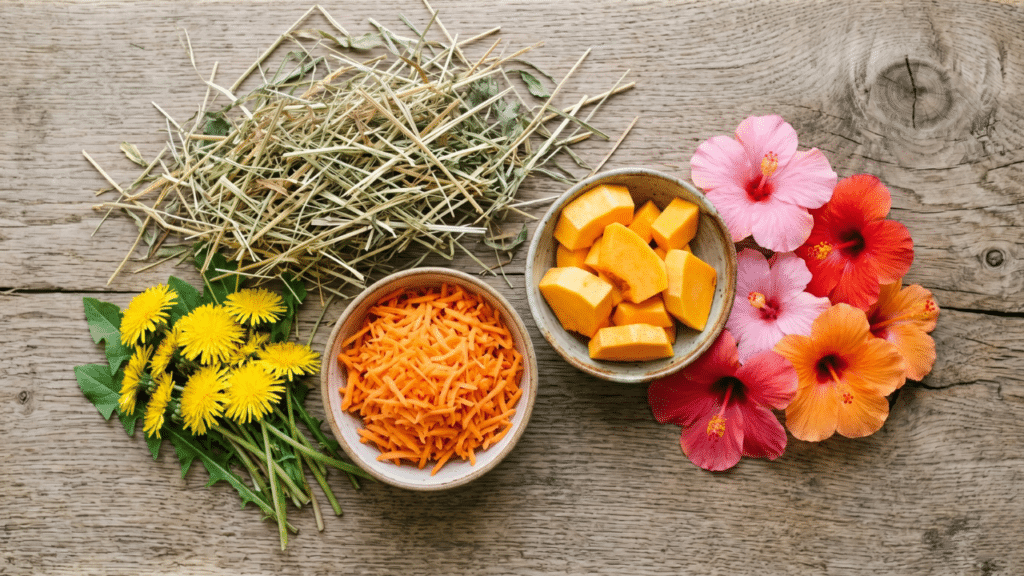
Sulcata Tortoise Food List: Quick Reference Table
Before diving into the detail on each category, use this table as your everyday reference guide for what to feed your sulcata tortoise and how often.
| Category | Foods | Frequency | Status |
|---|---|---|---|
| Grasses & Hay — STAPLE | Timothy, orchard, bermuda, meadow, oat, barley grass; quality grass hay | Daily / always available | ✅ Feed freely |
| Flowers, Weeds & Leaves | Hibiscus (flowers + leaves), dandelion (whole plant), pesticide-free rose petals, nasturtium, violet, plantain weed, chickweed | Several times/week | ✅ Excellent addition |
| Vegetables (limited) | Shredded carrots, butternut/acorn squash, dandelion greens, small amounts of romaine | 2–3× per week max | ⚠️ 5–10% of diet only |
| High-Protein Greens | Kale, turnip greens, mustard greens | Small amounts a few times/week | ⚠️ Use sparingly |
| Alfalfa | Alfalfa hay or pellets | Tiny amounts, juveniles only | ⚠️ Avoid for adults |
| Fruit | Any fruit whatsoever | Rarely or never; never for babies | 🚫 Almost never |
| Toxic Plants — NEVER | Avocado, rhubarb, tomato plant (green parts), potato plant, onions, garlic, chives, spinach (high oxalates) | Never | ❌ Never feed |
| High-Protein / Processed — NEVER | Meat, dairy, dog/cat food, beans, peas, soy, grains, seeds, bread, any processed food | Never | ❌ Never feed |
Why the Sulcata Tortoise Food List Looks So Different from Other Species
Understanding the biology behind this sulcata tortoise food list makes every rule easier to follow — and harder to rationalize around when your tortoise is eyeing your fruit bowl.
Sulcatas evolved eating tough, fibrous, low-protein grasses across a landscape that offered almost nothing else. To extract nutrition from that, they developed gut bacteria specialized for breaking down cellulose — the structural material in grass that most animals can’t digest at all. Their kidneys are adapted to very low protein throughput; excess protein produces uric acid that their systems cannot clear safely. And their slow metabolism is calibrated for high-volume, low-calorie plant matter, not the dense nutrition found in fruit or vegetables.
This is fundamentally different from forest tortoises like red-foots, which evolved in varied environments rich with fruit, fallen plant matter, and occasional protein. Feeding a sulcata like a red-foot — generous vegetables, fruit treats, high-protein variety — is asking a system built for one fuel type to run on another. The digestive system can’t process it correctly. The kidneys can’t clear excess protein. Gut bacteria get disrupted. And the consequences often don’t appear for months or years, which is precisely what makes incorrect sulcata feeding so dangerous: there’s no immediate alarm.
Grass and Hay: The Non-Negotiable Foundation (75–90% of Diet)
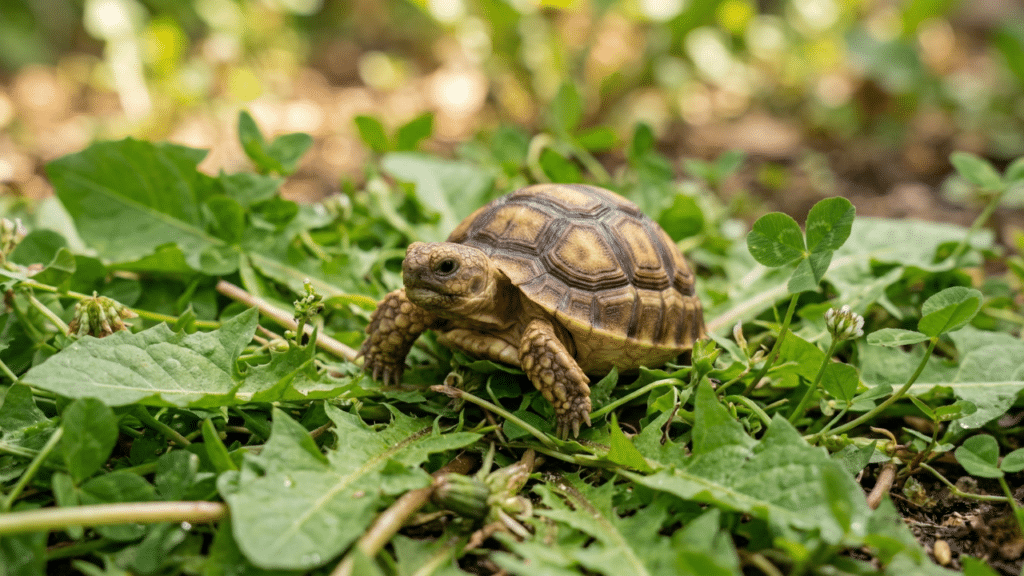
The single most important item on any sulcata tortoise food list is one that most pet stores undersell: grass and hay. This should make up 75–90% of everything your sulcata eats. Not as a guideline — as a requirement for long-term health.
Grass and hay are ideal for sulcatas because they’re high in fiber (essential for digestive function), low in moisture (matching the arid native environment), and low in protein (matching the kidney’s limited processing capacity). Most grasses are also low in oxalic acid, which interferes with calcium absorption when present in high quantities.
Best Grasses for Sulcata Tortoises
Timothy grass is the most widely available option and one of the strongest choices: excellent fiber, low protein, easy to source in bulk. Orchard grass has a slightly softer texture and tends to be accepted even by pickier eaters. Bermuda grass performs well in warm climates and makes an excellent grazing-lawn option. Meadow grass, oat grass, and barley grass round out a solid rotation.
If your sulcata has access to a pesticide-free lawn, direct grazing is ideal. It’s the most natural form of the correct diet, promotes natural movement, and provides variety that hay alone can’t match. Just confirm the lawn and any neighboring areas are completely free of herbicides, fertilizers, and pesticide treatments — even organic options can be toxic to tortoises.
Hay should be available at all times, even when fresh grass is accessible. It closely replicates wild diet and keeps digestion running as it should. Briefly soaking very dry hay in water helps sulcatas who struggle with texture, though most healthy adults eat dry hay without difficulty.
What About Alfalfa?
Alfalfa is widely marketed for tortoises and is easy to find in pet stores — but it’s a poor fit for most sulcatas, particularly adults. Despite looking like hay, alfalfa is significantly higher in both protein and calcium. For sulcatas, that triggers kidney stress and pushes growth at rates that lead to shell deformities. It can be offered in small amounts to juveniles during their fastest growth window, but should largely be avoided for adults.
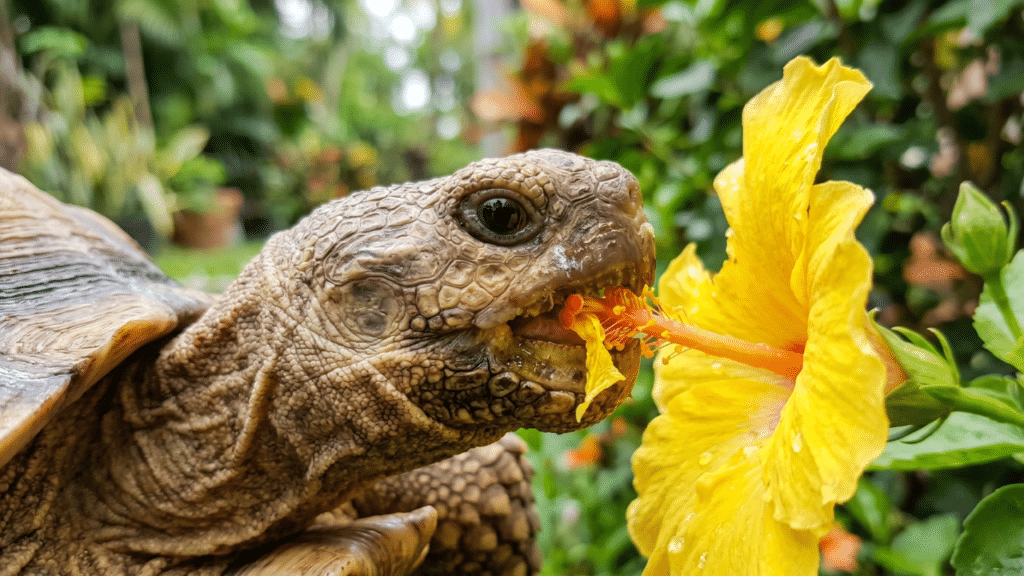
Flowers, Weeds, and Leaves: Excellent Additions to the Sulcata Food List
After grass, flowers, weeds, and appropriate leaves are some of the best items to add to your sulcata tortoise food list. They’re nutritionally valuable, sulcatas tend to be enthusiastic about them, and several are free if you have any outdoor space at all.
Hibiscus is a standout — both the flowers and the leaves are safe, and most sulcatas will abandon anything else for one. Dandelion (whole plant, including the stem and flowers) is a calcium-dense staple that can be fed regularly. Pesticide-free rose petals work well. Nasturtium flowers and leaves, violet flowers, plantain weed (not the fruit), and chickweed in moderation all make solid rotational additions.
The non-negotiable condition: anything from outdoors or your garden must be pesticide-free, herbicide-free, and fungicide-free. Even organic chemical treatments can be harmful to tortoises. If the source isn’t completely certain, don’t offer it. Growing hibiscus or nasturtium in untreated containers gives you a reliable, controlled supply year-round.
These foods supplement the grass foundation — they don’t replace it. A sulcata who would happily eat hibiscus all day still needs grass as the overwhelming majority of what goes in the enclosure.
Are You Starving Your Tortoise?
Save 10% on premium tortoise food and supplements from Tortoise Resource Center on Amazon now using code BUYNOWGET10
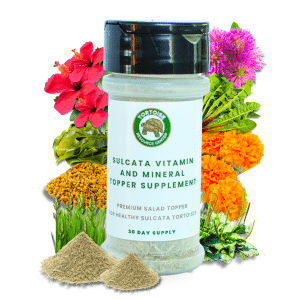
Sulcata Vitamin & Mineral Topper Supplement
30-Day Supply | 2 oz (56 g)
$24.99
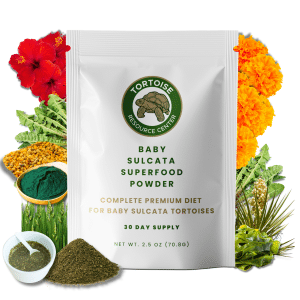
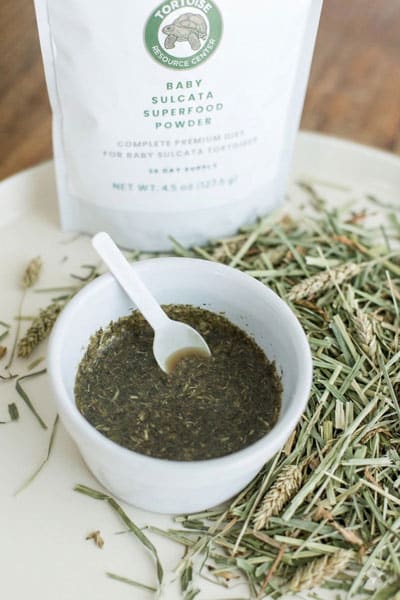
Baby Sulcata Tortoise Superfood Powder
30-Day Supply | 2.5 oz (70.8 g) Bag
$24.99
Vegetables: A Small Supporting Role on the Sulcata Food List (5–10% Maximum)
This is the entry on the sulcata tortoise food list that surprises most new owners. Vegetables — the first recommendation from pet stores and most generic care guides — should make up only 5–10% of total food intake. If grass and hay is the main course, vegetables are a small side dish. Not the feature.
Appropriate options in limited amounts: shredded carrots (good source of beta-carotene), butternut squash and acorn squash (raw or cooked), and dandelion greens — which can be fed more liberally than most other vegetables and are a genuinely useful calcium source. Small amounts of romaine or other lettuce won’t cause harm, though the nutritional return is minimal. Cabbage should appear only occasionally, as it contains goitrogens that affect thyroid function when consumed regularly.
The Leafy Greens Nuance Most Food Lists Skip
Kale, turnip greens, mustard greens, and similar dark leafy vegetables are commonly listed as safe sulcata foods — and they are, in the right amounts. The problem is that they contain significantly more protein than fresh grass or hay. Fed consistently in large quantities, they push protein intake above what sulcata kidneys can safely manage over time.
This is why ‘feed leafy greens’ is technically not wrong but seriously incomplete as sulcata feeding advice. A few times a week, in small portions, alongside a primarily grass-based diet: appropriate. As the bulk of daily meals: not appropriate. The correct sulcata tortoise food list treats leafy greens as a supplement to grass, not a substitute for it.
Fruit: Almost Never on the Sulcata Tortoise Food List
Fruit is not on the safe sulcata tortoise food list in any regular capacity. Your sulcata will likely eat it enthusiastically — that’s not the question. The question is whether it’s appropriate for their physiology, and the answer is no.
Sulcatas have gut bacteria that evolved specifically to break down cellulose from fibrous grasses. High-sugar foods like fruit disrupt those beneficial bacteria. When the disruption is significant enough, it interferes with digestion to the point of causing toxic shock syndrome — a condition that can be fatal. Unlike many species, sulcatas are particularly vulnerable to this because their gut flora is so specialized.
The risk is compounded by its delayed nature. A sulcata may eat strawberries or melon for months, appear perfectly healthy, and then develop progressive digestive problems that are difficult to trace back to the cause. By the time symptoms appear, the pattern has usually been entrenched long enough that owners don’t connect it to fruit feeding.
If fruit appears anywhere on your sulcata tortoise food list, treat it as a genuine rarity: a few small pieces a handful of times a year, maximum. For baby and juvenile sulcatas, remove it from the list entirely — their developing gut bacteria are even more vulnerable to disruption than an adult’s.
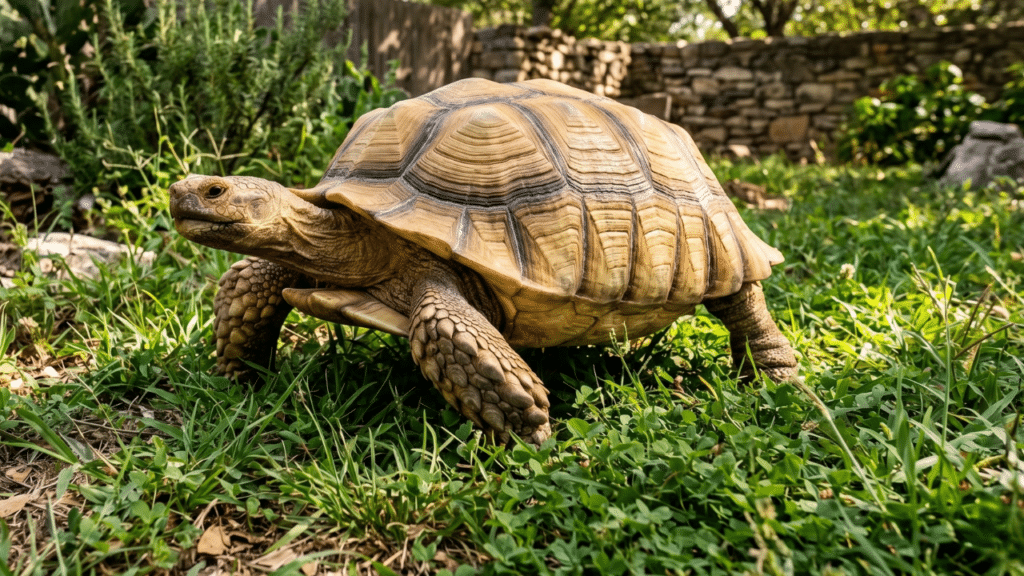
Foods That Should Never Appear on the Sulcata Tortoise Food List
Some items are predictable. Others catch experienced owners off guard. All of them need to stay out of the enclosure.
Protein-Overload Foods
Meat and dairy of any kind are an absolute no — sulcatas are strict herbivores with kidneys that cannot handle the protein load. Dog and cat food carries the same problem, plus nutrient ratios that are completely wrong for a tortoise. Beans, peas, soy, and legume products are high in protein regardless of how plant-based they appear. Grains and seeds — including bread, crackers, cereal, and any processed grain-based food — exceed safe protein levels and have no nutritional role in the correct sulcata tortoise food list.
Toxic and Harmful Plants
Avocado contains persin, which is highly toxic to reptiles. Rhubarb causes kidney damage. Tomato plants — particularly the green parts — contain solanine, a glycoalkaloid harmful to tortoises. Potato plants, especially any green portions or sprouts, carry similar risks. Onions, garlic, and chives cause anemia.
Spinach warrants specific attention because it’s widely considered a healthy vegetable. It is not directly toxic, but it’s very high in oxalic acid, which binds to calcium and blocks absorption. For a species that needs calcium more than almost any other nutrient, regularly feeding something that actively prevents calcium uptake undermines one of the core goals of a correct sulcata tortoise food list. The same concern applies to broccoli in large quantities.
Supplements: Closing the Gaps the Sulcata Food List Can’t Fill Alone
Even the most carefully constructed fresh food diet has nutritional gaps. Calcium is the most critical supplement at every life stage. Dust food with calcium powder — phosphorus-free — at every feeding for hatchlings and juveniles, scaling to 5–6 times per week for growing tortoises and 2–3 times per week for adults. Sulcatas get ample phosphorus from plant matter; adding more interferes with the calcium absorption you’re working to achieve.
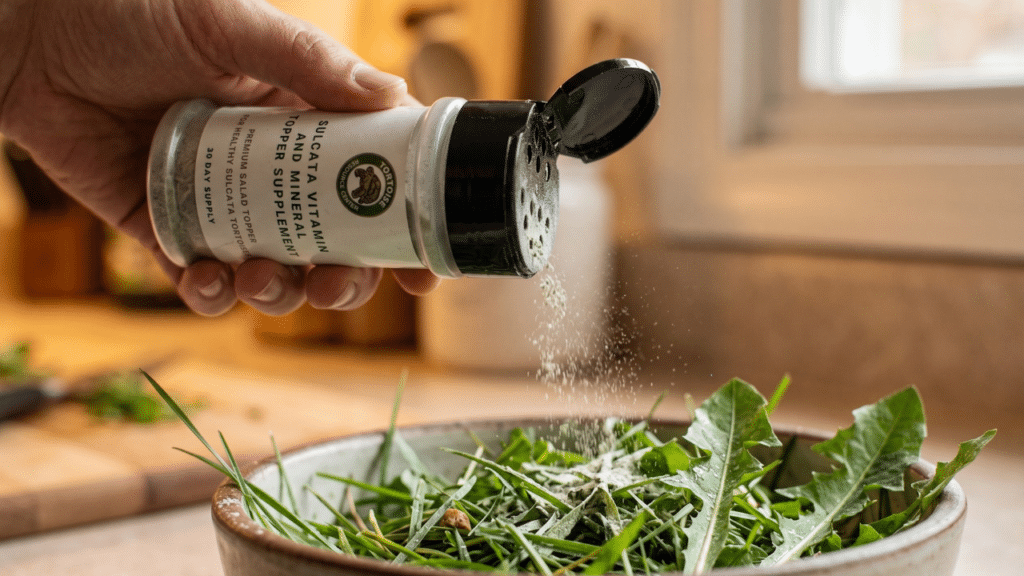
Getting the full spectrum of trace minerals consistently — selenium, zinc, magnesium, and others — is one of the harder parts of sulcata nutrition to nail with fresh food alone. Availability varies by season, grass variety, and regional soil content. Our Vitamin and Mineral Topper is formulated specifically for desert tortoise species to fill those gaps. A light dusting 1–2 times per week on fresh food covers what rotation and variety alone can’t reliably deliver.
For baby and juvenile sulcatas, where the protein-to-fiber-to-calcium ratio is especially critical during rapid early growth, our Baby Sulcata Superfood Powder takes the guesswork out of hitting correct nutritional targets at each developmental stage. It complements a grass-based diet rather than replacing it, and it provides the calibrated support that young tortoises need during the window where dietary mistakes have the most lasting impact on shell development and kidney health. Available in 2.5 oz and 4.5 oz sizes.
Vitamin D3 is worth a separate note. Sulcatas synthesize D3 through UVB exposure, which is essential for calcium absorption. Outdoor tortoises with genuine sunlight access typically need minimal D3 supplementation. Indoor tortoises relying on artificial UVB lighting may need more. Over-supplementing D3 causes toxicity, so follow product dosing carefully and consult a reptile vet if uncertain.
Scatter Feeding vs. Bowl Feeding
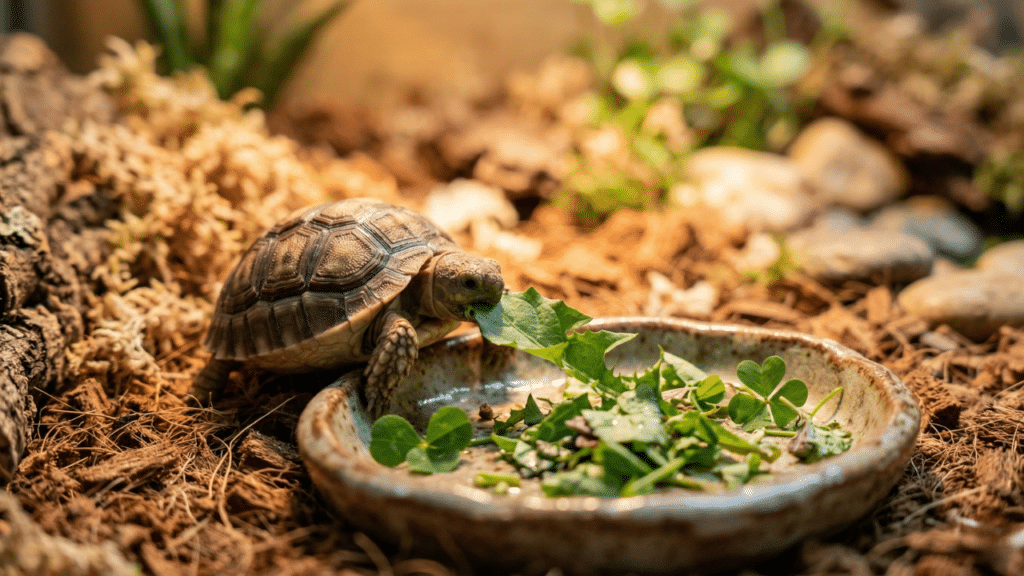
One practical habit that significantly improves a sulcata’s daily experience: scatter food around the enclosure rather than placing it all in one spot. In the wild, sulcatas spend most of their active hours foraging and moving. Scatter feeding mimics that pattern, promotes natural movement, encourages more thorough eating, and provides better behavioral engagement than walking to a fixed bowl. It’s a small change with meaningful impact on both physical and mental health.
Feeding Frequency by Age
Hatchlings and juveniles under 12 months should eat daily. They’re in a period of rapid growth and need consistent, correctly proportioned nutrition to build the bone density and shell integrity that will carry them for decades. Transitioning to 4–5 times per week is appropriate around 12–18 months. Healthy adult sulcatas do well on 3–4 feedings per week, though daily feeding is also fine for adults.
Appetite naturally decreases in cooler weather and during winter months. This is normal and not concerning as long as the tortoise maintains appropriate weight and remains alert when active. Continue offering food regularly through low-appetite periods — consistency matters even when intake varies.
What Happens When the Sulcata Tortoise Food List Goes Wrong
Understanding the consequences of poor diet reinforces why the sulcata tortoise food list looks the way it does. These aren’t arbitrary restrictions — each one maps to a real, documented health risk.
Shell pyramiding is one of the most visible signs of dietary problems. Diets too high in protein or overall calories drive rapid growth in young sulcatas that the shell structure can’t accommodate properly, producing the raised, bumpy scutes characteristic of pyramiding. This deformity is permanent and, in severe cases, affects long-term health and mobility.
Kidney damage from excess protein is silent until advanced. Uric acid — the metabolic byproduct of protein processing — accumulates in the bladder and organs when sulcata kidneys are consistently overloaded. The result is gout, organ damage, and a significantly shortened lifespan. By the time symptoms are externally visible, the damage is usually extensive.
Toxic shock syndrome from fruit or high-sugar foods disrupts the specialized gut bacteria sulcatas depend on for digesting fibrous plant matter. This is not a theoretical risk — it is a recognized cause of death in sulcatas whose owners didn’t realize the danger.
Calcium deficiency from inadequate supplementation, excess phosphorus, or high-oxalate foods like spinach leads to metabolic bone disease, shell softening, and developmental failures in young tortoises. These problems are preventable with a correctly constructed sulcata tortoise food list and consistent supplementation.
Final Thoughts: Building Your Sulcata’s Diet the Right Way
A correct sulcata tortoise food list is ultimately simple, even if the reasoning behind it takes time to absorb. Grass and hay at 75–90%, always available and always the foundation. Flowers, weeds, and safe leaves as nutritional bonuses and enrichment. Vegetables at a genuine 5–10% maximum — not as a staple. Fruit almost never, and never at all for babies. Calcium supplementation at every life stage. Trace minerals to fill what fresh food leaves uncovered.
The diet you provide today is building the tortoise your sulcata will be at 30, 50, and 80 years old. The health consequences of incorrect feeding accumulate quietly. Shell pyramiding is permanent. Kidney damage doesn’t announce itself until it’s advanced. Gut bacteria disruption from regular fruit feeding progresses slowly — until it doesn’t. Every correct feeding decision compounds in your tortoise’s favor over a lifetime that can span eight decades.
Getting this right is not complicated once the framework is clear. Follow the sulcata tortoise food list in this guide, supplement consistently, and give your tortoise the diet their biology was built for.To support your feeding routine, our Vitamin and Mineral Topper provides balanced trace mineral coverage formulated for desert tortoise species — 1–2 light dustings per week on fresh food. For hatchlings and juveniles, our Baby Sulcata Superfood Powder (2.5 oz and 4.5 oz sizes) is designed to complement a grass-based sulcata diet with the precise nutrition young tortoises need at each growth stage. Use code BUYNOWGET10 at checkout on Amazon to save 10% on either product.