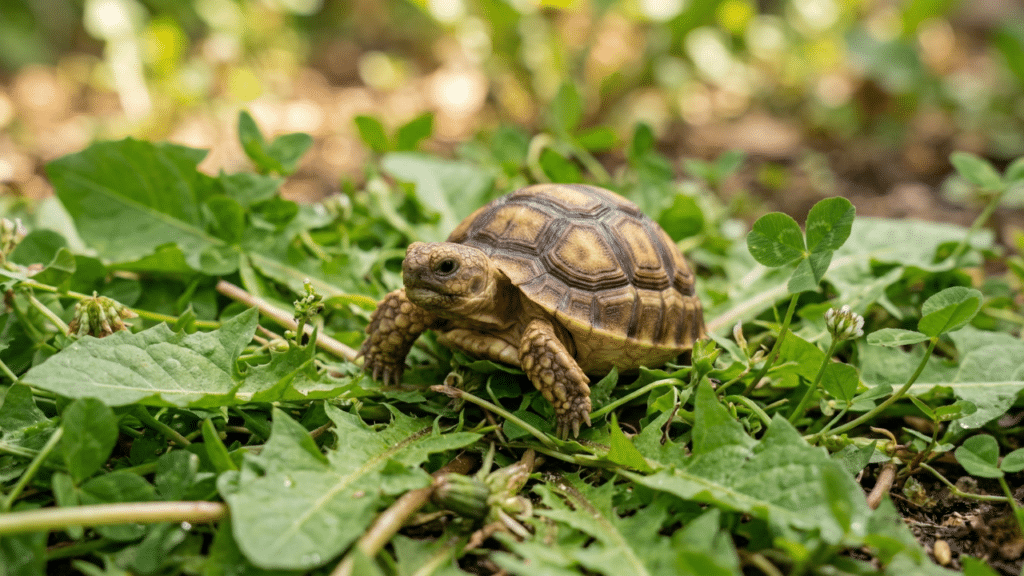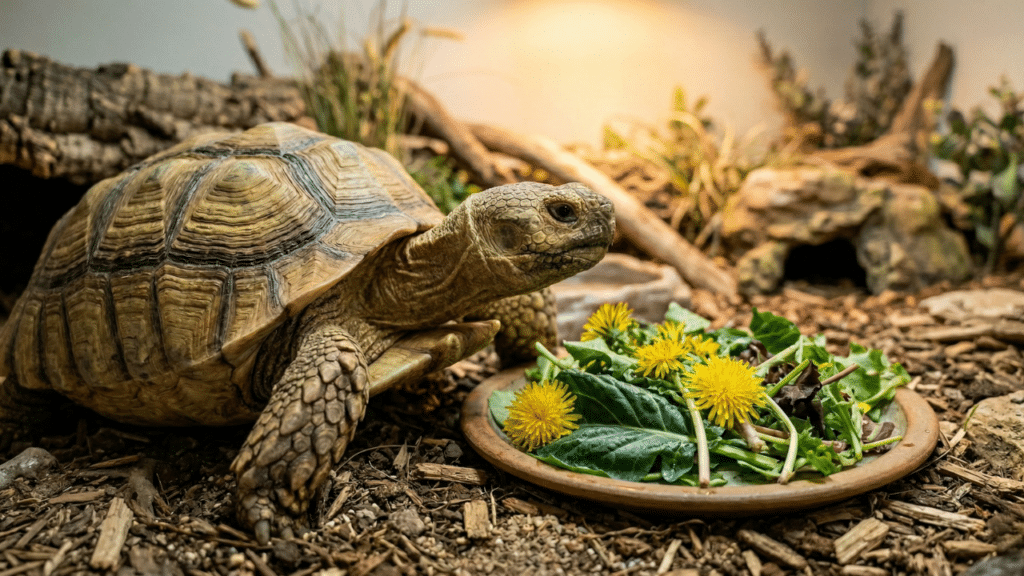
How much do baby sulcatas need to eat is one of the first questions new keepers search for — and it’s a good one. Baby sulcatas consume a surprisingly large proportion of their body weight daily, and getting the amount wrong in either direction has real developmental consequences. Too little, and growth stalls. Too much, and the rapid weight gain that looks like thriving is actually setting the stage for pyramiding, organ stress, and shell deformities.
But here’s the thing most feeding guides miss: amount is only half the equation. A hatchling sulcata eating the correct volume of the wrong foods isn’t well fed. And a tortoise eating slightly less than the textbook target but with excellent food quality and consistent temperature may be developing better than one that hits the numbers on paper but in suboptimal conditions.
This guide gives you the specific feeding amounts for every growth stage — including the practical visual methods that don’t require a scale every day — and then goes further, explaining the feeding mechanics that determine whether those amounts actually translate into healthy development. If you’re raising a baby sulcata, both parts matter.
Why Baby Sulcatas Need to Eat So Much More Than Adults
The metabolic gap between a hatchling sulcata and an adult is substantial enough that adult feeding guidelines are not just unhelpful for babies — they’re actively harmful if applied. An adult sulcata maintained on 2–4% of body weight daily is eating appropriately for an animal in maintenance mode. A hatchling needs 8–15% of body weight daily because it isn’t maintaining anything — it’s building everything.
In the first six months alone, a healthy baby sulcata can increase its body weight several times over. That growth represents new bone mineralizing, organ systems completing their development, digestive bacteria colonies establishing themselves in the hindgut, and shell keratin layering up scute by scute. Every gram of that new tissue requires amino acids, minerals, and energy — all of which come from food.
The digestive side of this matters too. Baby sulcatas haven’t yet developed the highly efficient hindgut fermentation system that allows adult sulcatas to extract maximum nutrition from fibrous, low-density plant matter. Their digestive efficiency is lower, which means they need more food volume to extract what they need. This is why the percentage targets for hatchlings appear high compared to adults — they’re compensating for both greater demand and lower extraction efficiency simultaneously.
How Much Do Baby Sulcatas Need to Eat: Stage-by-Stage Amounts
The table below gives weight-based targets for each growth stage alongside typical weight ranges and what to watch for. These are guidelines calibrated for healthy, active hatchlings in optimal temperature conditions — individual variation is normal, and the monitoring guidance in the later sections of this post matters as much as the numbers themselves.
| Stage | Age | Weight Range | Daily Target | Watch For |
|---|---|---|---|---|
| Hatchling | 0–3 months | 15–45 g | 10–15% body wt | Steady weekly gain; smooth scutes |
| Young Juvenile | 3–6 months | 45–150 g | 8–12% body wt | No pyramiding; active & alert |
| Older Juvenile | 6–12 months | 150–400 g | 6–10% body wt | Proportional shell width to length |
| Yearling | 12–18 months | 400–800 g | 4–8% body wt | Begin transition to every-other-day |
| Sub-Adult | 18–24 months | 800g–2 kg | 2–4% body wt | Shift diet ratio toward grasses |
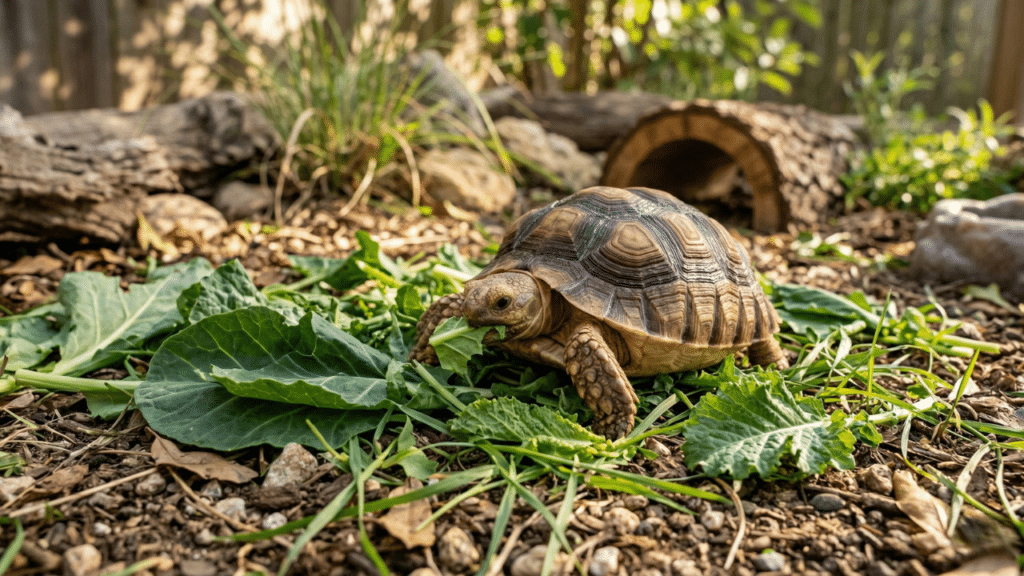
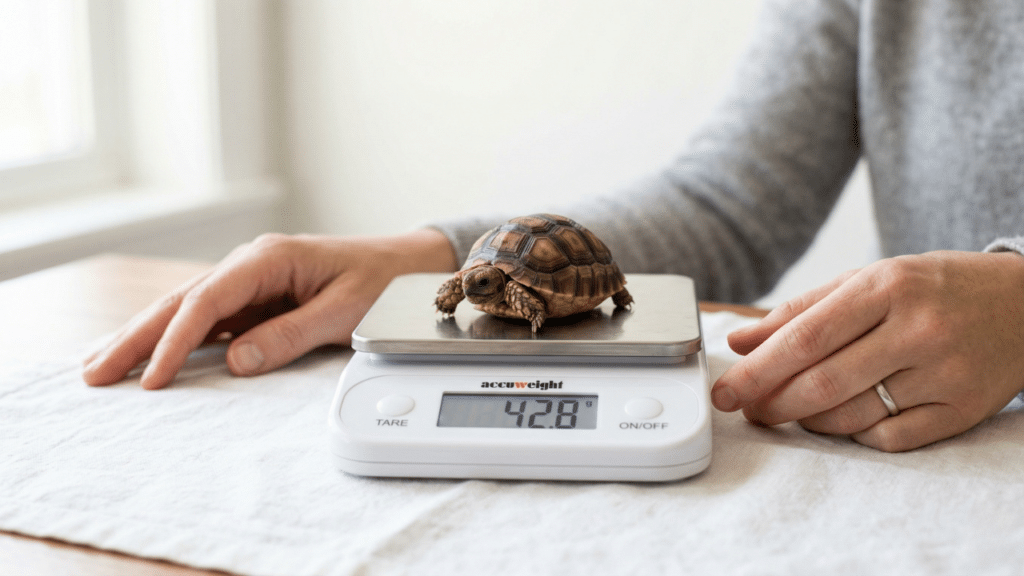
To put the hatchling numbers in concrete terms: a 30-gram hatchling eating 10% of body weight per day is consuming 3 grams of food — roughly the weight of a few dandelion leaves. That’s a small absolute amount that’s easy to undershoot accidentally. Weigh food for at least the first few weeks until you have a reliable visual sense of what the right portion looks like for your individual animal.
Visual Portion Methods for Everyday Feeding
Weighing food daily isn’t realistic for most keepers long-term, and it doesn’t need to be — once you’ve calibrated your eye with a few weeks of weighed portions, visual methods are accurate enough for daily practice. Here are three that work well for different setups:
The Shell Area Method
Offer food equal to approximately 1.5 times the surface area of your tortoise’s shell. This scales naturally as your tortoise grows and produces portions that are consistently in the right range for hatchlings through young juveniles. The 1.5x multiplier (rather than 1x) accounts for the higher metabolic needs of growing animals compared to what many keepers intuitively feel is “about right.”
The Dish Fill Method
Use a shallow feeding dish roughly twice the diameter of your tortoise’s shell. Fill it with food and expect your hatchling to eat 70–80% of what’s offered within 2–3 hours of active feeding time. If the dish is consistently empty within 30 minutes, increase portion size. If significant amounts remain uneaten after 3 hours at optimal temperature, reduce slightly and review temperature conditions — a tortoise that isn’t finishing food in a warm enclosure may be signaling a health issue rather than a preference.
The Depth Method
Pile food to a depth approximately equal to half the height of your tortoise’s shell. This is the quickest visual method for experienced keepers and works particularly well for leafy greens and mixed hay-based meals. It naturally produces larger portions as the tortoise grows, without requiring active adjustment.
Whichever method you use, offer food in the morning during or shortly after the basking period begins — digestion in sulcatas is temperature-dependent, and a tortoise that has warmed up to basking temperature will digest a morning meal far more effectively than one fed in a cold enclosure at night.
Are You Starving Your Tortoise?
Save 10% on premium tortoise food and supplements from Tortoise Resource Center on Amazon now using code BUYNOWGET10
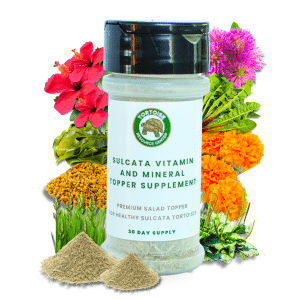
Sulcata Vitamin & Mineral Topper Supplement
30-Day Supply | 2 oz (56 g)
$24.99
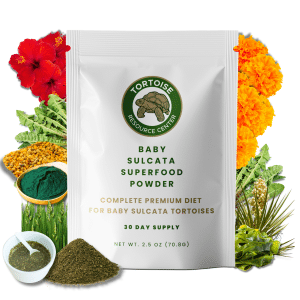
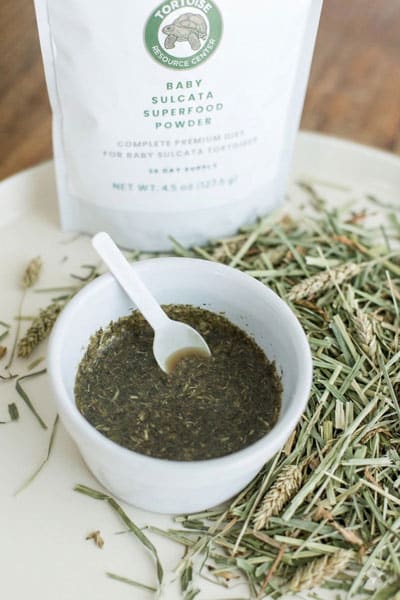
Baby Sulcata Tortoise Superfood Powder
30-Day Supply | 2.5 oz (70.8 g) Bag
$24.99
Feeding Frequency: Daily vs. Every Other Day
Daily feeding is the right approach for hatchlings under six months without exception. At this stage, they don’t have the metabolic reserves to skip days without developmental impact, and their gut microbiome is still establishing — consistent daily input supports that process.
The transition to every-other-day feeding is appropriate for most tortoises somewhere between 8 and 18 months, but the trigger should be body condition and growth rate, not age. A yearling that is still showing rapid growth, is underweight relative to length, or lives in a setup where temperatures run consistently cool may need daily feeding well past the 12-month mark. An 8-month-old that is growing steadily and has excellent body condition at optimal temperature may handle every-other-day feeding without any issues.
On off-days for older juveniles, grasses and hay should remain freely available even if the main meal isn’t offered. Sulcatas are natural grazers, and having something appropriate to nibble on throughout the day supports gut health and prevents the food-seeking behavior that can lead to substrate ingestion.
Why Food Quality Changes How Much You Need to Feed
This is the dimension that most feeding guides treat as secondary, but it has a direct bearing on how much food your hatchling actually needs and how well they use what they eat.
A sulcata eating high-quality, nutrient-dense food — young alfalfa, fresh dandelion, rotating leafy greens at peak freshness — extracts more usable nutrition from each gram than one eating mature, dry, or nutritionally depleted food. This matters practically: a hatchling with access to genuinely good food is less likely to show hunger behavior or stalled growth even at the lower end of the portion range, while one eating nutrient-poor food may show deficiency signs even while technically hitting the volume targets.
The Core Diet Composition
For baby sulcatas under 12 months, food composition should follow roughly this distribution:
- 50–60% grasses and hays — bermuda, timothy, orchard grass. Young, tender growth has meaningfully higher protein and nutrient density than mature dry hay.
- 30–35% dark leafy greens — dandelion greens (including flowers and stems), collard greens, mustard greens, turnip greens. Rotate regularly across the week.
- 10–15% varied vegetables — squash, bell peppers, prickly pear cactus. These contribute hydration and dietary diversity.
- Occasional safe flowers and plants — hibiscus, nasturtium, rose petals. These add enrichment and variety without nutritional compromise.
Avoid romaine lettuce and iceberg — these are high in water and very low in nutritional value, and they can cause loose stools. Spinach, beet greens, and Swiss chard are high in oxalates that bind calcium and should be excluded from hatchling diets entirely.
Supplementation as a Nutritional Accuracy Tool
Even a varied, well-chosen fresh diet has gaps — particularly for hatchlings cycling through the same available seasonal foods repeatedly. Calcium dusting addresses the most obvious gap, but the trace minerals, B vitamins, and micronutrients that support protein utilization, immune function, and shell keratin formation are harder to deliver consistently through fresh food alone.
How Temperature Directly Affects How Much Your Baby Sulcata Eats
Temperature and appetite in sulcatas are not loosely correlated — they are mechanistically linked. As ectotherms, sulcatas cannot initiate or sustain digestion without adequate environmental warmth. A hatchling that hasn’t reached basking temperature will not eat effectively, and even if it does eat, it won’t digest properly.
This creates a practical feeding rule that most guides bury in a footnote: adjust feeding amounts to match your enclosure’s temperature conditions, not the other way around.
- At consistent optimal basking temperatures of 95–100°F with a 75–80°F cool end, feed at the full recommended percentage for the growth stage.
- During cooler periods — seasonal temperature drops, temporary enclosure issues, or deliberate nighttime cooling — reduce portions by 20–30%. Food sitting in a cold gut doesn’t become nutrition; it becomes a bacterial problem.
- During the hottest summer months when outdoor temperatures are very high, some tortoises will reduce activity during the peak heat of the day and eat less. This is normal — shift feeding to early morning before temperatures peak.
If your tortoise is consistently leaving food uneaten and enclosure temperatures are correct, that’s a signal worth investigating — appetite suppression is often one of the first visible signs of a health issue in young sulcatas.
Reading Your Tortoise: Signs You’re Getting the Amount Right
Numbers give you a starting point. Your tortoise’s body condition, behavior, and development rate tell you whether those numbers are working for your individual animal. Here’s what healthy feeding looks like in practice:
Signs of Appropriate Feeding
- Steady weekly weight gain — consistent but not explosive. A hatchling gaining 1–3 grams per week is typically on track; doubling in size every few weeks is not.
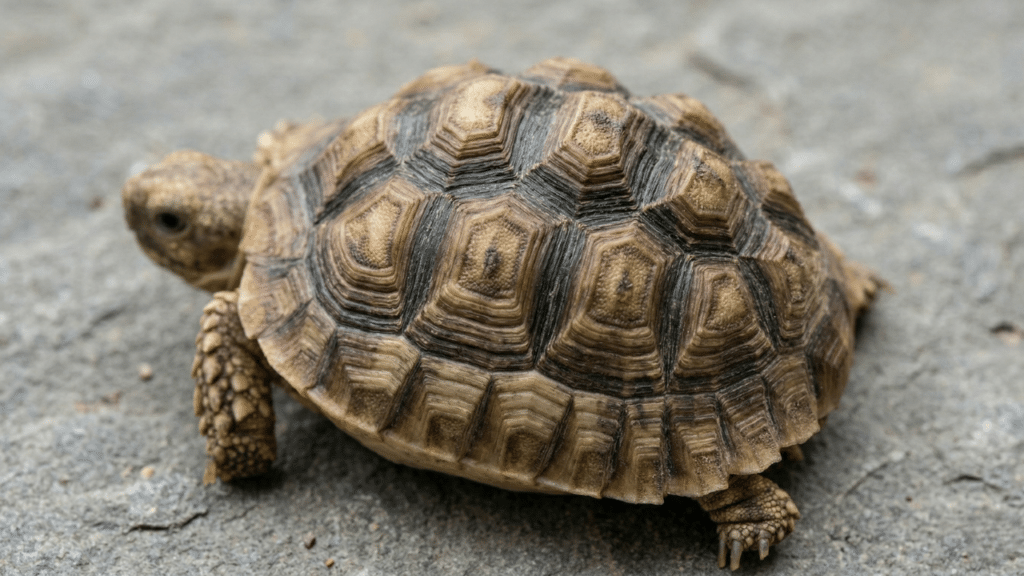
- Smooth, even scute growth with no raised or pyramid-shaped peaks forming at the edges. New shell growth should extend outward, not upward.
- Active, exploratory behavior during the warm part of the day. A well-fed hatchling at basking temperature is curious and moves around its enclosure regularly.
- Regular, well-formed waste. Frequency varies with feeding schedule, but consistency in appearance is a good sign.
- Alert response to food presentation — interest without desperation.
Signs of Overfeeding
- Rapid weight gain that outpaces shell and skeletal development — visible fat deposits around the neck, limbs, or tail, or a tortoise that looks “stuffed” when viewed from the side.
- Early pyramiding — raised, pointed scutes forming on a young hatchling. While humidity is also a factor, excessive caloric intake combined with rapid growth is a known driver.
- Lethargy that isn’t explained by temperature — an overfed tortoise may become sluggish and less exploratory as digestion dominates their physiology.
Signs of Underfeeding
- Weight plateau over two or more consecutive weeks without illness or temperature issues.
- Visible concavity to the shell when viewed from the side — a “pinched” appearance rather than a rounded one.
- Persistent food-seeking behavior, including attempts to eat substrate.
- Weak muscle tone — a hatchling that feels light or floppy relative to its shell size may not be getting adequate protein and caloric intake.
Calcium, Supplements, and Getting the Most from Every Meal
Feeding the right amount of the right foods is necessary but not sufficient for optimal baby sulcata development — what the body can actually absorb and use from that food depends on the supplement and lighting environment surrounding it.
Calcium is the most discussed supplement for sulcatas, and rightly so. Dust food with calcium (without D3) five to six times per week for hatchlings. Calcium with D3 should be used more sparingly — once or twice per week — because D3 is fat-soluble and accumulates. The critical dependency: dietary calcium is only as useful as the D3 status that determines how much gets absorbed, which in turn depends on UVB lighting quality. A hatchling with an aging or inadequate UVB bulb will absorb minimal calcium regardless of how consistently you dust.
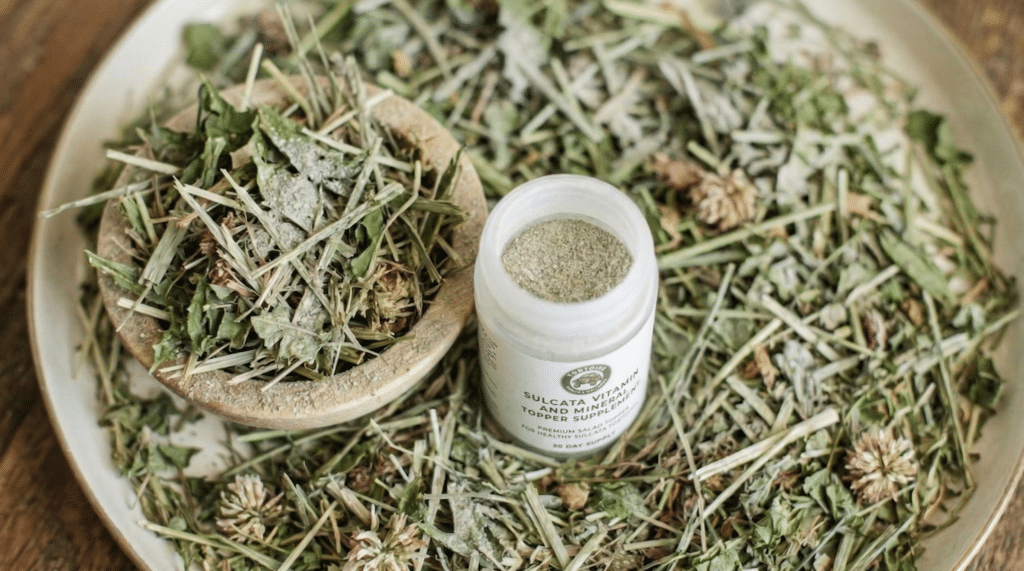
Beyond calcium, trace minerals including zinc, magnesium, and selenium — along with the B vitamins that act as coenzymes in amino acid metabolism — are essential to ensuring your hatchling actually uses the protein and calories in their food. The Vitamin and Mineral Topper covers these alongside calcium and vitamin D3, making it a practical complement to regular calcium dusting. A light application two to three times per week is sufficient.
Three Feeding Schedules That Work — and When to Use Each
Single Morning Meal
Offer the full daily portion in one feeding, timed to coincide with or shortly after the morning basking period begins. This is the most practical approach for most keepers and works well for the majority of baby sulcatas. The tortoise warms up, appetite is peak, and digestion benefits from a full warm day ahead of it.
Split Feeding
Divide the daily portion into two smaller meals, 4–6 hours apart. This approach suits very young hatchlings in the first 6–8 weeks of life, tortoises recovering from illness, or any animal that seems to eat enthusiastically for a short time and then lose interest before finishing a single larger portion. It requires more keeper involvement but can improve daily intake consistency in animals that fatigue quickly at feeding.
Continuous Availability
Leave appropriate foods — primarily grasses and hay — available throughout the day rather than a single timed feeding. This works best for keepers with outdoor setups or large indoor enclosures where food doesn’t spoil quickly, and it most closely replicates natural grazing behavior. Supplement it with a morning offering of fresh greens and vegetables. Avoid this approach with high-moisture foods in warm enclosures where spoilage happens quickly.
When Feeding Goes Wrong: What to Do
Tortoise Refuses Food for 2–3 Days
A healthy hatchling with good temperature, humidity, and lighting should eat consistently. Refusal for more than 48–72 hours in a young tortoise warrants prompt investigation — check that basking temperatures are genuinely reaching 95–100°F at the basking spot (not just nearby), that humidity isn’t excessively low, and that the tortoise isn’t showing other signs of illness. If temperatures are correct and refusal continues beyond 72 hours, contact a reptile veterinarian. Young tortoises do not have the reserves to fast safely.
Tortoise Eats Everything But Isn’t Growing
Good appetite with stalled growth almost always points to an environmental issue rather than a dietary one. The most common causes: basking temperatures that are lower than measured (thermometer placement matters — read at tortoise shell height in the basking zone), UVB output that has degraded without the bulb appearing dead, or a humidity environment so dry that the energy of growth is being partially redirected to stress responses. Review the full environment before increasing food volume.
Tortoise Is Growing Rapidly but Developing Pyramiding
Rapid growth combined with pyramiding is a sign that food volume or composition is pushing development faster than the shell can grow properly. Reduce high-protein foods such as alfalfa and clover, increase grass and hay proportion, and critically — review humidity. Pyramiding in a young hatchling is almost always partially a humidity failure, even when diet adjustment alone might slow it. Both need to be addressed simultaneously.
Transitioning Away from Baby Feeding Amounts
The feeding transition from juvenile to adult amounts is best measured in months, not weeks. Beginning around 18 months for most tortoises — though some may not be developmentally ready until 24 months — gradually reduce the percentage of body weight offered while shifting the diet composition further toward grasses and hay and away from the higher-protein foods that supported growth.
A useful pace: reduce by roughly one percentage point every 6–8 weeks while monitoring weight trend and body condition. Any sign of actual weight loss (not just slower gain, but loss) or marked decrease in activity signals the reduction is moving too quickly. Err on the side of slower transition — the consequences of remaining slightly above adult protein levels for a few extra months are far less serious than transitioning too quickly and compromising a tortoise still in an active development phase.
Getting Baby Sulcata Feeding Right Is a System, Not a Number
How much do baby sulcatas need to eat is the right question to start with — but the keepers whose animals develop best are the ones who understand that the answer includes food quality, temperature conditions, supplement consistency, and attentive monitoring alongside the portion amounts.
A baby sulcata eating the correct amount of high-quality, varied food in an enclosure with a proper thermal gradient, functioning UVB, and adequate humidity will almost always develop well. The feeding amount is the input; the development outcome is what you’re actually managing. Track both, and adjust when they diverge.
That attentiveness during the first 18 months — when every system is being built — is what makes the difference between a sulcata that arrives at adulthood with a smooth shell, strong bones, and robust health, and one that carries the visible and invisible marks of nutritional compromise for the rest of a very long life.
For nutritional support during the growth window, the Baby Sulcata Superfood Powder (4.5 oz) and 2.5 oz option are formulated specifically for the growth-phase sulcata, and the Vitamin and Mineral Topper rounds out the trace minerals that fresh food alone often misses. All are available on Amazon — use code BUYNOWGET10 to save 10%.