You noticed it one day — your sulcata’s shell isn’t smooth anymore. There are raised, pointed bumps forming on the scutes, and now you’re trying to figure out what went wrong and whether anything can be done about it. If that’s where you are right now, take a breath. Sulcata shell pyramiding is the most common serious condition affecting captive sulcatas, and the most misunderstood. The internet is full of single-factor explanations that lead well-meaning keepers to make one change and wonder why nothing improves.
The hard truth — and it’s worth stating clearly upfront — is that established pyramiding cannot be completely reversed. Once shell structures grow in pyramid formations, that keratin and bone structure is permanent. But that honest answer comes with something equally important: pyramiding is largely preventable, and if your tortoise already has it, a comprehensive approach can stop it from progressing, support healthier new growth, and protect long-term quality of life. The earlier you understand and act on all of the contributing factors, the better the outcome.
This post covers what sulcata shell pyramiding actually is at a structural level, the full picture of what causes it, the honest answer to whether it can be fixed, and a practical step-by-step action plan. The video below walks through the same content in around five minutes — the written sections go deeper on every point.
What Sulcata Shell Pyramiding Actually Is — and Why It Matters
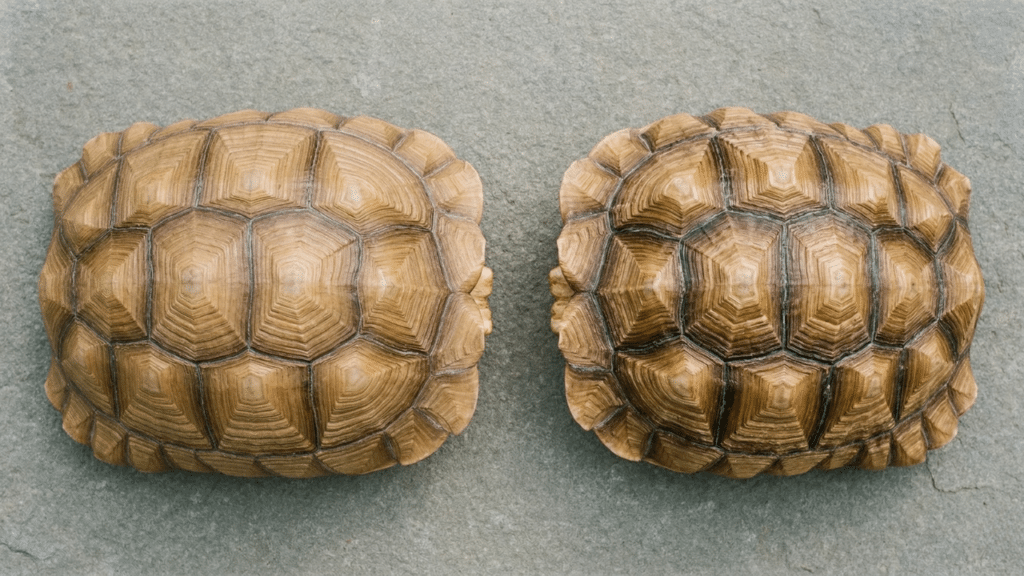
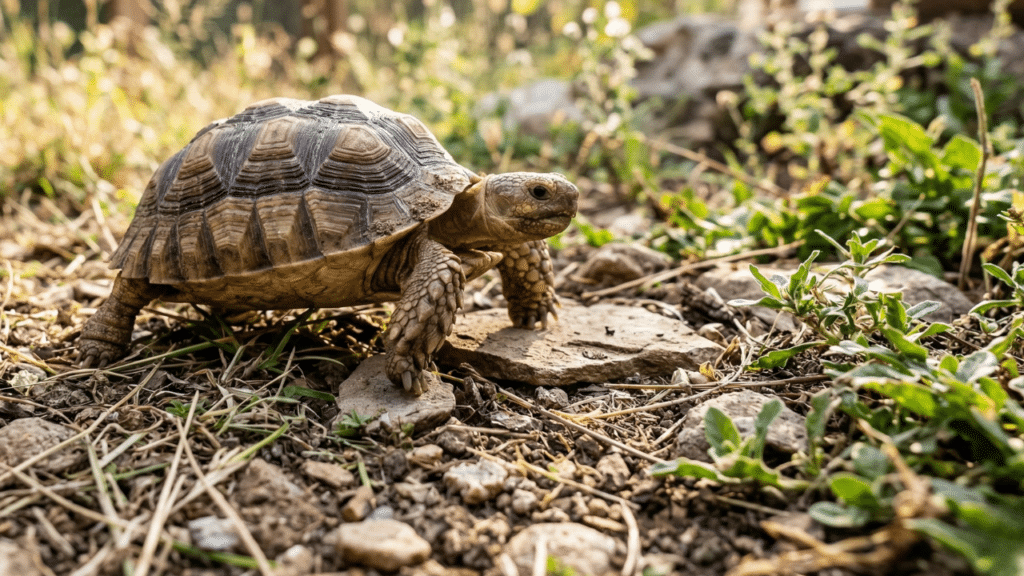
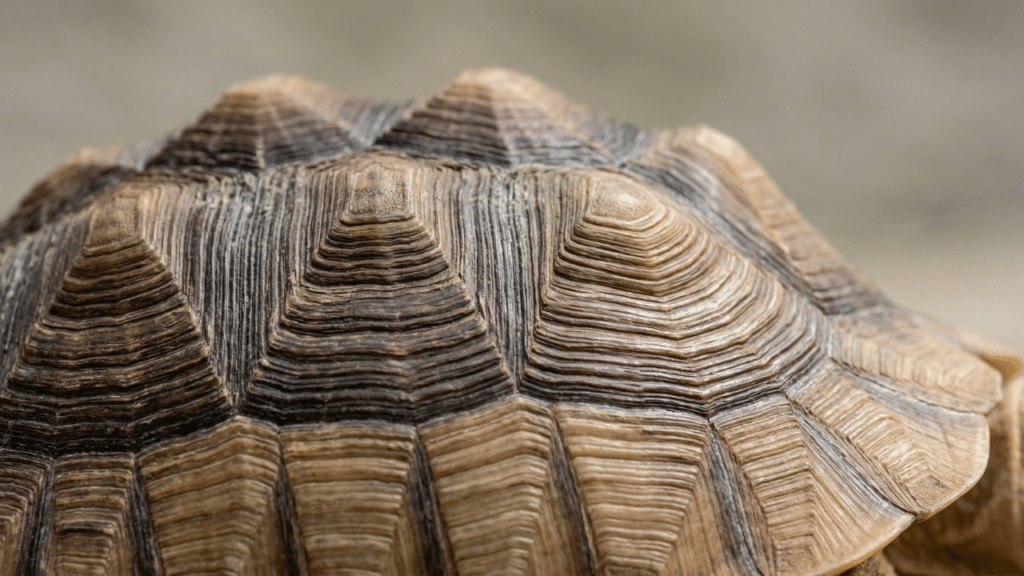
The shell is made up of individual sections called scutes. In a healthy sulcata, those scutes grow outward — relatively flat, with smooth, gently curved edges and even growth rings following the natural contours of each plate. In mild cases of pyramiding, the change is subtle: a slight raising of scute centers, minor irregularities in smoothness. In severe cases, the shell looks dramatically ridged and mountainous, with distinct cone or pyramid shapes rising from each scute.
Pyramiding almost always develops during the first 18 months of life, when shell growth is fastest and the tortoise is most developmentally vulnerable. Tortoises that develop pyramiding during this window carry the deformity for life, though the severity depends heavily on how quickly the underlying causes are identified and corrected. New pyramiding rarely develops in tortoises older than 18 to 24 months, but existing pyramiding can worsen if conditions remain poor — the shell continues growing throughout life, and poor conditions during any growth period can make existing deformities more pronounced.
One of the most important things to understand about sulcata shell pyramiding is that it is not cosmetic. It is a visible signal that something in the tortoise’s development went wrong — usually during that critical first 18 months. The deformity reflects real issues with bone formation, calcium metabolism, or growth rate. Severe pyramiding can affect internal organ positioning and mobility over time. This is why understanding and preventing it matters, and why managing it once present deserves serious ongoing attention.
What Actually Causes Sulcata Shell Pyramiding — The Full Picture
This is where most online advice gets it wrong. Sulcata shell pyramiding is not caused by one single thing. It is the result of multiple factors working together — and that is exactly why fixing only humidity, or only diet, often doesn’t fully work. You need to understand and address all of the contributing causes simultaneously.
| Cause | Impact Level | How It Contributes | Primary Fix |
|---|---|---|---|
| Low Humidity | Primary | Keratin layers don’t bond properly; grow unevenly upward instead of outward | 60–80% daytime humidity; humid hide; hygrometer at tortoise level |
| Rapid Growth / Overfeeding | High | Shell structure can’t keep pace with body growth — like building a wall too fast without letting mortar set | Reduce feeding frequency; prioritize grasses and weeds over dense foods |
| Poor Ca:P Ratios | High | High phosphorus blocks calcium absorption even with supplementation; undermines shell mineralization | Eliminate fruit, corn, and high-phosphorus foods; consistent calcium dusting |
| Inadequate Exercise | Moderate | Wild sulcatas walk miles daily; physical activity influences shell development; sedentary animals show abnormal growth patterns | Larger enclosure; varied terrain; supervised outdoor access |
| Temperature Inconsistency | Moderate | Fluctuating temps disrupt normal metabolism and development during growth periods | Reliable thermostat; 95–100°F basking, 75–80°F cool end consistently |
| Genetics | Minor | Some sulcatas have greater susceptibility; not a reason to ignore environment, but worth knowing | No fix; address all environmental factors more rigorously in susceptible animals |
Cause 1: Low Humidity — The Biggest Single Factor
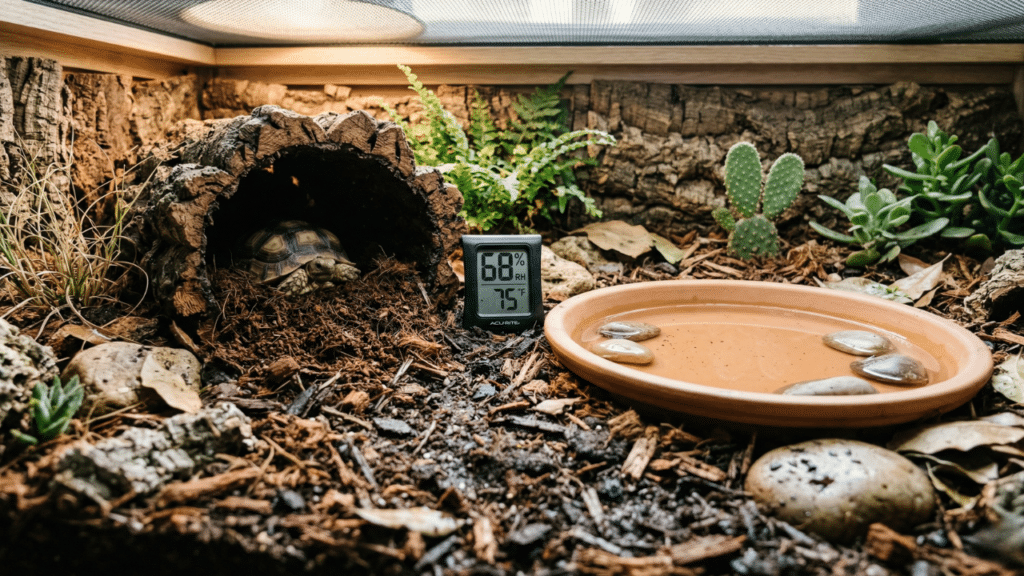
Sulcatas evolved in environments with seasonal humidity variation, including periods of significant moisture. When kept in consistently dry conditions — below 40 to 50 percent humidity — the shell’s keratin layers don’t bond properly during growth. Instead of forming smooth, integrated layers, they develop unevenly and create pyramid shapes. This is the mechanism that most single-factor advice addresses, and it is genuinely the most important factor. But it rarely operates alone, which is why fixing humidity in isolation often produces partial results.
The most common monitoring mistake: humidity measured at the top or sides of an enclosure can read significantly higher than at substrate level where the tortoise actually lives. Place your hygrometer at tortoise height — on the ground — for accurate readings.
Cause 2: Rapid Growth from Overfeeding
When a tortoise grows faster than its shell structure can properly develop, pyramiding results. Think of it like building a wall too fast without letting the mortar set — the structure forms before it can consolidate properly. This happens from feeding too much, too frequently, or relying on overly nutrient-dense foods that push rapid weight gain. The effect is compounded when combined with low humidity or calcium imbalances, which is why overfeeding and dry conditions together produce some of the most severe pyramiding seen in captive animals.
Steady, proportional growth is the goal — not rapid size increases. A hatchling gaining weight explosively is not thriving; it is at elevated risk.
Cause 3: Poor Calcium-to-Phosphorus Ratios
This is the hidden cause that most keepers miss. The issue isn’t simply whether you’re supplementing calcium — it’s whether phosphorus in the diet is blocking calcium from being absorbed. High-phosphorus foods like fruit, corn, and certain commercial foods can undermine calcium supplementation even when you’re applying it consistently. If a keeper is dusting food correctly but still feeding significant amounts of fruit daily, the calcium is largely wasted because the dietary phosphorus interferes with its absorption. The target ratio is 2:1 calcium to phosphorus or higher, and achieving it requires looking at the whole diet, not just what’s in the supplement jar.
Causes 4–6: Exercise, Temperature, and Genetics
Wild sulcatas walk miles daily across varied terrain. That physical activity — climbing, navigating obstacles, covering ground — influences how the shell develops. Captive animals in small, flat enclosures simply don’t receive this developmental input, and the absence shows up in shell growth over time. Adding varied terrain to the enclosure and providing supervised outdoor access when weather permits directly addresses this factor.
Temperature fluctuations during critical growth periods disrupt normal metabolism and development in ways that are less visible than humidity problems but equally real. Using a reliable thermostat — not just a lamp on a timer — to maintain consistent temperature gradients is part of a complete prevention or management plan.
Some sulcatas are genetically more prone to pyramiding than others. This is not an excuse to relax environmental controls — in fact, genetically susceptible animals need more rigorous management, not less. It is worth knowing, however, because it explains why two tortoises in apparently similar conditions can show different outcomes.
Are You Starving Your Tortoise?
Save 10% on premium tortoise food and supplements from Tortoise Resource Center on Amazon now using code BUYNOWGET10
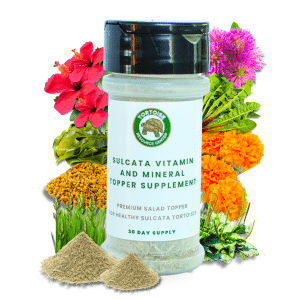
Sulcata Vitamin & Mineral Topper Supplement
30-Day Supply | 2 oz (56 g)
$24.99
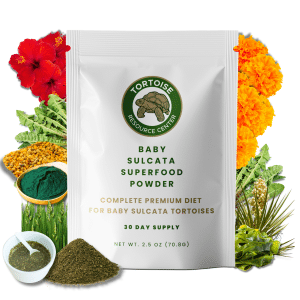
Baby Sulcata Tortoise Superfood Powder
30-Day Supply | 2.5 oz (70.8 g) Bag
$24.99
Can Sulcata Shell Pyramiding Be Fixed? The Honest Answer
This is the question every keeper with a pyramided tortoise wants answered, and it deserves a direct response rather than hedged reassurance.
Established pyramiding cannot be completely reversed. Once the shell has grown in pyramid formations, that structure is permanent. The keratin and bone that form the pyramid shapes will not remodel back to smooth. Any source telling you that better care will cure existing pyramiding is overstating what’s possible.
What is possible — and this matters a great deal — is everything else. With comprehensive care improvements, you can stop pyramiding from progressing further. You can help new growth come in more normally and smoothly at the outer edges of each scute. You can improve overall shell strength, density, and health. You can prevent the secondary problems that severe uncorrected pyramiding causes over time. And if the pyramiding is caught very early in a young tortoise, the contrast between older pyramided growth and newer healthier growth can become less visually pronounced as the tortoise continues developing.
The earlier you catch it and make changes, the better the outcome. This is why regular overhead shell photography from day one is one of the most practical things a sulcata keeper can do — it creates a record that makes early pyramiding visible before it becomes severe.
The Action Plan for Sulcata Shell Pyramiding: What to Do Now
If your tortoise has pyramiding, or if you want to prevent it in a young tortoise, address all of the following simultaneously. Single-factor fixes are the most common reason management attempts fail.
Step 1: Fix Humidity First
Get daytime enclosure humidity to 60–80%. This is the single most impactful change for most tortoises showing pyramiding. Use multiple humidity sources rather than relying on one: a large water dish, regular substrate misting, a dedicated humid hide filled with damp coco coir, and if needed, a room humidifier near the enclosure. Verify your readings with a hygrometer placed at ground level — not mounted on the wall at mid-height where readings are misleadingly higher than what the tortoise experiences.
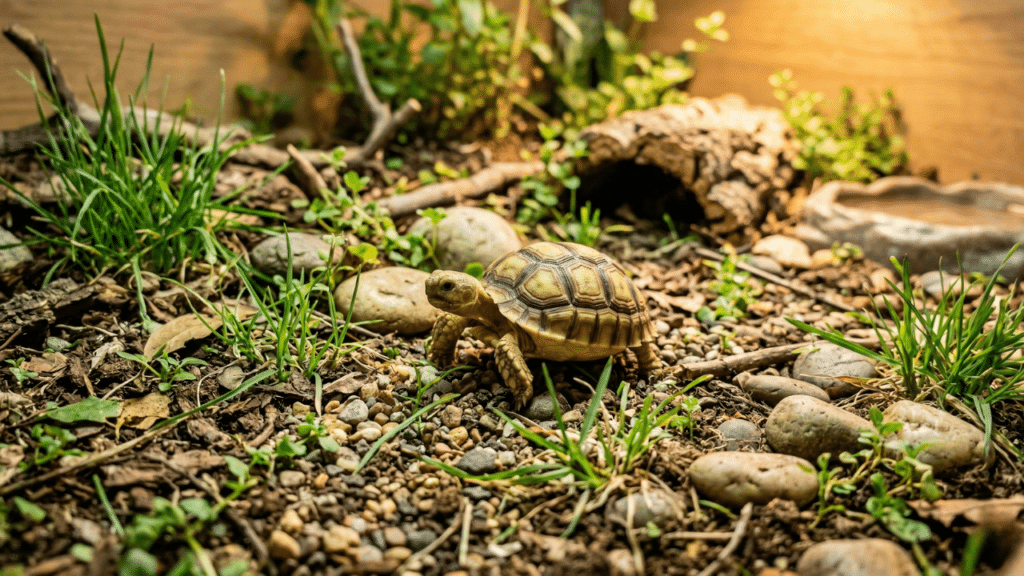
The humid hide deserves particular emphasis. It gives your tortoise the ability to regulate its own ambient moisture passively — retreating to absorb humidity when needed. This replicates how wild sulcata hatchlings spend much of their time in burrows where humidity is significantly higher than at the surface.
Step 2: Correct the Diet
If overfeeding has been a factor, reduce frequency — not to an extreme, but enough to slow the growth rate to a steady, proportional pace. Eliminate high-phosphorus foods: fruit should be gone or reduced to genuinely occasional treat quantities, and anything that isn’t primarily grasses, leafy greens, and appropriate weeds should be reconsidered.
Make calcium supplementation consistent and correctly calibrated: calcium without D3 five to six times per week for hatchlings and juveniles, calcium with D3 once or twice per week. Ensure your UVB lighting is functional — without adequate UVB, even consistent calcium supplementation is largely ineffective because D3 synthesis drives calcium absorption.
Alongside consistent calcium, the trace minerals that support bone density and shell keratin formation — zinc, magnesium, selenium — are often absent from basic calcium supplements. The Vitamin and Mineral Topper covers these alongside calcium and fat-soluble vitamins, making it a practical addition to a pyramiding management plan rather than something that needs to be assembled from multiple separate products. Light dusting two to three times per week on top of regular calcium supplementation. Use code BUYNOWGET10 for 10% off.
Step 3: Expand Space and Add Exercise Opportunities
If the enclosure is small and flat, that needs to change. This is a harder fix than adjusting humidity or diet, but it is a genuine contributing factor to pyramiding. Add gentle slopes, rocks to climb over or navigate around, substrate depth sufficient for digging behavior, and varied terrain that prompts natural movement patterns. When weather permits — consistently above 65–70°F — supervised outdoor access on natural ground provides developmental inputs that no indoor setup can fully replicate: unfiltered natural UV, varied walking surfaces, soil bacteria that contribute to gut microbiome health, and the stimulus of a genuinely varied environment.
Step 4: Stabilize Temperatures
Establish and maintain consistent temperature gradients using a reliable thermostat: 95–100°F in the basking zone, 75–80°F at the cool end, and nighttime drops to 70–75°F. A thermostat that responds to actual temperature rather than a timer maintains consistency through ambient temperature changes in the room that a lamp on a timer cannot account for. Check basking temperature with a probe thermometer or temperature gun at the surface of the basking spot at tortoise shell height — not ambient air temperature nearby.
Step 5: Get a Veterinary Assessment
If your tortoise is showing pyramiding — particularly a young tortoise or one where pyramiding has developed relatively quickly — a visit to a reptile veterinarian is worth scheduling. X-rays can assess bone structure and density. Blood panels can check calcium and phosphorus levels, kidney and liver function, and identify metabolic issues that aren’t visible externally. A vet can help you build a management plan calibrated to your specific tortoise’s situation rather than a general protocol, and can tell you whether what you’re seeing is mild and manageable or requires more active intervention.
Sulcata Shell Pyramiding Myths Worth Clearing Up
These five myths circulate widely in keeper communities and cause real harm by directing people toward incomplete or incorrect responses:
Myth 1: Pyramiding is just cosmetic
It is not. It reflects real developmental problems with bone formation, calcium metabolism, or growth rate. Severe pyramiding can affect internal organ positioning and long-term mobility. The appearance is the visible indicator of something that went wrong at a structural level.
Myth 2: Just fix the humidity and it will reverse
Humidity is the most important single factor, and fixing it is the right first step. But pyramiding has multiple causes. Addressing humidity alone while leaving diet, exercise, and temperature problems unaddressed rarely produces full results — and established pyramiding won’t reverse regardless of how good conditions become. All factors need to be addressed together.
Myth 3: Better care will completely cure it
Better care stops progression and improves new growth. That is genuinely meaningful and worth pursuing. But existing pyramided shell structure is permanent. Framing the goal as stopping progression and optimizing future growth is accurate and achievable. Framing it as a cure sets expectations that can’t be met.
Myth 4: Wild sulcatas never pyramid
Some pyramiding does occur in wild sulcata populations, typically during drought conditions when humidity is severely and chronically low. It is rarer in the wild than in captivity because wild conditions — despite being harsh — involve the humidity cycling, exercise, and dietary variety that captive setups often fail to provide.
Myth 5: It’s all environmental — genetics don’t matter
Environment is the primary driver, and environmental factors are what keepers can actually control. But some genetic susceptibility to pyramiding exists. This doesn’t reduce the importance of environmental management — it increases it for susceptible individuals.

Long-Term Outlook for a Sulcata with Shell Pyramiding
The honest long-term picture: mild to moderate pyramiding typically doesn’t significantly affect lifespan when properly managed. Most sulcatas with pyramiding live normal, comfortable lives with appropriate ongoing care. The key variables are the severity of the pyramiding at the point corrections are made, and the quality of ongoing management after that.
Severe pyramiding — the deeply ridged, mountainous shell development seen in tortoises kept in poor conditions for extended periods during their growth phase — can potentially affect mobility and internal organ positioning over time. This is why preventing progression matters so much: mild pyramiding that is caught and stabilized early is a very different long-term situation from severe pyramiding that develops over years of suboptimal conditions.
For ongoing monitoring: take overhead shell photographs from the same angle and distance monthly. This creates a visual record that makes progression visible before it becomes obvious in daily observation. Continue regular veterinary check-ups — once or twice a year for a tortoise with known pyramiding — to assess bone structure, mineral levels, and overall health as the animal ages.
A pyramided sulcata is not a lost cause and does not need to be treated as permanently compromised. With the right comprehensive approach — humidity, diet, space, stable temperatures, and veterinary support — most pyramided tortoises can be managed well for decades.
Prevention: Getting It Right from the Start
For keepers with a young sulcata, or anyone getting a baby sulcata, the most important thing to understand about sulcata shell pyramiding is that it is far easier to prevent than to manage after the fact. The critical window is the first 18 months. Everything that matters for prevention is the same as what matters for correction — the difference is that prevention has the advantage of starting before any structural damage occurs.
- Start humidity management immediately and maintain it consistently from day one. 60–80% daytime humidity is not optional.
- Feed correctly from the beginning — grasses and appropriate leafy greens as the foundation, with consistent calcium supplementation and minimal high-phosphorus foods.
- Provide adequate enclosure space with varied terrain, not a flat starter setup that gets upgraded when the tortoise gets bigger. Start larger than feels necessary.
- Establish stable temperature gradients with a thermostat, not a lamp on a timer, from the first day.
- Begin monthly shell photography immediately. This baseline record is what makes early pyramiding visible before it becomes significant.
Sporadic good care during this period is not sufficient — pyramiding can develop quickly during brief periods of poor conditions in young, rapidly growing animals. Consistency is more important than perfection.
Pyramiding Is Serious — and It Is Manageable
Sulcata shell pyramiding is one of the most common and most preventable problems in captive sulcata care. If your tortoise already has it, the focus is stopping progression and optimizing everything going forward. If you have a young tortoise, the focus is prevention starting now — before any raised scutes develop.
The four things that matter most, and that must be addressed together: humidity, diet, space and exercise, and stable temperatures. Not one or two of them. All four, simultaneously, consistently. That is the approach that works — and with it, even a tortoise with existing pyramiding can live a healthy, comfortable, decades-long life.